


Nvidia ReSTIR PT update makes path tracing 2-3x faster

Nvidia’s ReSTIR path tracing tech is about to become a lot faster
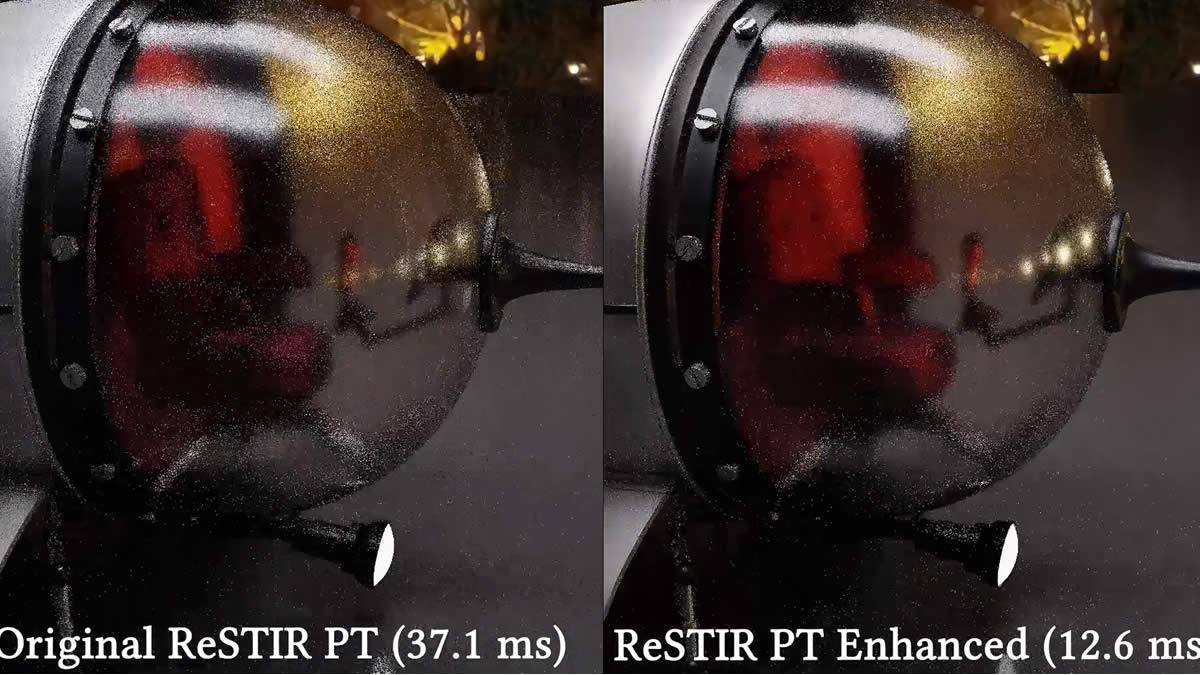
Nvidia Research has released a paper detailing a new “enhanced” version of ReSTIR PT (Spatiotemporal Importance Resampling PT), which reportedly delivers 2-3x the performance of Nvidia’s original version. Alongside improved performance, this new version of ReSTIR PT exhibits less “visual and numerical error”, making it more accurate.
Nvidia’s paper clearly shows that path tracing can run faster than it does today. While Nvidia does not call ReSTIR PT “production ready”, it says that it is now “closer to production ready”. Since path tracing is relatively new, there is ample room for software optimisation. To make the best use of modern gaming hardware, developers and researchers need to think differently. Research like this will enable path tracing across a broader range of hardware, impacting future PC and console games.
Algorithms leveraging ReSTIR-style spatiotemporal reuse have recently proliferated, hugely increasing effective sample count for light transport in real-time ray and path tracers. Many papers have explored novel theoretical improvements, but algorithmic improvements and engineering insights toward optimal implementation have largely been neglected. We demonstrate enhancements to ReSTIR PT that make it 2–3x faster, decrease both visual and numerical error, and improve its robustness, making it closer to production-ready. We halve the spatial reuse cost by reciprocal neighbor selection, robustify shift mappings with new footprint-based reconnection criteria, and reduce spatiotemporal correlation with duplication maps. We further improve both performance and quality by extensive optimization, unifying direct and global illumination into the same reservoirs, and utilizing existing techniques for color noise and disocclusion noise reduction.
– Nvidia Research
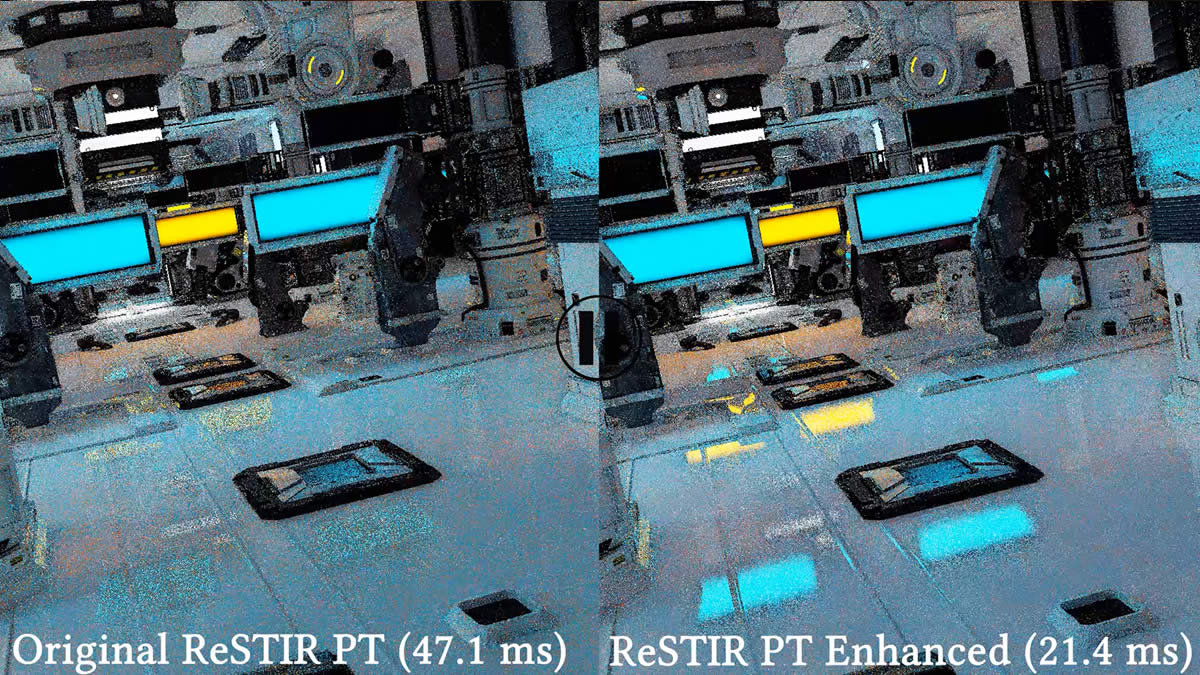
(Nvidia’s enhanced ReSTIR PT version is 2x faster in this example)
Nvidia’s paper (see here) states that the company has managed to “halve the spatial reuse cost by reciprocal neighbor selection” and “reduce spatiotemporal correlation with duplication maps”. Furthermore, the company claims that they have improved performance and image quality through “extensive optimization”.
Nvidia’s latest optimisations to ReSTIR PT reduce path tracing’s performance cost to make it more viable for future games. Instead of brute-forcing path tracing with more powerful hardware, Nvidia is accelerating the arrival of mainstream path tracing by discovering cheats and other techniques that can get more from today’s hardware.
Some games already use Nvidia ReSTIR, just not ReSTIR PT
Right now, no PC games use Nvidia’s ReSTIR PT technology. As mentioned before, it is not “production-ready” However, ReSTIR GI (Global Illumination) and DI (Direct Illumination) are currently used in some games. Cyberpunk 2077 uses ReSTIR GI and DI, while Capcom’s Resident Evil Requiem and Pragmata are recent examples of games that use ReSTIR GI.
Nvidia’s research into technologies like ReSTIR PT will help push gaming visuals forward with more advanced path tracing. If Path tracing can be made easier, gamers will be able to do more with today’s hardware. That’s good news for all gamers.
You can join the discussion on Nvidia’s ReSTIR PT improvements on the OC3D Forums.