


Leak-unveils game-changing specifications for AMD Radeon RDNA 5 GPUs

AMD Radeon RDNA 5 specifications leak hints at a major low-end GPU market shake-up
Specifications for two low-end Radeon RDNA 5 discrete graphics cards have leaked, hinting at a major change in strategy from AMD. Unlike prior graphics chips, which rely on GDDR (Graphics DDR) memory technologies, these GPUs will use LPDDR (Low-Power DDR) memory. Why? Reduced costs and support for more memory on smaller memory bus sizes.
The downside of LPDDR memory types is that they offer less raw bandwidth than the latest GDDR memory technologies. However, AMD appears to have reduced the bandwidth requirements of its RDNA 5 graphics architecture. These GPUs reportedly use a large L2 cache and potentially use this cache alongside AMD’s Infinity Cache technology. These technologies reduce the need for memory bandwidth from GPU memory, making the use of LPDDR memory technologies viable.
Using laptop-grade LPDDR memory will reduce AMD’s memory cost and make it harder for supply constraints to impact memory pricing. LPDDR memory is produced in much higher quantities than GDDR memory types, helping keep AMD’s costs consistent.
AMD RDNA 5 GPU Specifications
Based on Moore’s Law is Dead’s latest leak, AMD are working on two LPDDR-powered RDNA 5 discrete GPUs. The first is “Alpha Triton 4” (AT4), which reportedly features 24 RDNA 5 Compute Units (CUs), features 10MB of L2 cache, and uses a 128-bit LPDDR5X memory controller. This GPU could support 12GB or even 24GB of memory.
On the higher-end, AMD rumoured “Alpha Triton 3” chip reported features 48 RDNA 5 Compute Units (CUs), features 20MB of L2 cache, and features a HUGE 384-bit LPDDR6 memory controller. With this memory configuration, this chip can reportedly support up to 512GB of memory. However, it is more likely to feature 16-32GB of memory.
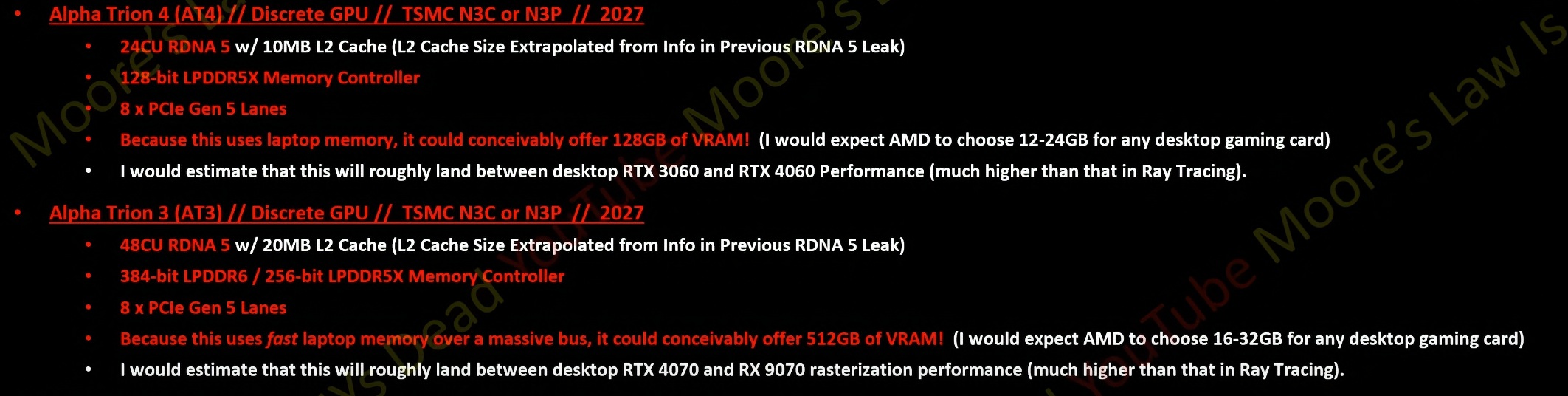
(Specifications from Moore’s Law is Dead)
RDNA 5 GPU Performance
AMD’s RDNA 5 graphics architecture reportedly delivers 10% more rasterisation performance per-CU than RDNA 4. However, it features a much larger generational uplift when it comes to ray tracing performance. AMD’s “Alpha Triton 4” chip will reportedly deliver performance levels between Nvidia’s RTX 3060 and RTX 4060. However, AMD’s chip will reportedly perform much better when ray tracing is used.
For “Alpha Triton 3”, this 48 CU chip will reportedly perform similarly to AMD’s Radeon RX 9070 (non-XT) in rasterised workloads. Again, this GPU’s performance is expected to be much higher when ray tracing is enabled.
With these graphics cards, AMD’s set to transform the low-end GPU market. Alpha Triton 4 is a low-end graphics chip, and its large VRAM capacity should make it great for running modern games. Its performance levels also suggest that it will feature low pricing, making it appealing to budget-oriented PC gamers.
AMD will reportedly offer higher-end RDNA 5 graphics cards with GDDR6 or GDDR7 memory. These GPUs will target the higher-end sections of the GPU market, where increased memory capacity is required.
You can join the discussion on AMD’s next-generation RDNA 5 graphics chips on the OC3D Forums.