


AMD Zen 6 CPU Specifications Leaks – Big Boost Unveiled

Zen 6 leak unveils more cores, higher clock speeds, and boosted IPC
If these leaks are true, AMD’s Zen 6 CPU lineup will be record-breaking. Red Gaming Tech has unveiled what their sources have told them about AMD’s next-generation CPU architecture. The long and short of it is that performance gains are expected in all areas.
With Zen 6 Ryzen, we have more cores, more L3 cache, higher clock speeds, and boosted IPC. The CPU also reportedly supports up to DDR5-8000 memory, a big increase over the DDR5-6000 speeds Zen 4/5 CPUs tend to max out at. That said, given the cost of DDR5 memory, it is a big ask to get consumers to invest in premium/high-speed DDR5 memory.
More cores, more cache, more 3D V-Cache
The biggest change to Zen 6 is the size of its CPU chiplets. For Zen 3, 4, and 5, AMD gave users 8 cores per CPU chiplet. With Zen 6, this increases by 50%. PC builders will have access to 12 cores per CPU chiplet. With two chiplets, AMD’s Zen 6 Ryzen CPUs will feature up to 24 CPU cores.
With these AMD’s higher core counts comes more L3 cache, with each CPU chiplet (CCD) having 50% more cache. While L3 Cache per core remains the same as Zen 5, each core will have access to a much larger cache pool. AMD’s Zen 3, 4, and 5 CPU CCDs feature 32MB of L3 Cache, with Zen 6, each CCD will have 48MB of L3 cache. For cache-sensitive workloads, this could greatly increase CPU performance. For gaming, this change could be transformative for baseline Zen 6 CPUs.
For Zen 6, AMD has also created larger 96MB V-Cache chiplets. This should give X3D CPU CCDs 144MB of L3 Cache. This will make AMD’s X3D CPUs even better at cache-sensitive gaming workloads. Larger caches will increase cache hit rates, boosting the performance of many PC games. Add on faster memory support, and Zen 6 should deliver much higher levels of gaming performance than Zen 5.
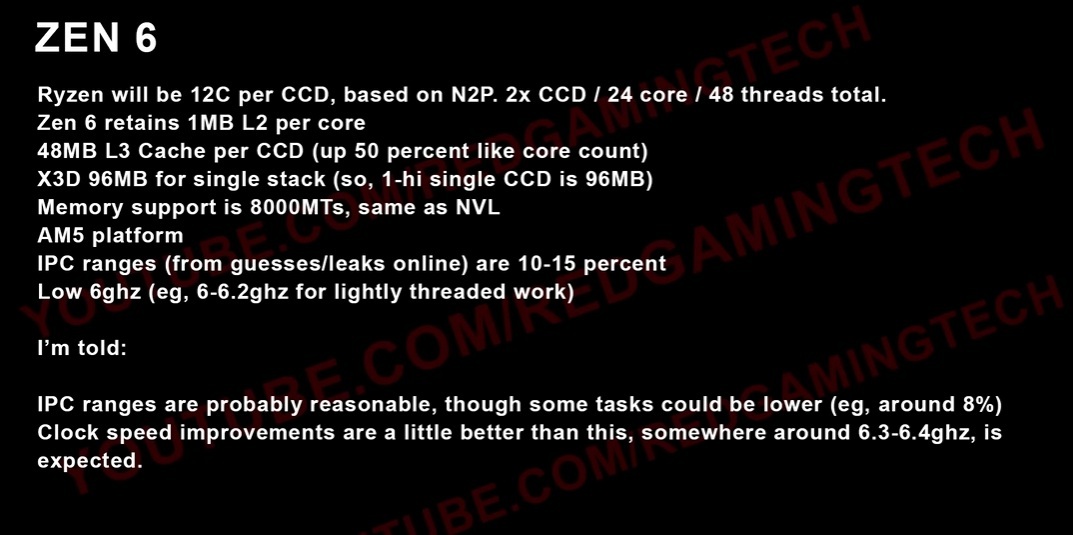
(Information from Red Gaming Tech)
IPC and clock speed gains
According to Red Gaming Tech, AMD’s Zen 6 CPUs should feature clock speeds of around 6.3-6.4 GHz. This is much higher than what AMD’s Zen 5 CPUs deliver. In terms of clock speed, AMD’s fastest Zen 5 CPU, the Ryzen 9 9950X, has a maximum boost clock of 5.7 GHz. This suggests that AMD’s Zen 6 clock speeds are at least 10% higher than AMD’s Zen 5 products. That’s a significant clock speed gain. Some earlier Zen 6 rumours claimed 7GHz speeds were possible, though this new leak suggests AMD will not hit that alleged performance target. Regardless, Zen 6 is expected to run much faster than Zen 5.
Additionally, AMD’s Zen 6 CPUs will reportedly feature 10-15% IPC (Instructions Per Cycle) gains. However, it is worth remembering that IPC gains vary significantly across workloads. After all, some software will benefit more from some architectural improvements than others. Red Gaming Tech says that some tasks will have lower IPC gains (around 8%), though this is common for new CPUs.
With more cores, significantly higher clock speeds, and a notable IPC boost, AMD’s Zen 6 architecture is set to impress. It is currently unknown when AMD’s Zen 6 CPU architecture will launch. Many currently expect AMD’s Zen 6 CPUs to arrive in early 2027, though they could still launch later this year.
You can join the discussion on AMD’s Zen 6 CPU leak on the OC3D Forums.