


EPYC MONSTERS – AMD unveils its EPYC 9006 series Zen 6 processors

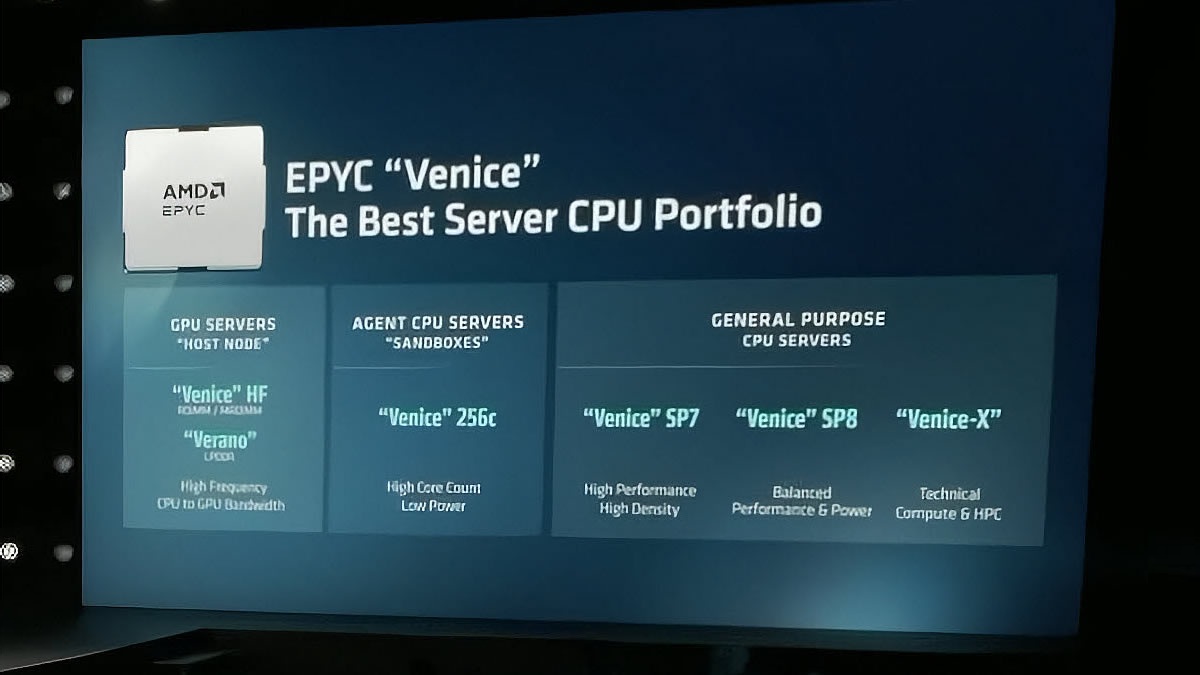
AMD takes its EPYC CPUs to the next level with Zen 6
At AMD’s Advancing AI 2026 event, Lisa Su unveiled the company’s 6th-generation EPYC (EPYC 9006) processors. With these CPUs, AMD promised next-level performance in the agentic AI era with a wide lineup of processors and critical feature upgrades.
AMD’s current-generation Zen 5 EPYC 9005 CPUs are already performing well in the datacenter market, and with Zen 6, AMD aims to extend its lead over its competitors. AMD has confirmed that its Zen 6 “Venice” SP7 CPUs are in production, with availability this year.
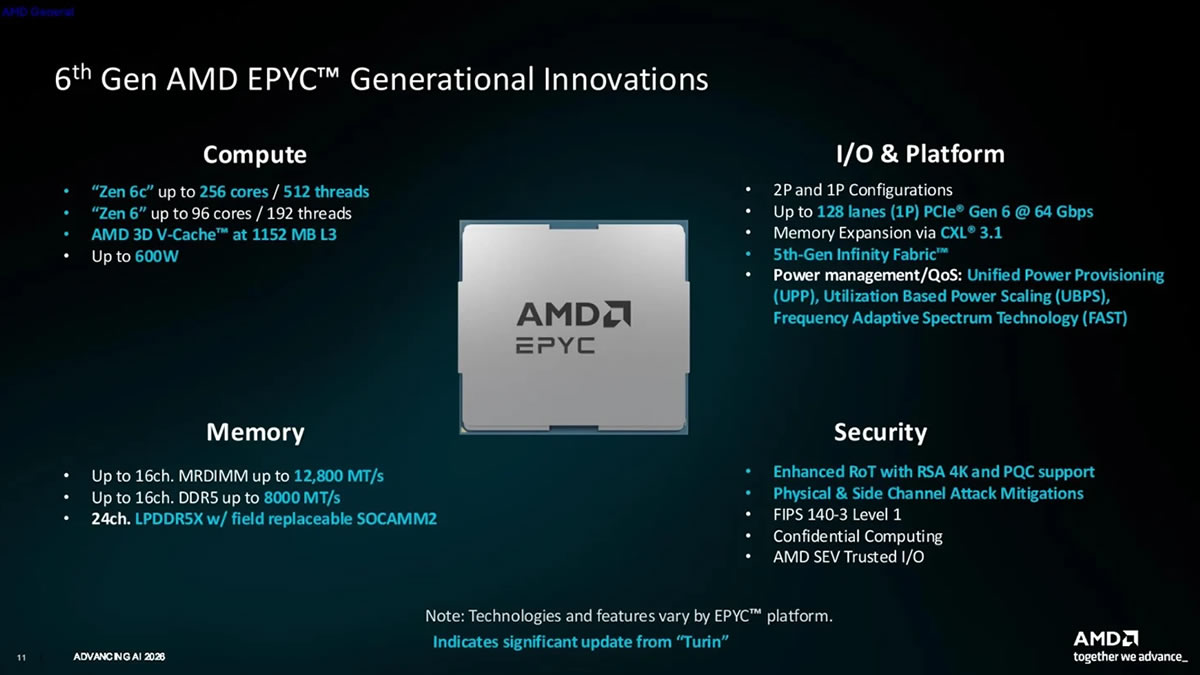
With EPYC Venice, AMD now offers Zen 6 series CPU cores and core counts of up to 256 “Zen 6c” cores or 96 Zen 6 cores. With L3 V-Cache, AMD can offer customers 1154MB of L3 cache per socket. To maximise performance, Zen 6’s TDPs can max out at 600W, enabling higher levels of performance across huge core counts.
New features
With Zen 6 comes support for MRDIMM memory modules, enabling support for 12,800 MT/s memory modules. With standard DDR5 memory DIMMs, DDR5-8000 memory speeds are supported. For AMD’s EPYC “Verano” CPUs, LPDDR5X memory will be supported, enabling higher levels of power efficiency with SOCAMM2 memory modules.
EPYC CPUs will also support PCIe Gen 6 connectivity and memory expansion through CXL 3.1. Venice will also add support for AVX-512 BMM, a new feature that could have interesting performance implications in supported workloads.
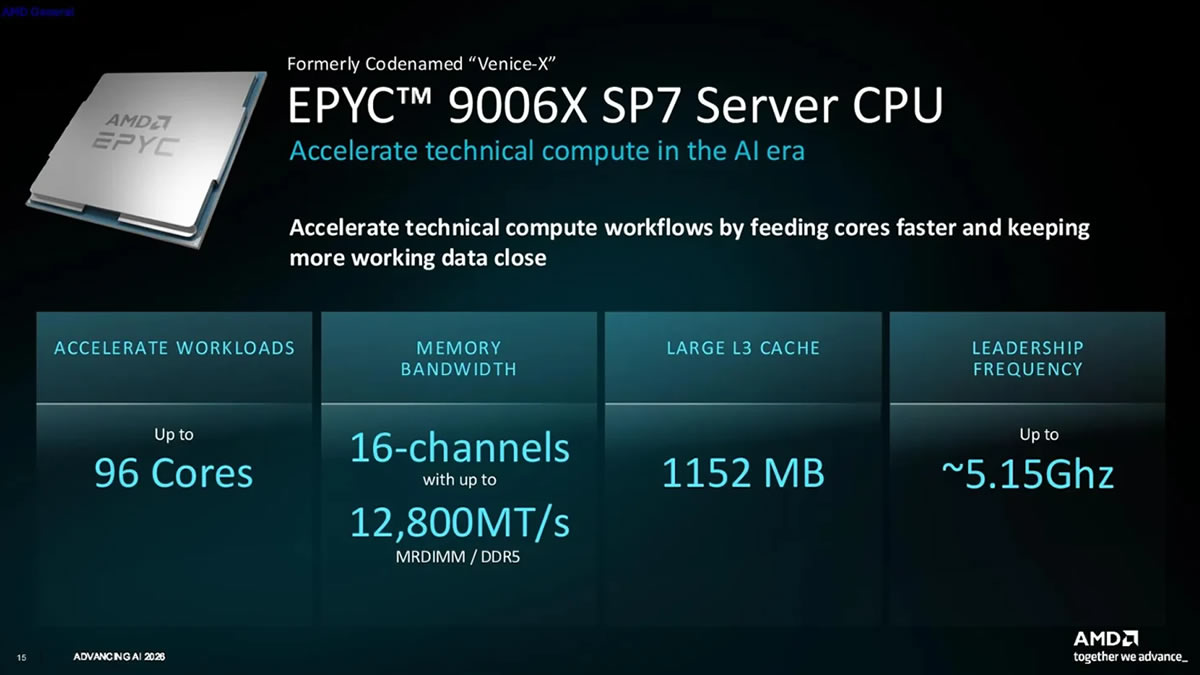
Venice-X – 3D V-Cache on Zen 6
In 2027, AMD plans to launch enhanced Venice-X series CPUs with AMD’s L3 V-Cache technology. These CPUs will offer users up to 96 CPU cores, frequencies of up to 5.15 GHz, and up to 1152MB of total L3 cache. That’s over 1GB of L3 cache per socket.
These CPUs will support up to sixteen memory channels with up to 12,800 MT/s memory. AMD’s Venice Non-X CPUs will be available in Q4 2026.
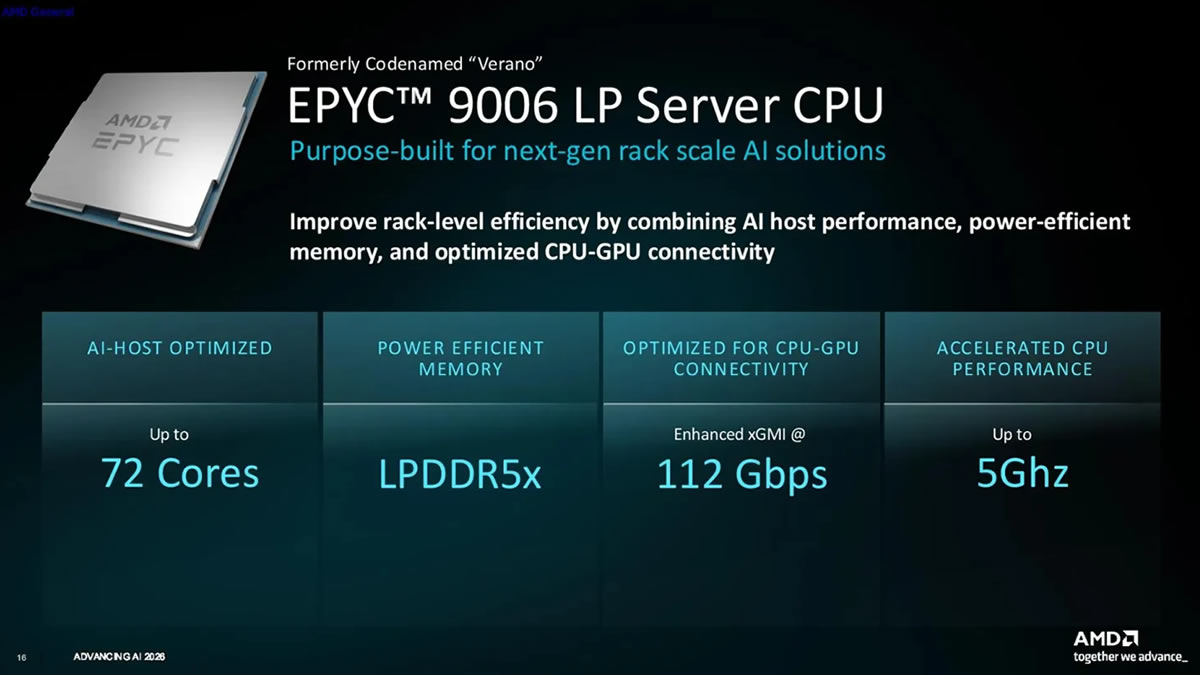
EPYC Verano – Zen 6 with LPDDR5X memory
In 2027, AMD plans to release EPYC 9006 LP series EPYC “Verano” CPUs, which will feature support for 24 LPDDR5X memory channels. These CPUs will offer frequencies of up to 5 GHz and are designed for rack-level AI host workloads. These processors prioritise CPU-GPU connectivity and power efficiency. As a result, they feature an enhanced xGMI interface (112 Gbps compared to 64 Gbps over PCIe 6.0) and use LPDDR5X memory.
With CPU availability in Q4 2026, today can be seen as a soft launch for AMD’s new Zen 6 EPYC processors. In performance terms, AMD is claiming strong performance gains in cloud workloads. In areas where AMD is already leading, its 6th-generation EPYC CPUs deliver further gains with more cores and more memory bandwidth. Some of AMD’s claimed performance gains are colossal, especially compared with Intel’s 6th generation Xeon and Amazon’s Graviton 5 CPU.
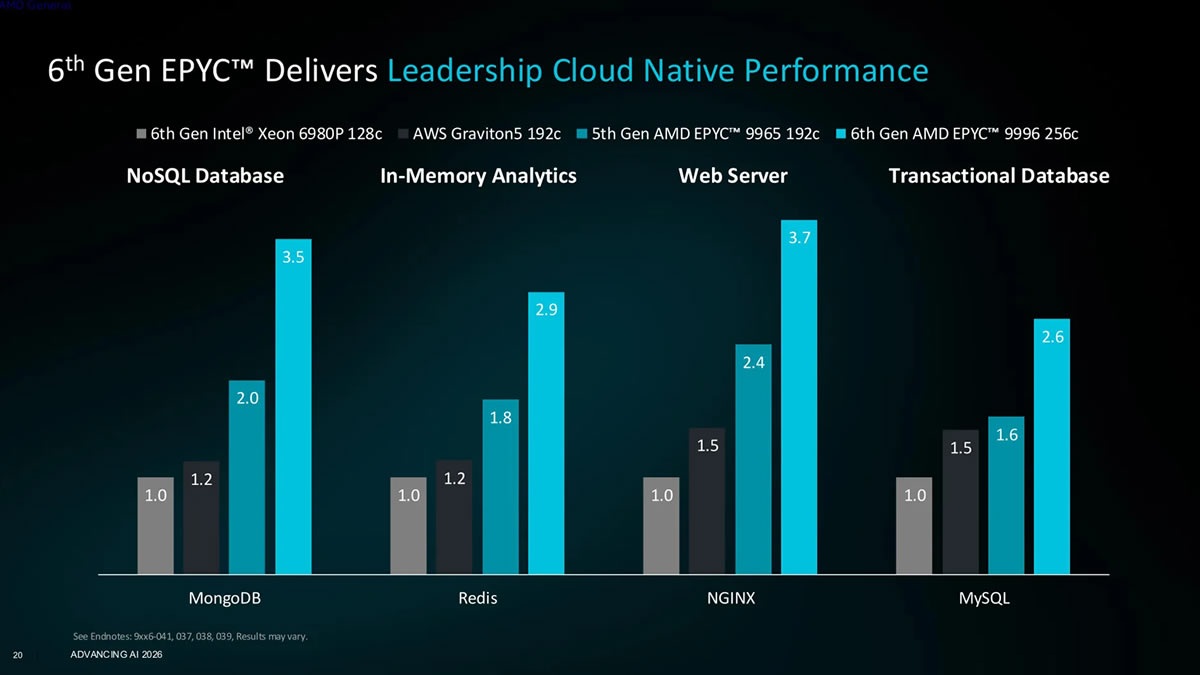
If AMD can deliver its promised performance gains, its 6th generation EPYC CPUs should be very popular. Performance and power efficiency are king, and AMD is promising both here. Furthermore, AMD has broadened its product line with its EPYC 9006 series. We have AI-focused SKUs, models that focus on heightened core counts, and models that push for extreme levels of cache. Round that off with general-purpose SKUs, and AMD has an “EPYC” product lineup.
You can join the discussion on AMD’s next-generation EPYC CPU lineup on the OC3D Forums.