


Fast and Small – JEDEC previews next-gen DDR6 memory

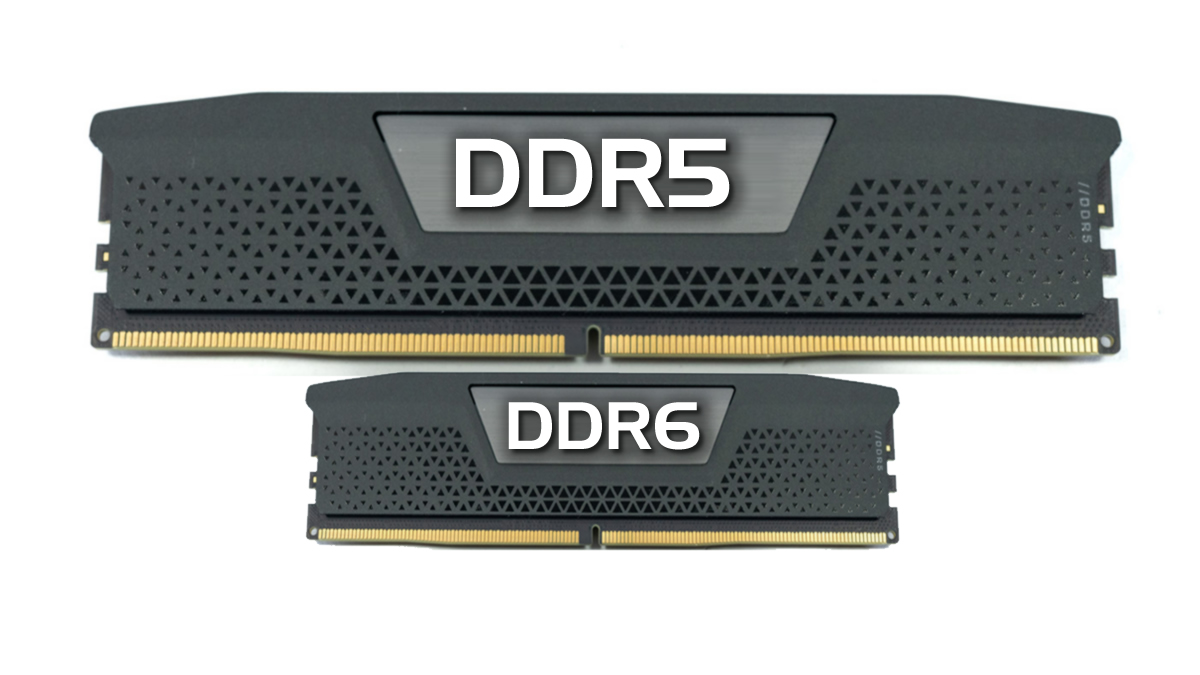
JEDEC plans to make DDR6 modules smaller and faster than DDR5
JEDEC has released an early preview for its DDR6 memory standard, detailing some of the changes that the next generation of DDR memory will bring. What’s interesting about DDR6 is that it doesn’t just focus on memory bandwidth. If DDR6 delivers its expected gains, it should deliver a 50% increase in bandwidth at launch. Additionally, next-generation memory modules will be much smaller than their current-gen counterparts.
Higher speeds
With DDR6, RDIMM speeds will start at 12.8 GT/s and extend to 14.4 GT/s and beyond. This extends far beyond the 9.2 GT/s speeds of today’s DDR5 RDIMMs. Note that DDR5-6000 memory is commonly used with today’s PCs, and those modules run at 6 GT/s. DDR6 will also widen the standard’s memory bus from 64 DQ to 96 DQ, a 50% increase.
Other changes with DDR6 include a new “Pseudo-channel” architecture, which will support more bandwidth per DRAM package. DDR6’s 2x increase in bank count and improved refresh boost data bus efficiency should also enable higher system performance.
Increased Performance
- Higher bandwidth: Improved data rates and a wider bus will combine to increase bandwidth more than 50% at introduction, with further bandwidth increases as data rates increase. This bandwidth target is distinct from a claim of equivalent improvement in application performance.
- Higher data rates: DDR6 RDIMMs move beyond DDR5’s 9.2 GT/s to a data rate that will start at 12.8 GT/s with a roadmap extending to 14.4 GT/s and beyond.
- Wider bus: The data bus expands from 64 to 96 DQ, a 50% increase in data bus width.
- Pseudo-channel architecture: DDR6’s planned architecture organizes memory access into pseudo-channels to support higher bandwidth per DRAM package. It is intended to provide greater configuration flexibility for system reliability and more efficient data movement.
- Higher bank availability: 2X bank count and improved refresh boost data bus efficiency, enabling system performance at higher speed grades and higher capacities.
Smaller Modules
DDR5 DIMMs are 133mm long. With DDR6, memory modules will be 74mm long. That’s a 44% reduction in module length. DRAM die densities will also be available with sizes of up to 128Gb. That’s 16GB per memory package. These changes should help increase the memory density of DDR6 platforms. Memory modules will be physically smaller, and their memory chips will be much more memory-dense. This change is intended to help the server market.
Higher Capacities
- Higher DRAM density: Support for up to 128Gb DRAM die density.
- Efficient capacity scaling: Optimizations for die stacking in DDR6 packages delivers more density per package footprint.
- Compact module footprint: A significantly narrower 74mm DDR6 module length, compared with 133mm for DDR5, is intended to help accommodate higher system memory density.
Other Factors
DDR6 memory is being built with datacenters in mind. DDR6 will also support die stacking, enabling much higher levels of memory density than DDR5.
Reliability
- Flexible reliability: Support for multiple system error-correcting code (ECC) implementations will allow system designers to balance cost, power, and reliability at the system level.
- Built for the data center: Interface optimized for high-capacity modules with configurations oriented to general purpose compute as well as AI inferencing and agentic AI, which demand more capacity and performance close to the CPU.
Energy Efficiency
- Improved performance-per-watt: DDR6 targets significantly improved performance-per-watt versus DDR5 through a change to VSS-terminated IO and data-center-focused low power modes.
Form Factors
- Breadth of form factors: DDR6 is being defined across multiple form factors — potentially including RDIMM, UDIMM, and CAMM to serve a broad range of applications while balancing reliability, performance, power, and cost.
With DDR6, the focus remains on boosting memory bandwidth. That said, this time memory density is a large consideration. DDR6 will be a much more compact memory standard than DDR5, resulting in smaller modules and boosted memory densities. Expect future motherboards to feature much shorter DIMM slots.
Join the discussion on JEDEC’s plans for DDR6 on the OC3D Forums.