


Nvidia has Launched their GTX 1660 Graphics Card – Here’s Everything We Know


Nvidia has Launched their GTX 1660 Graphics Card – Here’s Everything We Know
Little movement has been made in this segment for the past number of years, with AMD’s Polaris lineup and Nvidia’s Pascal lineups holding strong within this section of the market for well over two years. Now, Nvidia hopes to shake things up, by injecting a little Turing into the mix.
Presenting the GTX 1660, a graphics card which Nvidia claims offers performance levels which are, on average, 68% higher than a GTX 970 and 113% higher than a GTX 960. When compared to the humble GTX 1060, Nvidia claims that the GTX 1660 offers on average a 15% performance boost over the 6GB model and a 30% boost over the 3GB model at 1080p, all while shipping with a TDP of 120W.
Nvidia targets this graphics card at fans of Battle Royale games, hoping that it will be used with G-Sync, or G-Sync Compatible monitors to offer smooth gaming and low latency response times, utilising Nvidia’s Turing architectural enhancements to excel in today’s games as well as future titles.
With Turing, Nvidia ships with a unified cache architecture, a larger L1 cache, support for adaptive shading and enhancements which enable concurrent Floating Point and Integer calculations.
Below are the full specifications of Nvidia’s GTX 1660 graphics card, with Nvidia confirming that all models will feature an 8-pin PCIe power connector. Nvidia has also confirmed that no Founders Edition graphics cards will be available for the GTX 1660.
| Geforce RTX 2080 Ti (Ref) | Geforce GTX 2080 (Ref) | Geforce RTX 2070 (Ref) | Geforce RTX 2060 (FE) | Geforce GTX 1660 Ti (Ref) | Geforce GTX 1660 (Ref) | Geforce GTX 1060 6GB (FE) | |
| Architecture | Turing | Turing | Turing | Turing | Turing | Turing | Pascal |
| CUDA Cores | 4,352 | 2,944 | 2,304 | 1,920 | 1,536 | 1,408 | 1,280 |
| Ray Tracing Performance (Gigarays) |
10 GR | 8 GR | 6 GR | 5 GR | N/A | N/A | N/A |
| Base Clock |
1350MHz | 1515MHz | 1410MHz | 1365MHz | 1500MHz | 1530MHz | 1506MHz |
| Boost Clock | 1545MHz | 1710MHz | 1620MHz | 1680MHz | 1770MHz | 1785MHz | 1708MHz |
| Memory Type | GDDR6 | GDDR6 | GDDR6 | GDDR6 | GDDR6 | GDDR5 | GDDR5 |
| Memory Capacity | 11GB | 8GB | 8GB | 6GB | 6GB | 6GB | 6GB |
| Memory Speed | 14Gbps | 14Gbps | 14Gbps | 14Gbps | 12Gbps | 8Gbps | 8Gbps |
| Memory Bandwidth | 616GB/s | 448GB/s | 448GB/S | 336GB/s | 288GB/s | 192GB/s | 192GB/s |
| Memory Bus Size | 352-bit | 256-bit |
256-bit | 192-bit | 192-bit | 192-bit | 192-bit |
| SLI | Via NVLink | Via NVLink | N/A | N/A | N/A | N/A | N/A |
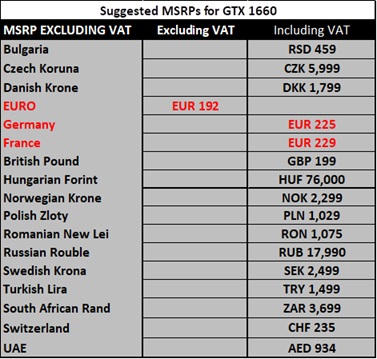
In the UK, pricing for the GTX 1660 will start at £199, which is how much some of today’s cheapest GTX 1060 6GB graphics cards cost. With Nvidia’s performance claims in mind, it is clear that the company hopes to deliver gamers increased price/performance levels with this launch, which is excellent news for the mid-range market.
If you want to learn more about Nvidia’s GTX 1660, here is our full review for MSI’s GTX 1660 XS OC Edition.
You can join the discussion on Nvidia’s GTX 1660 graphics card on the OC3D Forum.