


Full PlayStation 6 console specifications leak, unveiling huge performance boost


Specifications leak for Sony’s planned PS6 Handheld and Console systems
Specifications for Sony’s next-generation PlayStation 6 (PS6) console have leaked, revealing a hybrid approach to the next console generation. It looks like Sony plans to release a PlayStation 6 handheld alongside a PlayStation 6 home console. This will give Sony a competitor to Nintendo’s Switch system, and a more powerful home console for gamers who don’t want handheld play.
Both systems will use AMD Zen 6 series cores alongside AMD RDNA 5 graphics. Both chips will reportedly use TSMC’s 3nm lithography node, with the PS6 handheld using a chip that is less than half the size of its main console counterpart.
Sony plans to destroy Switch 2 with its “Canis” handheld
If these leaked specifications are accurate, AMD’s “Canis” PS6 handheld chip will feature six CPU cores (4x Zen 6c + 2x Zen 6 LP) and a GPU with 16 RDNA 5 Compute Units (CUs). The system will use LPDDR5X memory over a 192-bit memory bus. The Chip is reportedly 135mm² in size.
Overall, this chip appears similar to the one used with ASUS’s ROG Xbox Ally X. Both use LPDDR5X memory and have 16 GPU Compute Units. However, Sony’s “Canis” silicon appears to feature fewer CPU cores (6 cores total) and will likely use faster LPDDR5X memory alongside newer CPU and graphics architectures.
Canis will use AMD’s RDNA 5 architecture alongside AMD Zen 6 CPU cores. The AMD silicon in ASUS’ ROG Xbox Ally uses AMD Zen 5 CPU cores alongside RDNA 3.5 graphics. Canis should easily outperform PC gaming handhelds like the ROG Xbox Ally and Steam Deck. The combination of faster, more power-efficient architectures with a newer lithography node will do that. This is especially true for power-constrained gaming handhelds.
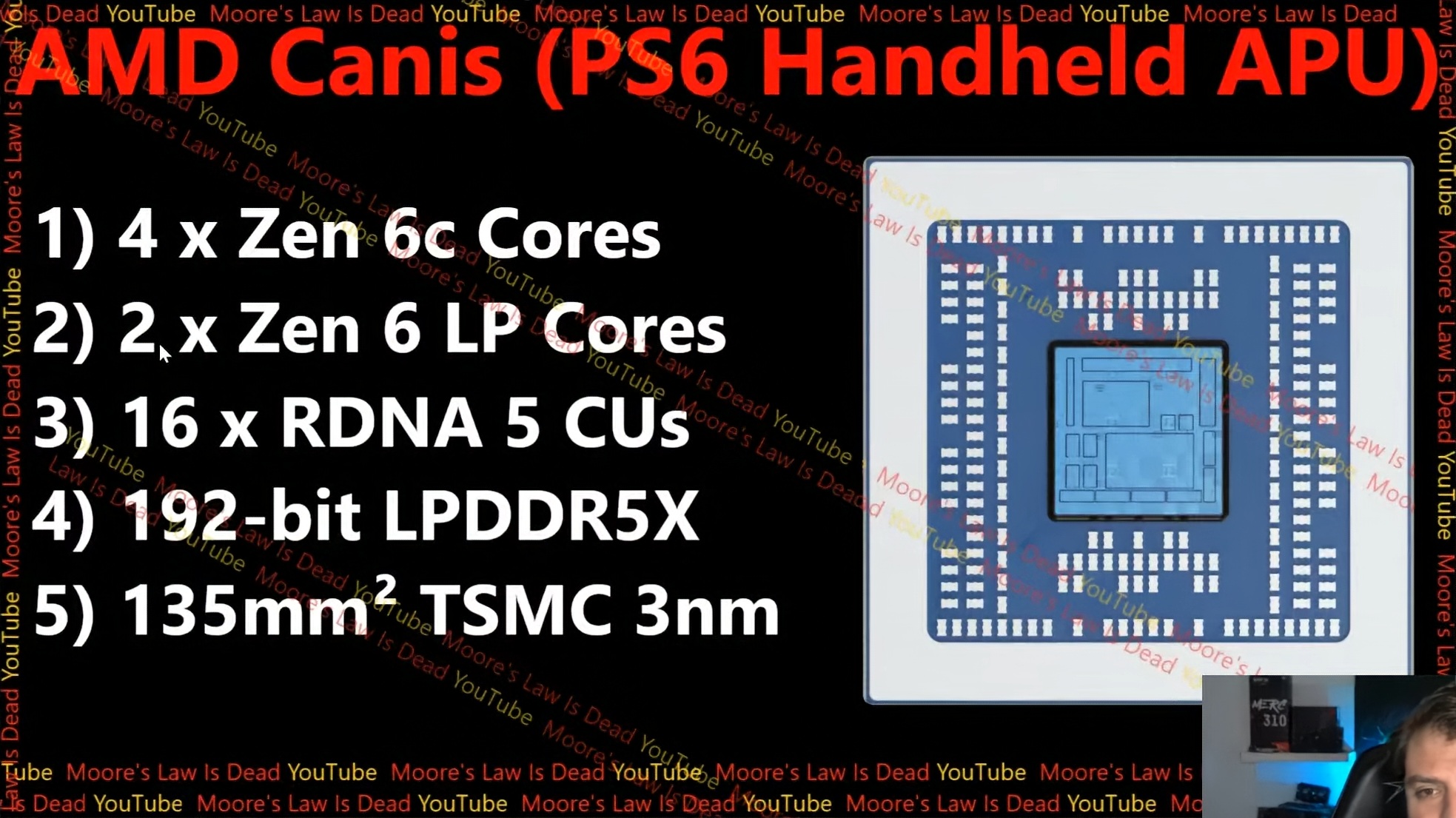
(Leaked PlayStation 6 Handheld Specifications – via Moore’s Law is Dead)
PlayStation 6 Console Specifications
Sony’s PS6 console will reportedly feature up to 10 total CPU cores (7-8 Zen 6c CPU cores and 2 Zen 6 LP cores). There is talk of Sony potentially disabling a single core to increase chip yields and reduce costs. This chip itself is said to be 280mm² in size, making it more than 2x larger than their Canis silicon. This chip will also be built using TSMC’s 3nm node. Note that this CPU’s two Zen 6 LP cores will be used by the PS6’s OS, freeing up performance on the other CPU cores.
GPU-wise, Sony’s PS6 silicon reportedly features an AMD RDNA 5 GPU with 52-42 Compute Units, clocked at 2.6-3GHz. The system will use a 160-bit memory bus alongside GDDR7 memory to deliver 640 GB/s of memory bandwidth. Depending on Sony’s chosen memory configuration, this system can feature 30GB or 40GB of GDDR7 memory. However, this specification has not been finalised. Memory pricing may influence the amount of memory the PS6 has.
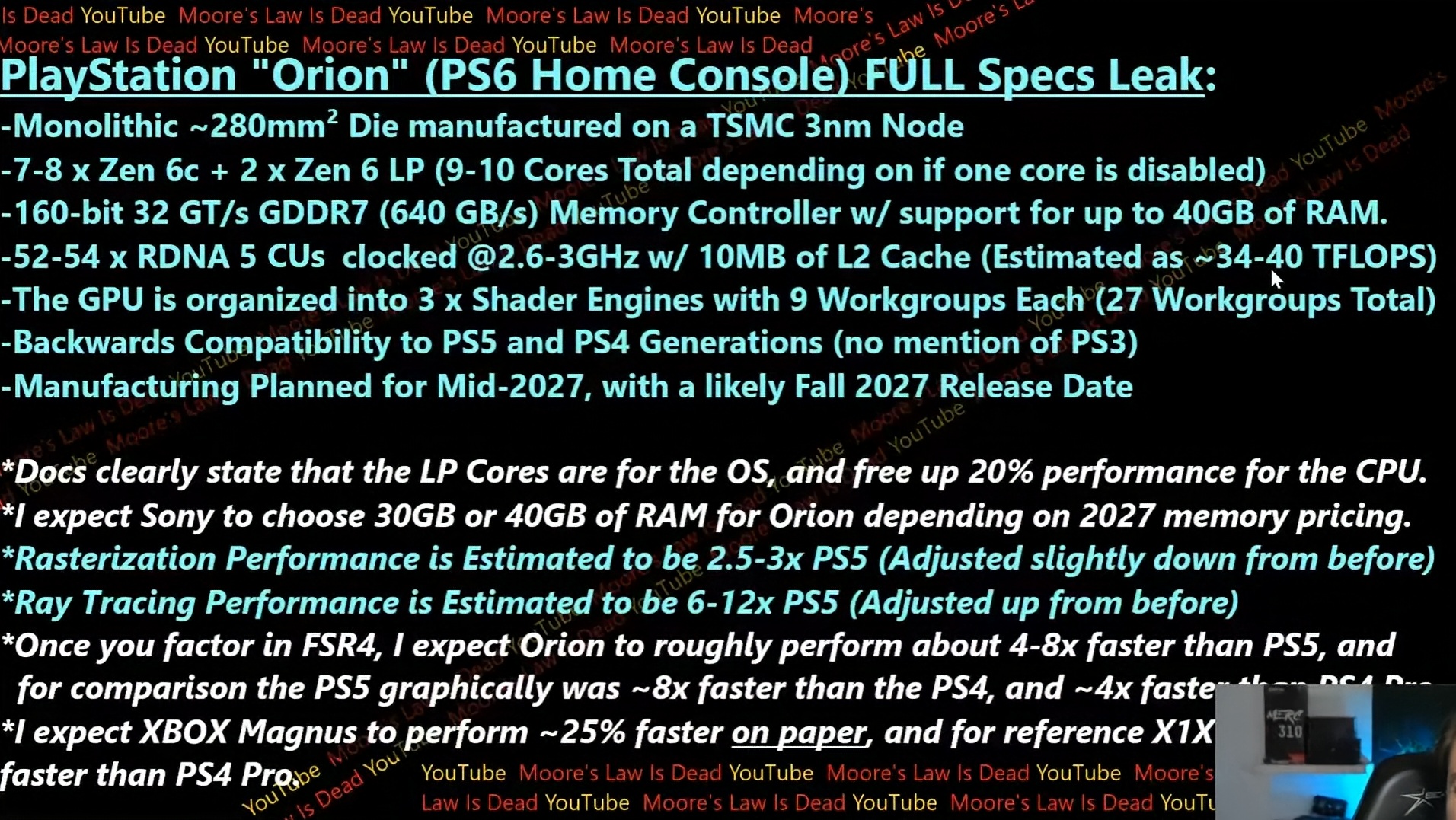
(Leaked PlayStation 6 Console Specifications – via Moore’s Law is Dead)
PlayStation 6 Console Performance
The performance of Sony’s next-generation console depends on many factors. For starters, it depends on the exact workloads being attempted. Furthermore, features like modern upscaling (FSR 4/PSSR) need to be considered. If we consider pure rasterisation performance, the PlayStation 6 is reportedly 2.5-3x faster than the PlayStation 5. However, if we consider ray tracing, PlayStation 6 is 6-12x faster than PlayStation 5. For this reason, we believe that ray tracing will become more widely adopted once the next generation of consoles is released.
Right now, Sony’s PS6 consoles are expected to be less powerful than Microsoft’s planned “Next Xbox“. However, with both consoles sharing a similar feature set, the performance difference is likely to result only in a minimal visual difference. With modern upscaling and the same CPU/GPU architectures, most gamers are unlikely to notice the difference between PS6 and Xbox Next. Unless one side has some special features that the other lacks, both consoles should be broadly similar.
You can join the discussion on Sony’s leaked PlayStation 6 console and handheld specifications on the OC3D Forums.