


Xbox finalises Next-Gen console silicon – Specifications Leak

Microsoft reportedly finalises its next-gen Xbox silicon ahead of planned 2027 launch
Earlier this month, AMD’s CEO, Lisa Su, confirmed that they will be ready to support the launch of “Microsoft’s next-gen Xbox” in 2027. Now, leakers have claimed that Microsoft has finalised the specifications of their next-gen console silicon. This chip is codenamed “Magnus”, and its specifications have leaked.
With their silicon finalised, Microsoft can now only make minor changes to their console design ahead of mass production. For now, details such as CPU/GPU clock speeds and power draw remain unknown, as they can only be determined once final or near-final silicon becomes available for testing.
Microsoft is reportedly using AMD’s next-gen CPU and GPU architectures to power their new console. This includes new Zen 6 CPU cores and RDNA 5 graphics. This gives Microsoft’s new Xbox several architectural leaps over the Zen 2 CPU cores and custom RDNA 2 graphics inside its Xbox Series consoles. Additionally, Microsoft has reportedly added an NPU to its console, enhancing the system’s AI performance.
More CPU cores and GPU compute units
Xbox’s “Magnus” chip reportedly features three Zen 6 CPU cores and eight Zen 6c CPU cores. The system’s Zen 6 cores will act as faster performance-optimised CPU cores, while AMD’s Zen 6c CPU cores are focused on area/silicon density and power draw. This should provide Microsoft with strong single-threaded and multi-threaded performance at minimal cost.
With 68 active CUs, Xbox’s new “Magnus” chip has more than 30% more CUs than the Xbox Series X. With the benefits of AMD’s RDNA 5 graphics architecture, Microsoft should be able to deliver significantly more raw GPU performance with its new Xbox. This will be especially true for AI and ray tracing workloads.
Memory-wise, Xbox’s “Magnus” chip reportedly supports GDDR7 memory over a 192-bit memory bus. The chip reportedly supports up to 48GB of memory. That said, Microsoft is unlikely to ship a console with that much memory (unless DRAM pricing were to plummet).
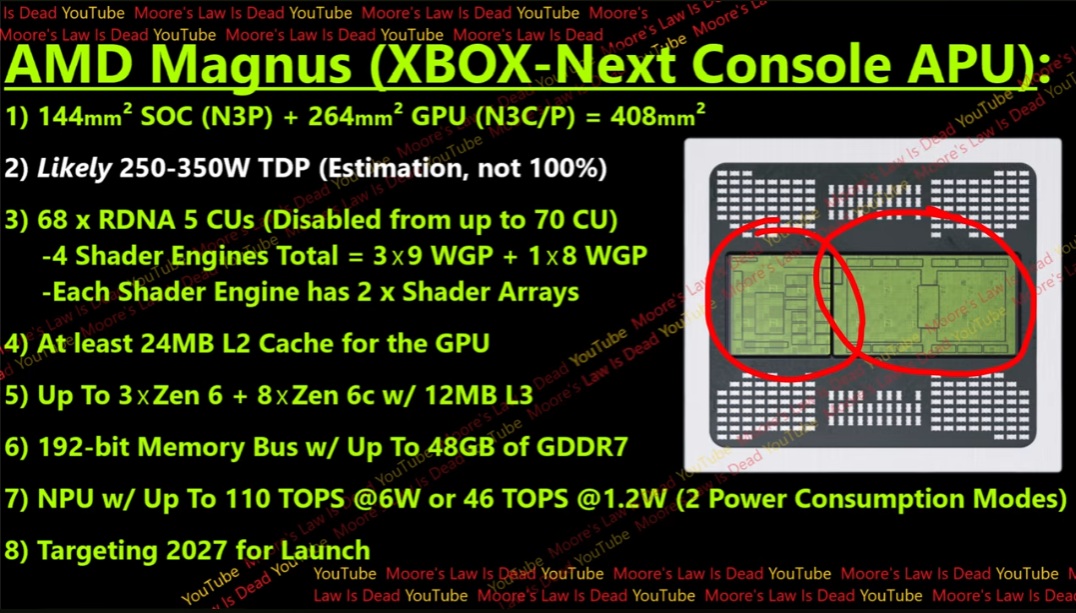
(Leaked Xbox Next Specifications – Moore’s Law is Dead)
Microsoft’s NPU brings low-power AI to Xbox
Microsoft’s next-generation Xbox will reportedly feature an NPU capable of delivering up to 110 TOPS of AI performance. This NPU may be an AMD XDNA 3 NPU, though this has not been confirmed. The console reportedly targets 110 TOPS of NPU performance at 6 watts, and up to 46 TOPS of AI performance at 1.2W. Developers reportedly can choose the performance mode for Microsoft’s NPU. This allows them to use part of the Xbox’s power budget for NPU-based AI workloads or other tasks.
It is currently unknown how developers will use the NPU hardware of future consoles. That said, the inclusion of a dedicated AI accelerator could give Microsoft’s new Xbox some interesting new features.
| Xbox Series S | Xbox Series X | Xbox Next (Leaked) | |
| CPU Architecture | Zen 2 | Zen 2 | Zen 6/6c |
| CPU Cores | 8 Cores | 8 Cores | 3 Zen 6 8 Zen 6c |
| GPU Architecture | Custom RDNA 2 | Custom RDNA 2 | RDNA 5 |
| GPU Compute Units | 20 | 52 | 68 |
| Memory Type | GDDR6 | GDDR6 | GDDR7 |
| Memory Capacity | 10GB | 16GB | Up to 48GB |
| NPU | N/A | N/A | Up to 110 TOPS NPU |
With its RDNA 4 graphics hardware, AMD has already demonstrated huge improvements in AI and ray tracing performance. We expect AMD to double down on these areas with RDNA 5. With this in mind, we can expect Microsoft’s new Xbox to be much more capable of handling high-end AI and ray tracing workloads than its predecessor. That means that Microsoft’s next-gen Xbox could be the first console that’s capable of handling path tracing. It also means that we can expect high-quality AI upscaling for the first time on Xbox console hardware.
You can join the discussion on Microsoft’s next-gen Xbox on the OC3D Forums.