

Toshiba plans to launch 40TB HDDs with new 12-Disk Stacking Tech

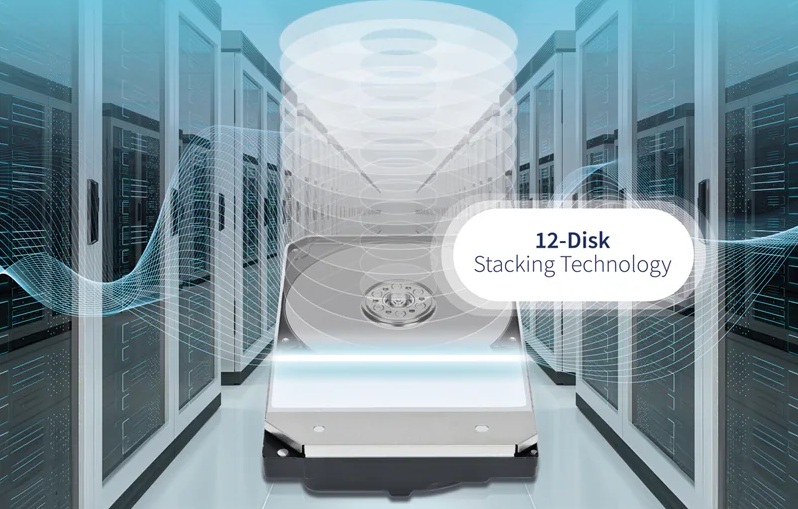
Toshiba is boosting the storage potential of its HDDs by stacking more disks – 20% improvement!
Toshiba has become the first HDD manufacturer to verify 12-disk stacking technology for high-density Hard Disk Drives (HDDs). Using this tech, Toshiba plans to launch 40TB MAMR (Microwave-Assisted Magnetic Recording) drives within the standard 3.5-inch form factor. These HDDs are intended for data centers and will launch in 2027.
Standard HDDs use 10-disk platters, giving Toshiba’s new HDDs 20% more platters. Toshiba has managed to fit these additional platters into its HDDs by developing thin, compacted components. This creates space for additional platters, allowing for more data storage.
Key advances include the replacement of the HDD’s aluminium substrate medium with a glass substrate medium. This enables increased durability and thinner designs. Toshiba claims that these changes boost mechanical stability and in-plane accuracy while allowing higher densities and increased reliability.
Toshiba Electronic Devices & Storage Corporation (Toshiba) is first in the storage industry to verify 12-disk stacking technology for high-capacity hard disk drives (HDDs). By combining this achievement with Microwave-Assisted Magnetic Recording (MAMR) technology, the company aims to introduce 40 TB-class 3.5-inch HDDs for data centers to the market in 2027.
This revolutionary stacking technology leverages advanced design and analysis technologies Toshiba has cultivated in developing thin, compact products, and adds two disks to the standard 10-disk, 3.5-inch disk track that the company uses in its nearline HDDs. Key advances include the development of new dedicated parts in the stack, and replacement of the current aluminium substrate medium with a glass substrate that offers greater durability and allows thinner designs. These advances deliver improved mechanical stability and in-plane accuracy, higher density and greater reliability.
Data generation and storage continue to explode as cloud services expand, streaming video services gain in popularity, and generative AI and data science enjoy rapid growth. Recognizing the need to raise storage capacities, Raghu Gururangan, Vice President, Engineering & Product Marketing at Toshiba America Electronic Components, added, “Toshiba’s 12-disk HDD platform delivers the scalability and reliability needed to support the exponential growth in AI-driven data center storage, enabling exabyte-class capacity with proven recording technologies.”
Toshiba is also investigating the use of 12-disk stacking technology with next-generation Heat Assisted Magnetic Recording (HAMR). The goal is higher-capacity HDD solutions that keep up with ever-growing storage demands from data centers while realizing a lower total cost of ownership (TCO) for customers. John Chen, Vice President at TRENDFOCUS, stated, “Toshiba’s ability to design HDDs with increased platter counts has been demonstrated over the past decade, enabling it to achieve higher capacity points using well-tested recording technologies along with improvements in head and media design. As the first HDD company to announce plans to commercialize a 12-disk HDD, the company paves a path for competitive high-capacity HDD offerings that will be further enhanced by its future transition to HAMR.”
Toshiba’s new 12-disk stacking technology will be featured at the IDEMA Symposium on October 17, 2025 in Kawasaki, Japan. For more information, please visit the IDEMA website.
– Toshiba
Toshiba plans to push beyond 40TB by combining its 12-disk tech with HAMR
There are two ways to increase the storage capacity of HDDs. One way is to add more disks/platters. The other is to increase the amount of data on each platter. Both of these options need to be used/combined to continue moving HDD tech forward.
Toshiba is now investigating how its 12-disk stacking tech can be used with next-gen HAMR (Heat-Assisted Magnetic Recording) tech. If Toshiba can merge these technologies, it will be able to create HDDs that are much more storage-dense than today’s models. Despite the speed advantage of SSD storage, HDDs maintain an advantage when it comes to cost/TB. If HDD manufacturers can keep pushing HDD densities to new heights, HDD tech can remain relevant during the SSD era.
You can join the discussion on Toshiba’s 12-disk stacking HDD technology on the OC3D Forums.