


Nvidia’s RTX 5060 Ti 8GB suffers further performance issues with PCIe 4.0

From bad to worse – PCIe 4.0 users get even less performance from Nvidia’s RTX 5060 Ti 8GB
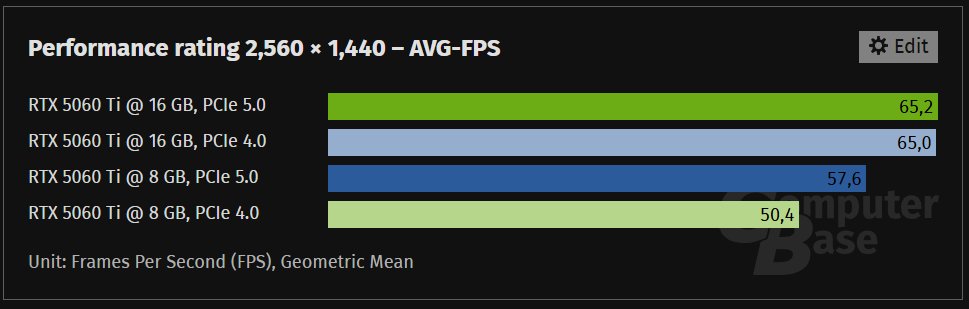
Reviewers were already calling Nvidia’s 8GB RTX 5060 Ti “instantly obsolete,” but according to ComputerBase, things get worse when you use PCIe 4.0. Based on their testing, the 1440p gaming performance of Nvidia’s RTX 5060 Ti 8GB is around 12% slower than its 16GB counterpart on average when using PCIe 5.0. When PCIe 4.0 is used, the 8GB model is over 22% slower than its 8GB counterpart.
Based on Computerbase’s testing, PCIe bandwidth can significantly affect gaming performance when a graphics card is VRAM-limited. Nvidia’s 8GB RTX 5060 Ti doesn’t have enough VRAM. This forces the GPU to rely on a PC’s DRAM and the PC’s available PCIe bandwidth. This allows PCIe 5.0 compatible PCs to deliver more performance than PCIe 4.0 PCs in VRAM-limited scenarios.
(Image from Computerbase)
In an extreme case, Computerbase showcased how lowered PCIe bandwidth could cripple the performance of some games. In Dragon Age: The Veilguard, moving from 5.0 to 4.0 speeds saw 1st percentile framerates drop from 24.6 to 3.3 FPS. Note that moving from a 16GB RTX 5060 Ti to an 8GB version already saw 1st percentile framerates drop from 47.6 FPS to 24.6. These performance differences are huge.
On average, so games, where 8 GB are sufficient and make no difference, are included as well. Our worst case: https://t.co/B6xSeJ9unX pic.twitter.com/s5wUcRjYHS
— ComputerBase 🕊️ (@ComputerBase) May 3, 2025
Based on this testing, we can confirm that PCIe bandwidth matters. That said, it only has a huge impact when graphics cards are VRAM-limited. If a GPU has sufficient VRAM, games will not need to rely on system memory and PCIe bandwidth to handle GPU workloads. This is another reason why gamers should avoid 8GB GPUs in new systems. This is especially true for those who use PCs that lack PCIe 5.0 support.
You can join the discussion on Nvidia’s RTX 5060 Ti 8GB performing worse with PCIe 4.0 on the OC3D Forums.