


Intel patent unveils “Software Defined SUPER Cores” that boost “single-core” performance

Intel’s working on “SUPER cores” that boost single-threaded performance by letting cores cooperate
To boost single-threaded performance, CPU manufacturers typically need to do one of two things. First, they can make their cores run at higher clock speeds. Second, they can build larger, wider cores that can complete more Instructions Per Cycle (IPC). Now, Intel has patented a new method to enhance single-core performance, which involves cooperatively utilising multiple CPU cores. Intel are working on “Software Defined Super Cores”.
Instead of creating a larger core, Intel is working on a way that two (or more) cores can work together as a “super core”. Cores are virtually fused to create a larger block that can work together. Each core can complete a different portion of an application’s instructions while still delivering results in the right order. This gives Intel’s “Super Core” the appearance of a larger single core, at least in the eyes of software. To the OS, these two cores will look like a single, larger core. In reality, it is two cores that could be used together or separately.
Software defined super cores (SDC) seek to aggregate the Instructions-per-Cycle (IPC) capabilities of neighboring cores into a “super core.” A super core is a virtual construct grouping of two or more cores (in some examples, physically adjacent core) that are virtually “fused” such that they each run different portions of an application’s instructions, but retire the instructions in original program order. Thus, the virtually fused “super cores” gives to software applications and/or an operating system the semblance of being a single core. A super core enables energy-efficient, high-performance capability at the same voltage/frequency. SDC-enabled platforms have a wide dynamic range and flexibility depending on system load and task requirements using just a core intellectual property substrate. SDC is a software and hardware solution enabling neighboring cores to run as virtual clusters of a super core – reducing the traditional process technology node dependence on scaling core size.
– Intel Patent EP4579444A1
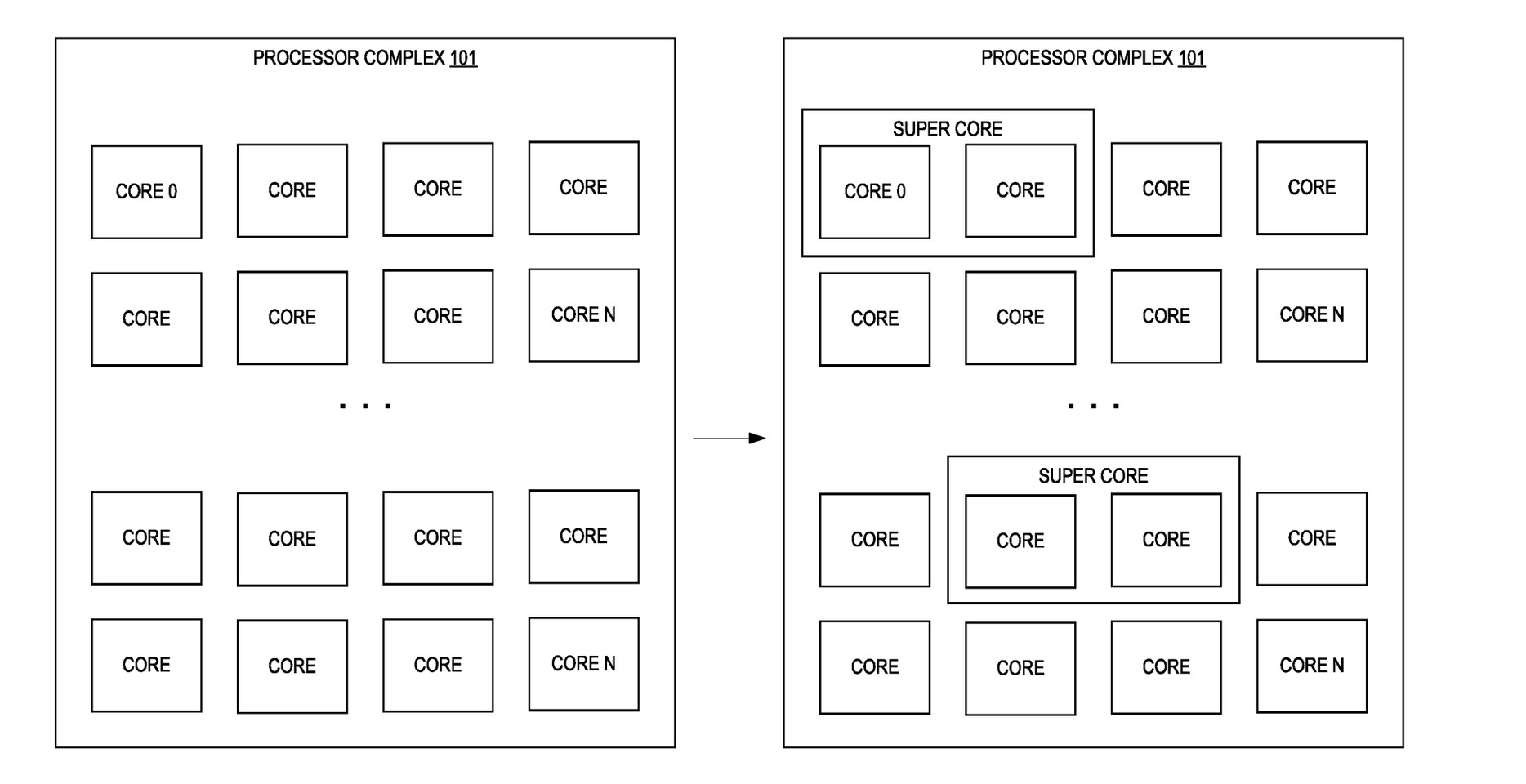
(Image from Intel SUPER Cores CPU patent)
Will “SUPER cores” force Intel to abandon its P-Core and E-core designs?
Rumour has it that Intel plans to abandon P-Cores and E-Cores with its TITAN Lake series processors. These CPUs will reportedly launch two generations after next year’s Nova Lake CPUs with a new “Unified Core” design. Intel’s new “Unified Cores” will reportedly be based on Intel’s E-cores, although they will be significantly larger and more performant than today’s E-cores.
If Intel adds Software Defined Super Cores to its Titan Lake CPUs, Intel will benefit from the advantages of P-cores in its future CPUs without having to include P-cores. Software Defined Super Cores could replace P-Cores, simplifying Intel’s CPU designs by allowing the company to focus exclusively on a single CPU architecture.
You can join the discussion on Intel’s “SUPER Cores” CPU patent on the OC3D Forums.