


AMD targets “at least 7GHz” boost clocks for Zen 6 Ryzen – Insider claims

“At Least 7GHz Boost” – Alleged AMD Insider claims huge speed bump for Zen 6
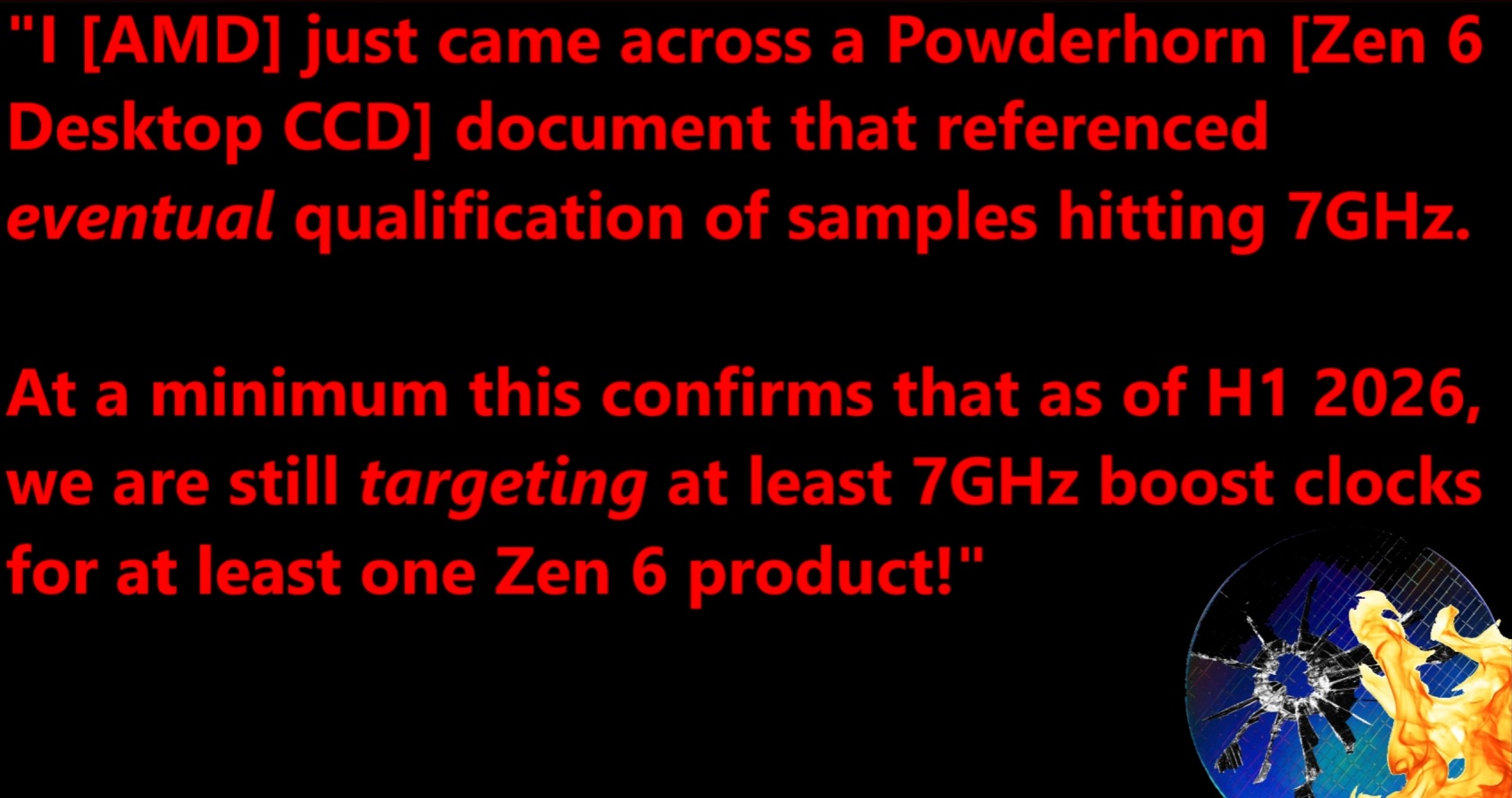
A reported AMD insider has claimed to have seen internal documents referencing 7GHz clock speed targets for Zen 6 Ryzen qualification samples. This implies that AMD plans to break both the 6GHz and 7GHz barriers with its next-generation Ryzen CPUs, at least for its highest-end models.
This alleged AMD insider, according to Moore’s Law is Dead, says that this document confirms that AMD were still targetting 7GHz boost clock speeds in Q1 2026. It is currently unknown how many products will hit this 7GHz target. The insider only says that AMD is targeting these speeds for “at least one Zen 6 product”.
While a 7GHz clock speed target sounds insane, this isn’t the first time that AMD delivered major clock speed gains with Ryzen. AMD’s move from Zen 3 to Zen 4 delivered large clock speed gains. AMD’s Ryzen 9 5950X has a boost clock speed of 4.9 GHz. Its Zen 4 counterpart, the Ryzen 9 7950X, has a boost clock speed of 5.7GHz. If AMD could deliver the same benefits again with Zen 6, they would be far past 6GHz speeds.
Two factors are in AMD’s favour
AMD uses leapfrogging design teams for its Zen CPU core designs. AMD’s Zen 6 team was the same team that designed Zen 4. As noted above, AMD’s last major clock speed boost came with its Zen 4 processors. If AMD has a team that can deliver the same benefits again, it’s their Zen 4 team.
Additionally, AMD is moving from TSMC’s 4nm node for Zen 5 to TSMC’s 2nm node for Zen 6. This gives AMD two generations of lithography node advancements to benefit from. AMD has skipped TSMC’s 3nm node generation and has moved directly to 2nm. That lays the foundation for strong performance gains from AMD’s next-generation CPU cores.
(AMD Source – via Moore’s Law is Dead)
Zen 6 could be transformative for AMD
Even without significant clock-speed gains, AMD’s Zen 6 architecture could be transformative for the company. AMD is reportedly moving from 8-core CCDs to 12-core CCDs with its Zen 6 Ryzen CPUs. That means 50% more cores per CCD, so Zen 6 Ryzen CPUs should offer users up to 24 total CPU cores across two CCDs. Furthermore, these larger CCDs should feature 50% more L3 cache to match AMD’s core count boost. Having more accessible L3 cache should boost gaming performance and other cache-sensitive workloads.
AMD is also reportedly building a new IO die for Zen 6, and plans to use a new “bridge die” interconnect between its CCDs and IO die. This change should increase bandwidth and lower latency, which should reduce memory latency (as AMD connects its DRAM through its I/O Die). Note that AMD is reportedly targeting higher DDR5 memory speeds with Zen 6, which also offers performance benefits.
If AMD can also deliver higher clock speed support with Zen 6, it could deliver one of the largest generational performance leaps in AMD’s history. With higher clock speeds, faster memory, more cores, and lowered latencies, Zen 6 should improve performance on all fronts. That’s great news for AMD and PC enthusiasts.
You can join the discussion on AMD targeting 7 GHz boost clocks for Zen 6 CPUs on the OC3D Forums.