


AMD unveils next-generation RDNA and PlayStation tech with Sony

AMD’s “Project Amethyst” is yielding strong results for AMD and PlayStation
AMD has unveiled a suite of new “AMD Gaming Technologies” alongside Sony’s Mark Cerny, Sony’s Lead Architect for PlayStation. Remember that AMD will be the company behind both the next-generation PlayStation and next-generation Xbox, with both using new RDNA graphics technology. AMD has now revealed some of these new next-generation Radeon technologies, spanning ray tracing, AI, and memory efficiency.
AMD’s next-generation gaming technologies for PlayStation 6
Alongside Sony, AMD unveiled three aspects of AMD’s next-generation RDNA/Radeon gaming architectures. These are “Neural Arrays”, “Radiance Cores”, and “Universal Compression.” These changes will yield performance increases in AI/machine learning, ray tracing/path tracing, and memory/bandwidth efficiency, respectively.

With “Neural Arrays”, AMD plans to connect several GPU compute units together to allow them to share data and work together like a single, larger AI engine. This will allow AMD’s AI engines to work on larger models with less memory overhead and with greater processing efficiency.
It sounds like AMD is uniting the cache pools of its AI engines to enable data sharing and decrease latencies. This should allow for faster, less latent AI. This should lower memory bandwidth requirements and help increase throughput. Both are vital for making AI/ML performant on next-generation consoles.
Neural Arrays – instead of a bunch of compute units working separately, we’ve built a way for them to team up… sharing data and processing together like a single, focused AI engine. This changes the game for neural rendering: bigger ML models, less overhead, more efficiency, and far greater scalability as workloads grow.

Next-generation AMD RDNA Ray Tracing Tech
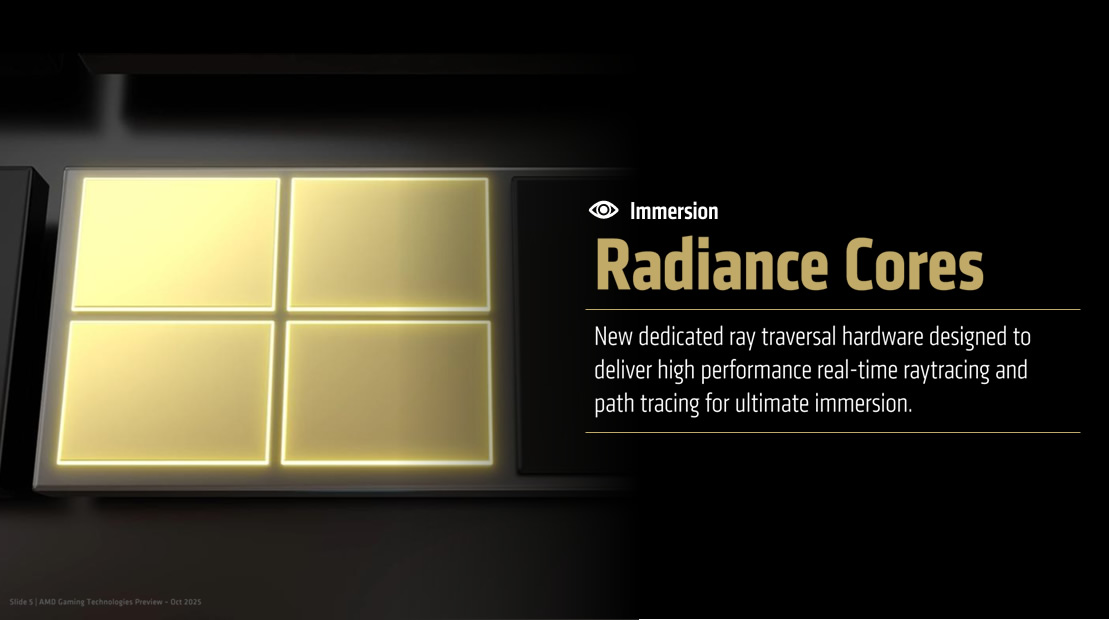
AMD appears to have made some significant changes to its ray tracing technology. With a “new dedicated hardware block”, AMD plans to rework how it does ray tracing. These new hardware units are specifically designed for ray tracing, enabling more efficient operation. With specified units, AMD’s GPU components will be able to focus on their strengths, enabling more efficient operation.
With these units, AMD and Sony have made it clear that they are targeting path tracing with their next-generation hardware.
Radiance Cores – a new dedicated hardware block designed for unified light transport. It handles ray tracing and path tracing in real time, pushing lighting performance to a whole new level. This lets the GPU focus on what it does best: shading the scene. The result? A cleaner, faster, and more efficient pipeline, built for the next generation of ray-traced games.
Increased memory efficiency for next-gen gaming PCs and consoles
Alongside Sony, AMD has developed “Universal Compression”, which should help compress data within a GPU to deliver higher levels of memory efficiency. This reduces memory usage and memory bandwidth usage. This frees up memory bandwidth for other tasks. Furthermore, it effectively gives next-generation hardware more memory space to work with.
Note that Mark Cerny states that this compression technology will have “synergies” with AMD’s Neural Arrays and Radiance Cores. After all, smaller, more compressed/optimised data will fit better onto caches and optimise workflow.
Universal Compression – a system that evaluates every piece of data headed to memory, not just textures, and compresses it wherever possible. Only the essential bytes are sent, dramatically reducing memory bandwidth usage. This means the GPU can deliver more detail, higher frame rates, and greater efficiency.

AMD and Sony’s partnership has already yielded great results. AMD’s FSR 4 upscaling technology was developed as part of their collaboration with Sony. In fact, Sony is working to reimplement FSR 4 for PlayStation 5 Pro, creating a new version of PSSR.
AMD’s deeper partnership with Sony has helped them develop the next-generation hardware that game developers want. This is great for both AMD and Sony. AMD and Sony benefit from each other’s knowledge. As a result, AMD can create better hardware, and Sony can benefit from that hardware. Furthermore, their combined work on AI will make future game development for PC and PlayStation 6 easier. After all, both will feature the same AI technologies.
Now, it’s clear that PlayStation 6 won’t just be a faster PlayStation 5. It will benefit from entirely new technologies. Furthermore, AMD plans to deliver a substantial generational leap with its next-gen GPUs. AMD is making big changes to its hardware, and those changes will benefit gamers on PC and consoles.
You can join the discussion on AMD’s next-gen RDNA tech for PlayStation 6 on the OC3D Forums.