


AMD claims huge CPU advantage over Nvidia’s “Vera” chips with Zen 6 EPYC “Venice”

AMD releases early rack-level benchmarks for its Zen 6 EPYC Venice CPUs
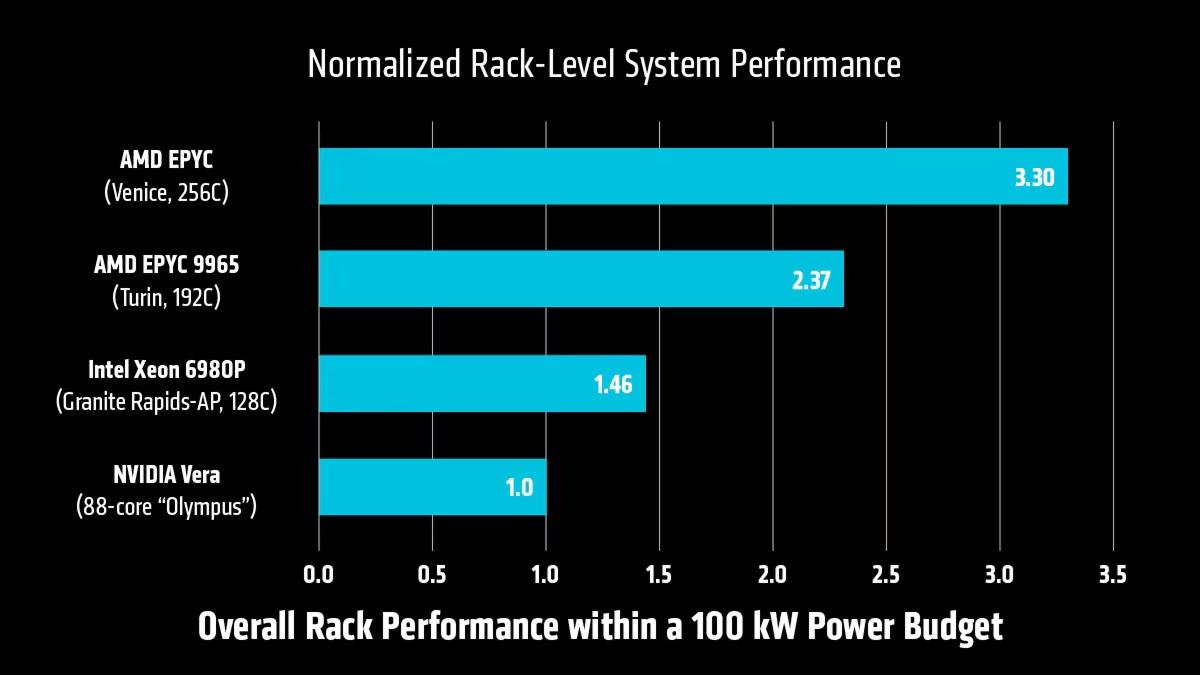
AMD has released its first official benchmarks for its Zen 6 EPYC CPUs, claiming they deliver 3.3X more “normalised rack-level performance” than its recently unveiled “Vera” CPUs. This claim is based on a 100kW rack-scale hardware deployment, highlighting AMD’s power efficiency and performance density advantages. However, it is worth noting that AMD’s data is limited.
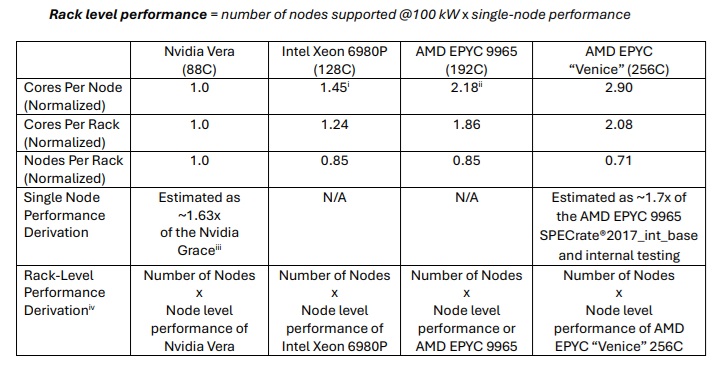
In their methodology, AMD has admitted that they have not tested Nvidia’s Vera CPUs. AMD simply took data from Nvidia’s current-generation “Grace” chip and multiplied it by 1.63x. This multiplier is based on data recently released by Phoronix. However, it is also worth noting that Phoronix’s data is limited to workloads selected by Nvidia. These are workloads Nvidia specifically wanted to highlight.
Regardless of how you look at it, AMD’s data for Vera involves a lot of guesswork. AMD also says that its EPYC “Venice” CPU results are based on a 1.7x scaling factor over its current-generation EPYC 9965 CPU. However, this scaling factor is based on AMD’s internal testing.
Because these estimates rely on published results, internal measurements and projection-based scaling factors, they are intended to provide directional comparison rather than direct measured rack benchmarks.
– AMD
Guesswork based on guesswork, but AMD paints a clear picture
While AMD’s performance claims need to be taken with a pinch of salt, they paint a clear picture. AMD claims major compute density benefits and more CPU performance at a 100kW rack scale. When data centers want to deploy hardware at Mega-Watt or Giga-Watt scales, compute density and power efficiency matter. Power efficiency reduces electricity costs for server operation, and density improvements save significant space at the datacenter scale.
Zen 5 VS Zen 6
Based on AMD’s data, its Zen 6 EPYC Venice CPUs outperformed its Zen 5 Turin counterparts by 39% on a 10kW rack power budget. This suggests a major boost in power efficiency for AMD’s new CPU platform, and a large increase in performance density. AMD expects its Zen 6 CPUs to be a major upgrade for hyperscalers, and to smash Nvidia Vera.
AMD is hosting an “Advancing AI” event next month, where we expect to hear more about its upcoming EPYC CPUs and Instinct Accelerators. For now, AMD’s benchmarks make it clear that they don’t expect Nvidia’s Vera chips to deliver any real competition against their newest CPUs.
You can join the discussion on AMD’s early EPYC Venice CPU benchmarks on the OC3D Forums.