


AMD RDNA 5 GPU launch plans leak – 2027 release targeted

Major OEM allegedly leaks AMD’s RDNA 5 GPU launch plans
A new report claims that AMD partners will begin receiving “first shipments” of desktop RDNA 5 GPUs in mid-2027, suggesting AMD will launch its next-generation GPUs next year. This backs up rumours from Computex 2026, where OEMs were expecting a mid-to-late launch for AMD’s next-generation GPUs.
Moore’s Law is Dead, citing a source at a “major OEM”, claims that AMD will launch its RDNA 5-based desktop GPUs in 2027. This could mean that AMD will release its next-generation GPUs ahead of Nvidia’s RTX 60 series, allowing AMD to define the high-end PC gaming market.
A 2027 launch makes sense for AMD
AMD is reportedly targeting a 2027 launch for its RDNA 5 series GPUs. This makes a lot of sense, as this is also reportedly the target release timeframe of the next-generation Xbox and PlayStation. Both Xbox “Project Helix” and PlayStation 6 (leaked specifications here) will use AMD hardware, with both featuring RDNA 5-based GPUs. Simply put, if RDNA 5 is ready for consoles, it’s ready for desktop PCs.
With RDNA 5, AMD has worked more closely with Microsoft and Sony to develop custom features and hardware-level enhancements. AMD and Sony have already unveiled some of RDNA 5’s features through “Project Amethyst“, with the fruits of their development efforts being Neural Arrays for advanced AI, Radiance Cores for advanced ray tracing, and Universal Compression for increased hardware efficiency.
AMD has also confirmed it has a “deep co-engineering partnership” with Microsoft on Project Helix. Furthermore, they confirmed that their next-generation “FSR Diamond” feature set is “natively optimised” for Xbox “Project Helix”.
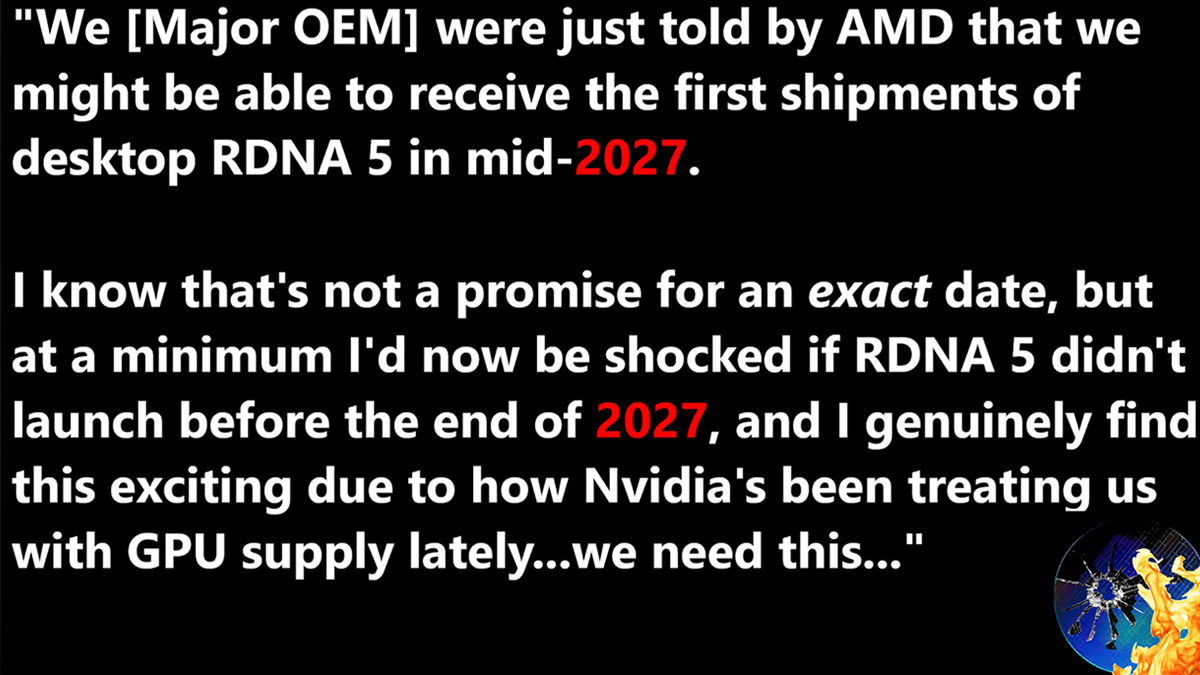
(AMD RDNA 5 GPU Leak – via Moore’s Law is Dead)
Moore’s Law is Dead’s source claims that they would “be shocked” if RDNA 5 didn’t launch in 2027. While memory pricing concerns could be a major factor in 2027, there are also reports that Nvidia plans to launch RTX 50 SUPER series GPUs this year. These new “SUPER” series GPUs feature more memory than their predecessors, suggesting that there will be a stronger supply of GDDR7 memory in the future. There’s also the potential for a memory price crash if the “AI bubble” were to burst.
AMD RDNA 5 should have both high-end and low-end models
Rumour has it that AMD plans to release ultra-high-end RDNA 5-based graphics cards as well as lower-end GPU models. Unlike AMD’s RDNA 4 GPU lineup, AMD should have a competitor for Nvidia’s high-end RTX XX90-class graphics cards. That’s a big deal for AMD, especially if they can launch their GPU ahead of Nvidia’s RTX 60 series.
With RDNA 5, AMD will have an enhanced graphics architecture and a software feature set, “FSR Diamond”, that is officially backed by Microsoft/Xbox. AMD’s partnership with Sony also ensures that AMD’s GPU feature set will be well utilised on PlayStation platforms, which is good news for Radeon users on PC. Multi-platform games will have a strong incentive to use AMD’s software/hardware features on PC, countering Nvidia’s “DLSS advantage”.
2027 is shaping up to be an exciting year for PC gamers. If memory prices lower, 2027 could be a strong year for the PC market, especially for gamers.
You can join the discussion on AMD’s rumoured 2027 RDNA 5 launch plans on the OC3D Forums.