


Sam Alman admits he was “wrong” and “too ambitious” with his AI timelines

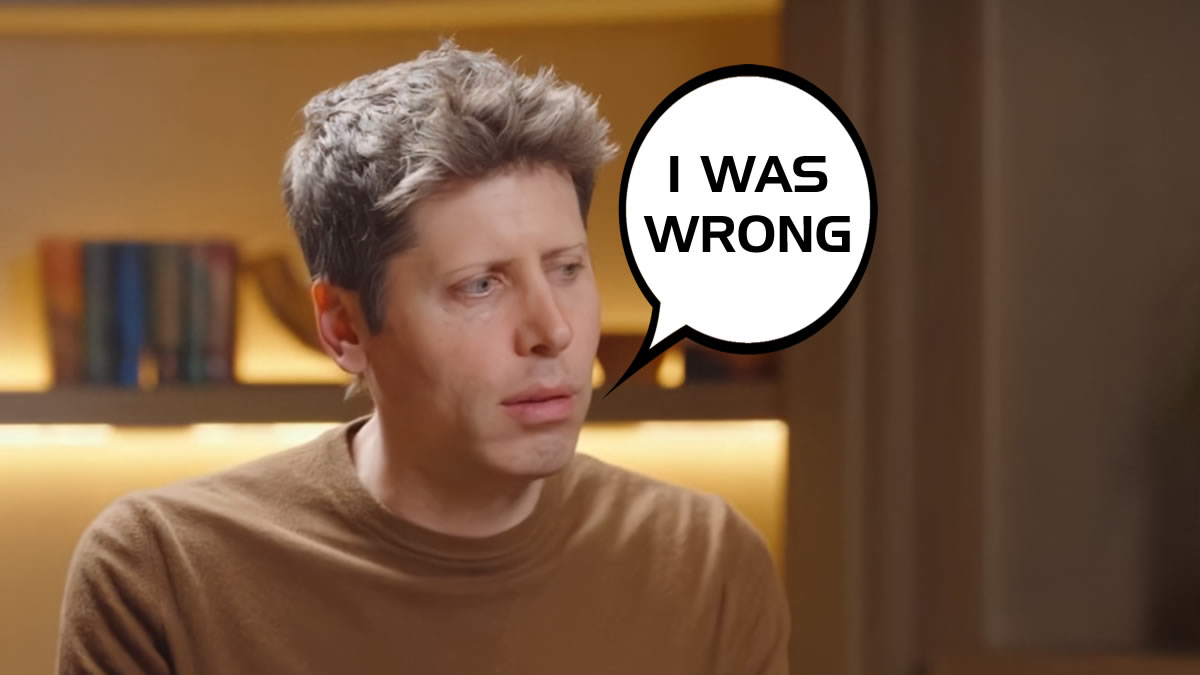
Sam Altman makes ominous statements about AI’s adoption
Sam Altman, while on David Senra’s Founders Podcast, has stated that the AI industry has been “too ambitious with its timelines”, an ominous remark from the head of the world’s most well-known AI company. His remarks imply that OpenAI and other AI companies will fail to deliver on their promises of hypergrowth, calling their value and sustainability into question.
If you have followed the AI industry for a while, you will know that Sam Altman has predicted many things over the years. He frequently suggested that AI would drastically change the workforce, only to say that he was “delighted to be wrong” and that a “job apocalypse” was now unlikely. Similarly, his predictions for when AGI (Artificial General Intelligence) would be achieved have also slipped.
Given Altman’s statement, several questions must be asked. If the AI industry was too ambitious, what does that mean for datacenters? Will all in-progress datacenters be needed if demand has not materialised as predicted? What does that mean for AI’s profitability? Did the AI datacenter buildout unnecessarily ruin the rest of the electronics market with high DRAM prices?
If demand isn’t materialising as expected, will all these new AI datacenters be profitable? Thanks to high component costs, higher power costs, and other issues, many datacenters have already proven to be more expensive to build than predicted. Between higher costs and AI’s inability to meet growth expectations, will investors lose money? These AI datacenters need demand to turn a profit. That means that AI needs to succeed. Is it?
I thought when we got to GPT-4, which was back in 2023, I think, that very quickly after that there was going to be much more disruption, software businesses up for grabs right away, than it turned out to be.
I think I was wrong about a few things, but one in terms of the speed: the economy just has so much inertia.
People keep doing the same things, buying from the same company, wanting to use their tools the same way. I think this is actually a positive in many ways, and it’s going to make this big transition go smoother and slower. I’m grateful for it.
But it means we’ve all been too ambitious on timelines. Even with this incredible technology, I think AI is one of the most incredible technologies humanity has ever invented, society and the economy will adapt more slowly.
– Sam Altman – OpenAI CEO
Really have to say it for Sam – he knows exactly the worst thing to say at the worst time to say it. This is almost as funny as a few months ago when companies were fretting over huge token bills he said it was a “huge issue for customers.” Amazing stuff man https://t.co/ORbHkaKYEM
— Ed Zitron (@edzitron) August 23, 2026
(Sam Altman’s statement, as shared by famed AI hater Ed Zitron)
Is the AI bubble about to pop?
Let’s be clear, this article is not financial advice. Sam Altman now claims that the economy will adapt more slowly to AI, assuming that OpenAI’s predicted demand will eventually materialise. Today’s rapid datacenter buildout assumes all compute will be used. Investors made a bet that all of these datacenters would be required. They weren’t built based on the assumption that demand would eventually materialise; they were built assuming that demand would be there when they were finished.
The so-called “AI transition” is not materialising as Sam Altman and his ilk predicted. While Altman claims that this is a good thing for society, it calls into question OpenAI’s viability. OpenAI assumed AI would be disruptive and create insatiable demand. Now, Sam Altman has stated plainly that AI has been much less disruptive than expected.
OpenAI is facing many issues right now, one of which is that Anthropic appears to have overtaken it in key sectors. Tools like Claude Code have given Anthropic a larger enterprise audience. While OpenAI is better known to the general public, those customers don’t have the same spending potential. Additionally, OpenAI has had several high-level departures over the past month. This includes Denise Dresser, OpenAI’s Chief Revenue Officer, and Brad Lightcap, OpenAI’s Chief Operating Officer. This question must be asked: Is OpenAI on the road to decline?
You can join the discussion on OpenAI being “too ambitious” on the OC3D Forums.