


AMD Zen 6 (6c) delivers huge single-threaded gains in Geekbench 7

AMD delivers up to 25.7% single-threaded gains over Zen 5 with its new Zen 6c cores
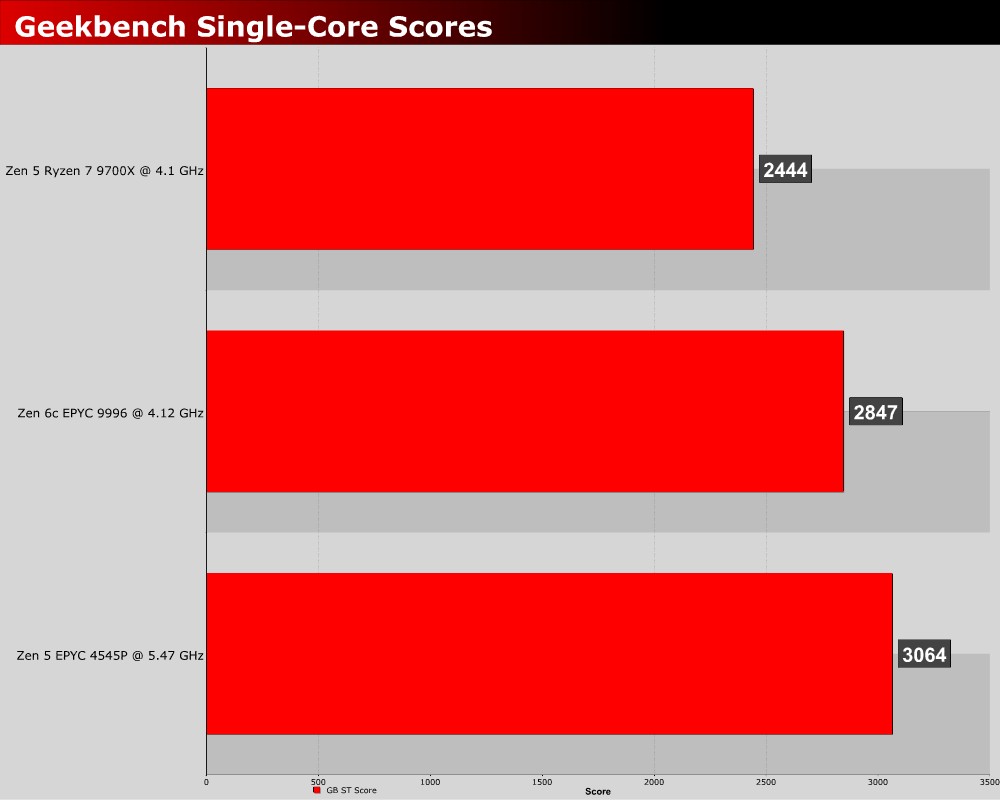
Geekbench 7 results for an AMD Zen 6-powered (Zen 6c) EPYC 9996 CPU have been released, unveiling a single-threaded score of 2,847 points. Upon the release of these results, analysts quickly compared them to results from AMD Zen 5 CPUs, noting significant gains in single-threaded IPC (Instructions Per Cycle) for AMD’s new architecture. In other words, AMD’s Zen 6c CPUs deliver much more performance than their Zen 5 counterparts at equivalent clock speeds.
AMD’s EPYC 9996 CPU is a 256-core processor that runs at up to 4.1 GHz. This CPU delivered a single-threaded score of 2847 points. Compared with a 4.1 GHz Ryzen 7 9700X, an 8-core Zen 5 CPU that scored 2444 points, AMD’s Zen 6 CPU delivers a single-threaded score that is 16.49% higher.
When Geekbench 7’s scores are split into its 15 individual tests, AMD’s Zen 6c CPU achieved single-threaded gains of between 8.2% and 25.7% over Zen 5 at 4.1 GHz. The largest gains were seen in HTML5 Browser, Photo Editor, Structure and Motion, and Video Player. The lowest gains were seen in File Compression and Clang.
So i guess it's one the first proper Zen 5 vs Zen 6 ST comparisons
My 9700X
@ 4.1 GHz fixed
@ DDR5-6000C34 / auto secondaries / FCLK 2000 MHz
Ran on Cachy OS Linux https://t.co/TShSdtG0aVZen 6 EPYC scores ~16.5% higher in GB7 @ 4.1GHz. https://t.co/fiCWAZY3oq pic.twitter.com/cG5NF3DLL9
— three twenty six (@326powah) October 23, 2026
Zen 6c EPYC at 4.1 GHz gets close to Zen 5 EPYC at 5.47 GHz
AMD’s Zen 5 EPYC 4545P CPU operated at up to 5.47 GHz and achieved a single-threaded score of 3064 in Geekbench. That’s only 7.6% higher than AMD’s new Zen 6c single-threaded score, despite its much larger 32.77% clock speed increase. This gives AMD’s new Zen 6c cores an IPC increase of around 23.36% with normalised frequencies.
What’s worth noting here is that all of these CPUs are tested on different platforms and core configurations. As such, comparison data here is of limited usefulness. Furthermore, the Zen 6 test here uses a CPU with Zen 6c cores, not the Zen 6 cores that desktop AMD Ryzen CPUs will use. This means that this data is not directly applicable to AMD’s next-generation desktop CPUs. Could Zen 6 (non-c) be even faster?
What does this mean for Zen 6 Ryzen?
If these results are any indication, AMD’s Zen 6 CPUs should be strong performers. That said, it remains to be seen how Zen 6 will perform on a desktop platform. Furthermore, it is unknown what clock speeds these CPUs will run at. If AMD can deliver these IPC gains alongside clock-speed improvements, Zen 6 desktop should deliver significant performance gains over Zen 5. Even without large clock speed gains, these performance improvements are notable. However, it remains to be seen how vital consumer workloads like gaming are impacted.
Join the discussion on AMD’s impressive single-threaded performance levels on the OC3D Forums.