


Alleged AMD Zen 7 CPU specifications and IPC details leak


AMD’s making some big changes to Zen with its planned “Grimlock” CPU design
Today’s another CPU leak day, with detailed AMD Zen 7 CPU details hitting the web. As always, these leaked details should be taken with a grain of salt, especially for CPU designs that are this far from launch. Remember, AMD’s Zen 6 CPUs are expected to arrive in mid-late 2026. That means that we should expect to see Zen 7 CPUs sometime in 2028.
Based on Moore’s Law is Dead’s newest leak, AMD’s Zen 7 “Grimlock” CPU design will feature CCDs (Core Complex Dies) that feature up to sixteen cores. That’s two times as many cores as AMD’s Zen 5 CCD designs. This means that each CCD will feature more total L3 cache. With two of these chiplets, AMD’s Zen 7 Ryzen desktop CPUs will feature up to 32 CPU cores. That means that AMD’s planned Zen 7 CPUs should deliver incredible levels of multi-threaded CPU performance. Note that AMD reportedly plans to have a smaller 8-core CCD for its lower-end Zen 7 CPU models.
Big Cache changes for AMD’s Zen 7 CPU cores
Another major chance for Zen 7 is its enlarged L2 cache. Today’s Zen 5 CPU cores feature 1MB of L2 cache per core. With Zen 7, this allegedly increases to 2MB. This increase in L2 cache size will allow Zen 7 CPUs to store more data in their faster, less-latent cache. This reduces pressure on AMD’s L3 cache and should accelerate a wide range of workloads. Note that Intel’s Raptor Lake CPU cores feature 2MB of L2 cache per core. This design element is a key factor in Raptor Lake’s enhanced gaming performance compared to Alder Lake.
Moore’s Law is Dead claims that AMD’s new cache design alone should give Zen 7 an 8% IPC increase over Zen 6. Along with other architectural changes, AMD anticipates additional IPC gains with its Zen 7 CPU cores.
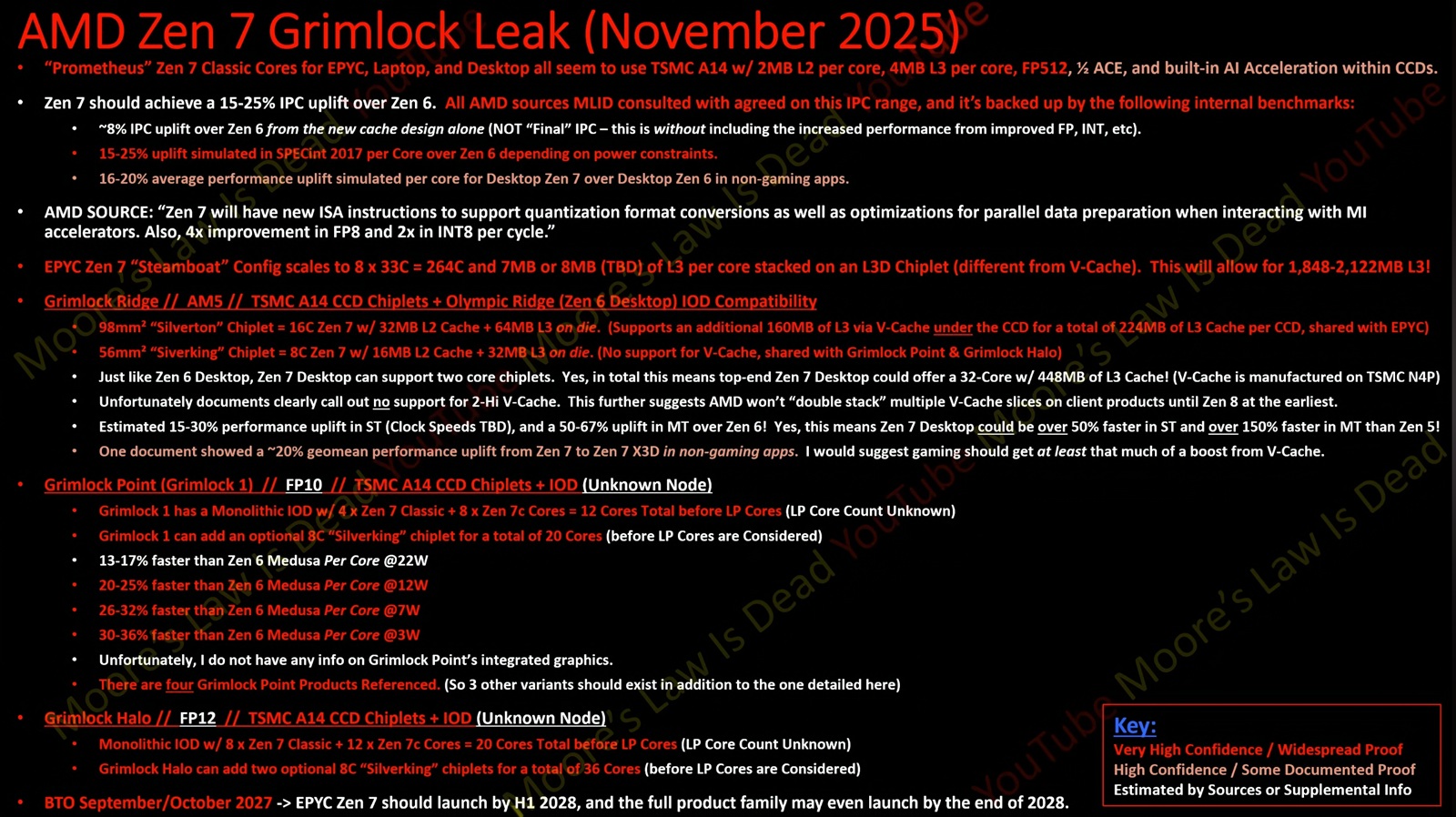
(Moore’s Law is Dead – AMD Zen 7 “Grimlock” CPU Leak – November 2025)
AMD Zen 7 IPC leak
According to Moore’s Law is Dead, AMD’s Zen 7 CPU core design should deliver a 15-25% increase in simulated SPECint 2017 performance over Zen 6. The exact change depends on power constraints. Note that this is simulated performance, and it may not accurately reflect Zen 7’s finalised CPU design. Furthermore, AMD has not launched Zen 6, which means that this leak compares the performance of two unlaunched products. While AMD will have working Zen 6 CPUs in its labs, this data should be taken with a huge grain of salt.
AMD’s Zen 7 CPU cores will reportedly use TSMC’s A14 silicon. This means that AMD plans to skip TSMC’s A16 node and proceed directly from Zen 6’s 2nm node to A14. If that is true, AMD may not launch any TSMC A16 products.
What about Zen 7 X3D?
AMD’s planned 16-core Zen 7 CCDs will reportedly contain 64MB of L3 cache on-die and support 160MB of extra L3 cache using a V-Cache chiplet. This should mean that AMD will be able to produce a 16-core Zen 7 CPU with 224MB of L3 cache. Note that today’s Ryzen 7 9800X3D CPU features 96MB of L3 cache, less than half of the case that AMD’s planned Zen 7 X3D CPUs will have.
It has been claimed that AMD’s Zen 7 X3D CPUs will deliver large performance gains in non-gaming workloads. It is claimed that a “20% geomean performance uplift” can be achieved with 3D V-Cache in non-gaming workloads. This suggests that AMD’s Zen 7 V-Cache no longer suffers from clock speed disadvantages, and that the Zen 7 CPU design may be memory bandwidth-limited.
AMD’s Zen 7 Ryzen CPUs will reportedly launch on AMD’s AM5 CPU socket. Note that this means that AMD’s Zen 7 desktop CPUs should support existing motherboards and DDR5 memory.
You can join the discussion on AMD’s rumoured Zen 7 CPU specifications on the OC3D Forums.