


Gigabyte promises to “revolutionise your gaming performance” with their X3D Turbo mode


Gigabyte confirms AMD’s 16-core X3D CPU plans and promises HUGE performance gains with “X3D Turbo Mode”
Gigabyte has promised significant performance gains with its new “cutting-edge” X3D Turbo Mode feature. This new feature for X870E, X870, and 600 series motherboards arrives with AMD’s AGESA 1.2.0.2a update and supports AMD Ryzen 7000X3D and 9000 series CPUs.
This new “X3D Turbo Mode” feature specifically targets gaming workloads. Note that this new mode isn’t Gigabyte-exclusive but an implementation of an AMD AGESA feature. For AMD’s upcoming 16-core Ryzen 9000 X3D CPU (9950X3D?), Gigabyte reports 18% performance gains. For the 9950X (non-X3D), 18% performance gains are also promised. Additionally, 5% performance gains are promised with AMD’s Ryzen 7 9800X3D.
How does this tech work? The answer is simple: This “Turbo Mode” disables features that may lower the gaming performance of AMD’s latest CPUs. This can result in higher framerates, especially on multi-CCD Ryzen CPUs.
GIGABYTE TECHNOLOGY Co. Ltd, a leading manufacturer of motherboards, graphics cards, and hardware solutions, is proud to announce the launch of X3D Turbo Mode, a revolutionary feature designed to maximize gaming performance on X870E, X870, and 600 series motherboards with AMD Ryzen 7000 X3D and Ryzen 9000 series processors.
GIGABYTE X3D Turbo Mode is a cutting-edge feature that unifies cores distribution, bandwidth tuning, and hardware power balancing, resulting in pushing the boundaries of gaming performance. Empirical testing demonstrates that this feature delivers tangible benefits to gamers, with performance increases of up to 18% for incoming Ryzen 9000 series 16-core X3D processors, an astounding 18% for Ryzen 9000 non-X3D processors, and 5% for Ryzen 9800 X3D processors*. Notably, X3D Turbo Mode’s unique optimization parameters allow even Ryzen 9000 non-X3D processors to achieve similar gaming performance levels as their Ryzen X3D counterparts. Experience smoother gameplay, higher frame rates, and reduced latency with GIGABYTE’s BIOS innovation- X3D Turbo Mode.
*Performance improvement may vary by processor model and DRAM conditions.
The X3D Turbo Mode is integrated with AMD AGESA 1.2.0.2a in the latest BETA BIOS release and is synchronized with the latest version of AORUS AI SNATCH when activated. Update the latest BIOS and unlock your CPU’s hidden potential for gaming with GIGABYTE’s X3D Turbo Mode now. Please visit GIGABYTE official website.
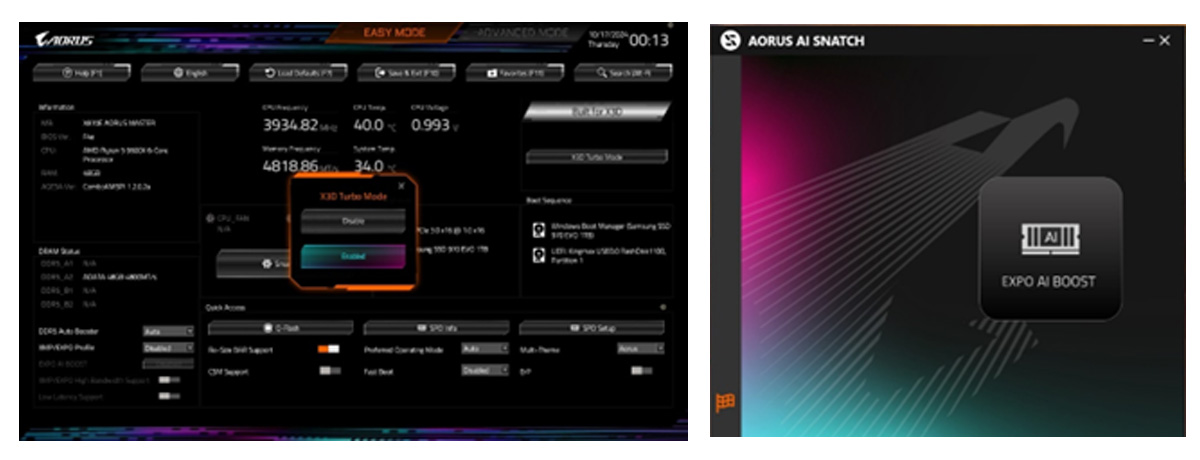
(Image from Gigabyte)
So, what does Turbo Mode do? The simple answer is that it disables SMT (Simultaneous Multi-Threading) and the second CCDs of dual-CCD Ryzen processors. So, for a 16-core 32-thread AMD CPU, it would disable one CCD to make it an 8-core 16-thread CPU. Then, it would disable SMT to make the CPU an 8-core, 8-thread CPU. This can deliver higher levels of gaming performance, as inter-CCD latencies are eliminated, and all CPU power can be dedicated to a single CCD.
Users of this “Turbo Mode” would need to enable and disable this feature before and after playing games. This would ensure they have access to the full performance of their CPUs in other workloads. After all, many workloads benefit from higher core/thread counts.
You can join the discussion on Gigabyte’s “X3D Turbo Mode” on the OC3D Forums.