


Intel delivers HUGE performance with its Xeon 600 workstation CPUs

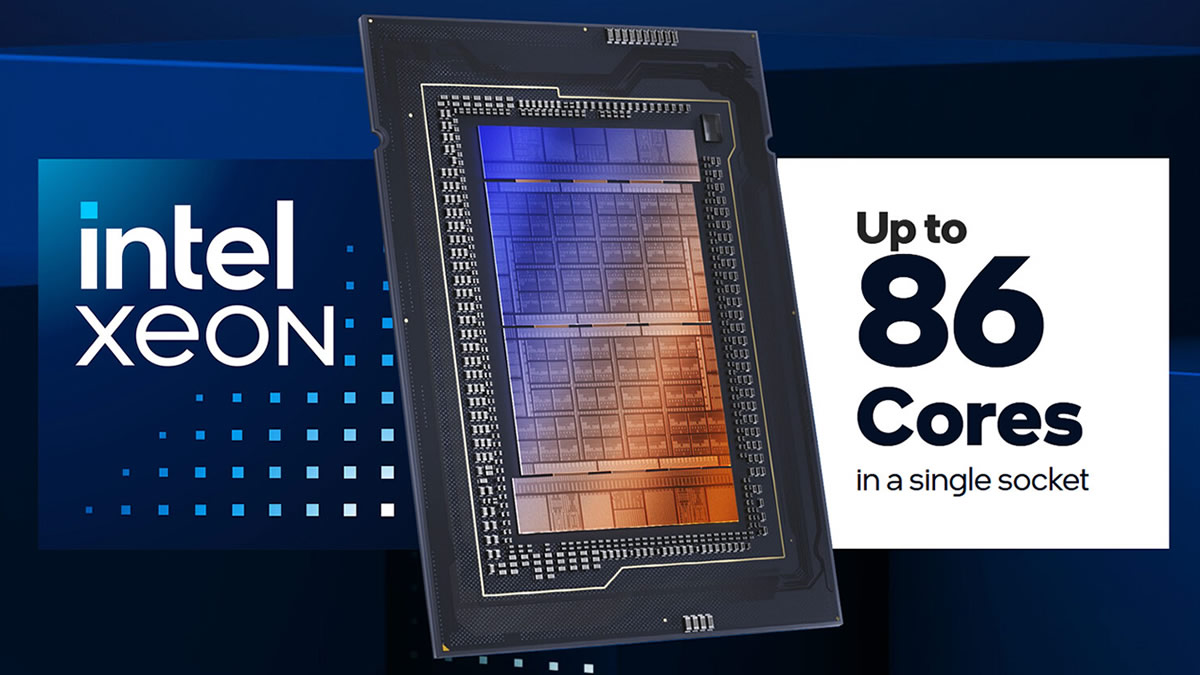
Intel delivers up to 86 cores on a single socket with its Xeon 600 series workstation processors
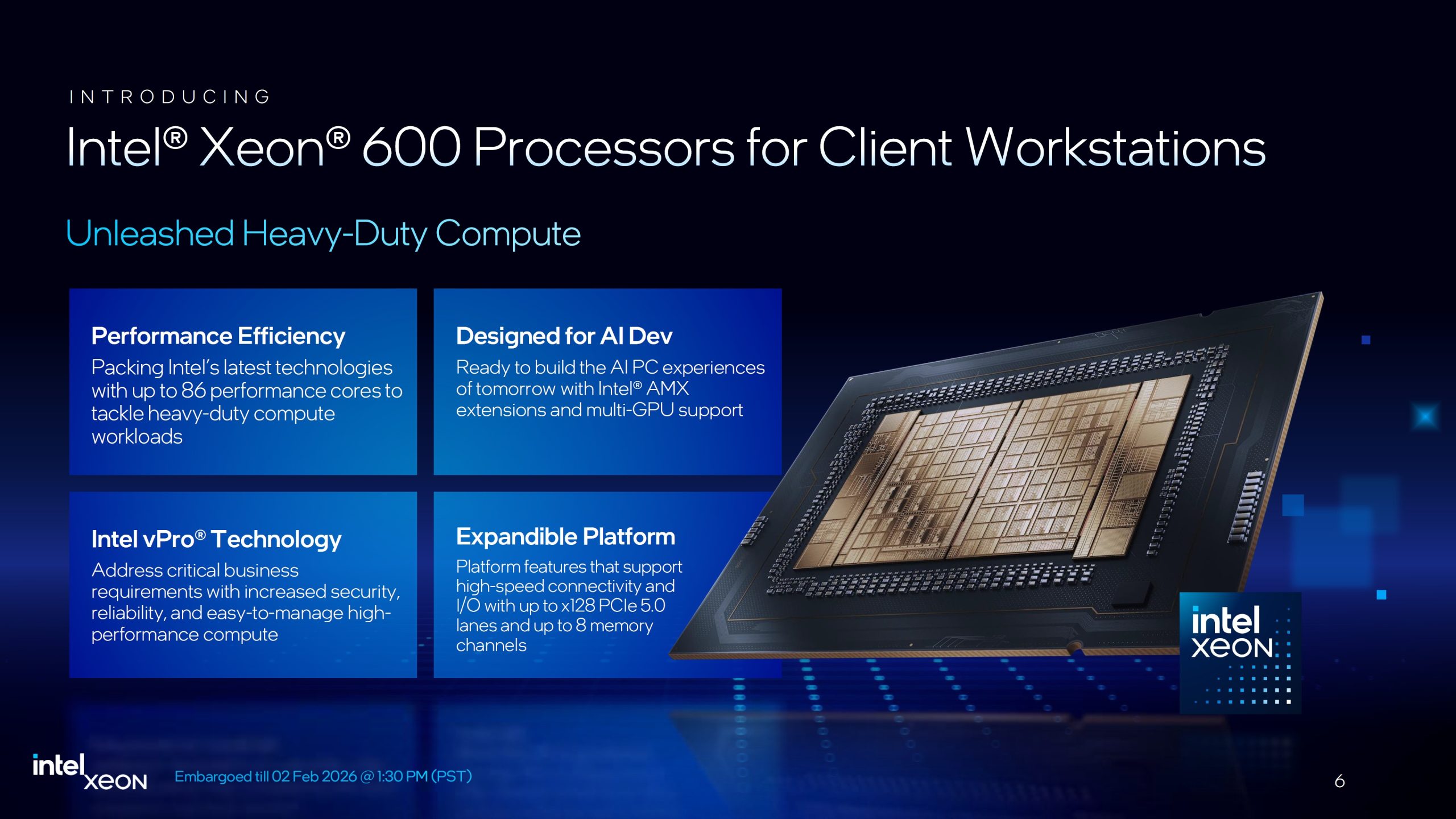
Intel has officially launched its new Xeon 600 series of workstation processors. These CPUs deliver up to 86 performance cores and eight DDR5 memory channels to deliver exceptional performance for demanding workstation tasks. Add its 128 PCIe 5.0 lanes of connectivity, and we have a processor that can support a large number of connected devices. This includes GPUs, AI accelerators, and more.
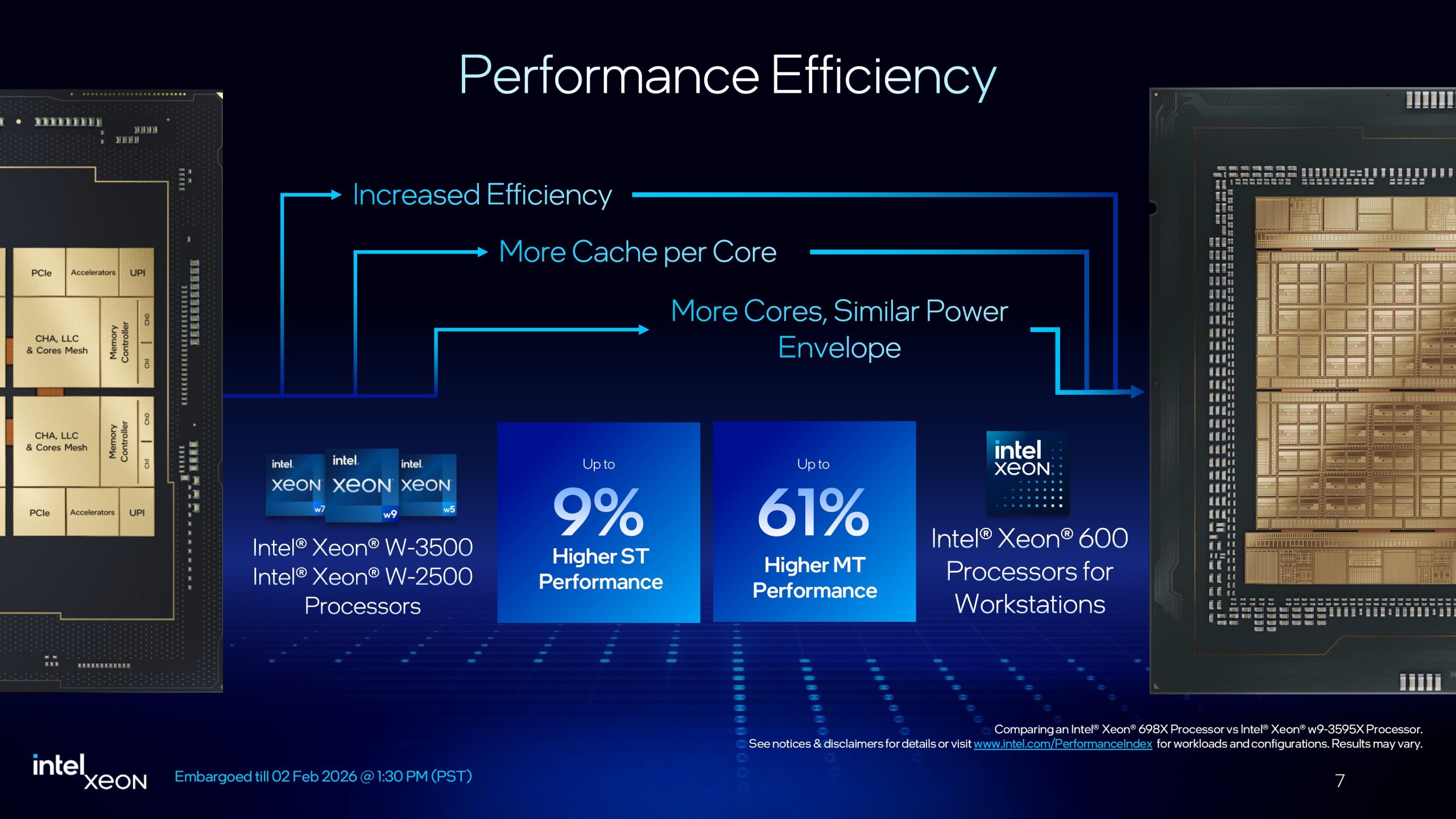
Compared with Intel’s last-generation Xeon W-3500 and W-2500 series CPUs, Intel’s new Xeon 600 series CPUs promise higher levels of single-threaded and multi-threaded performance. Intel promises up to 9% higher single-threaded performance and 61% more multi-threaded performance.
Note that Intel says its new Xeon CPUs deliver higher efficiency and more cache per core. That’s great news for power-focused users and those with latency-sensitive workloads.
Specifications
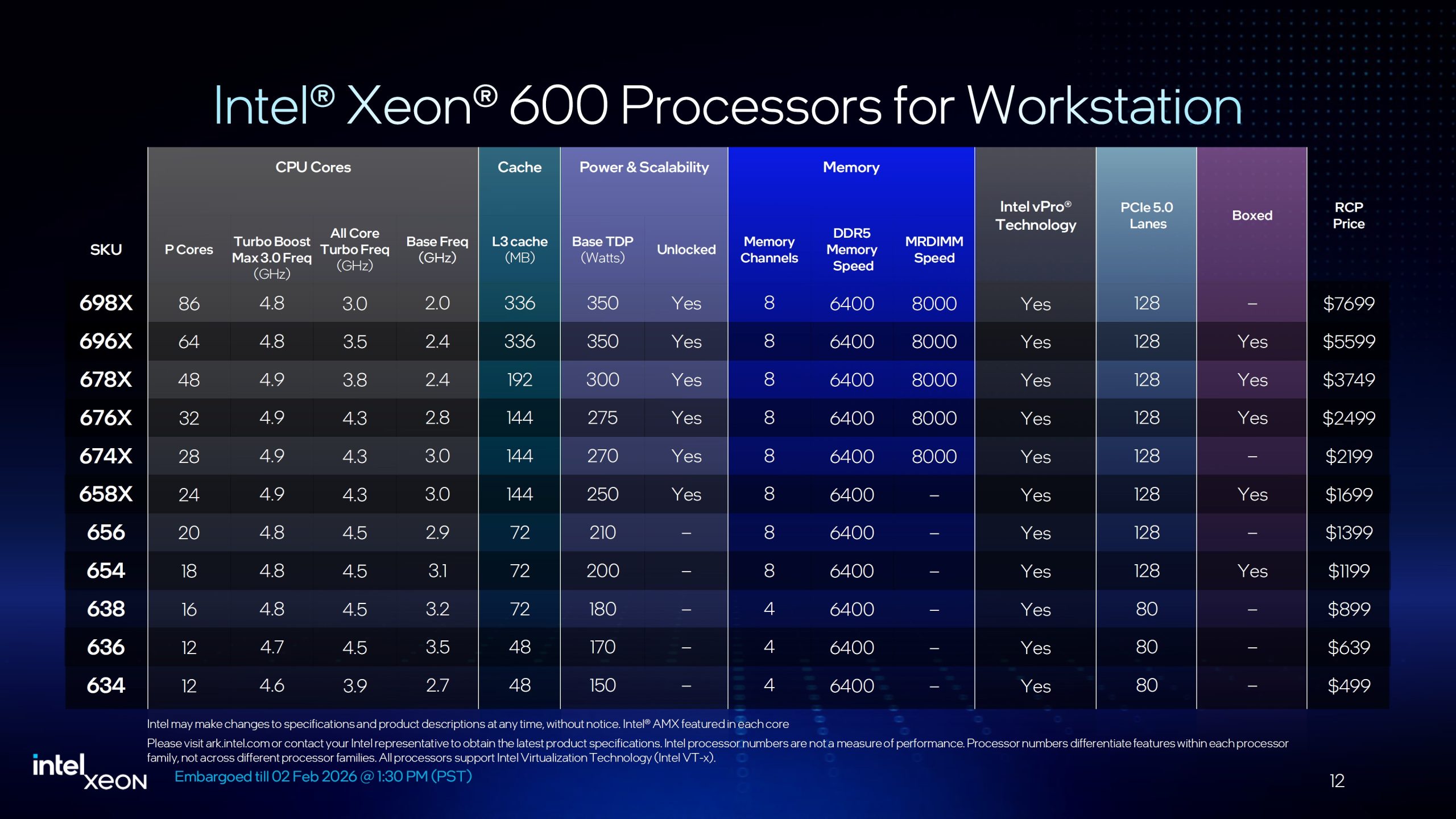
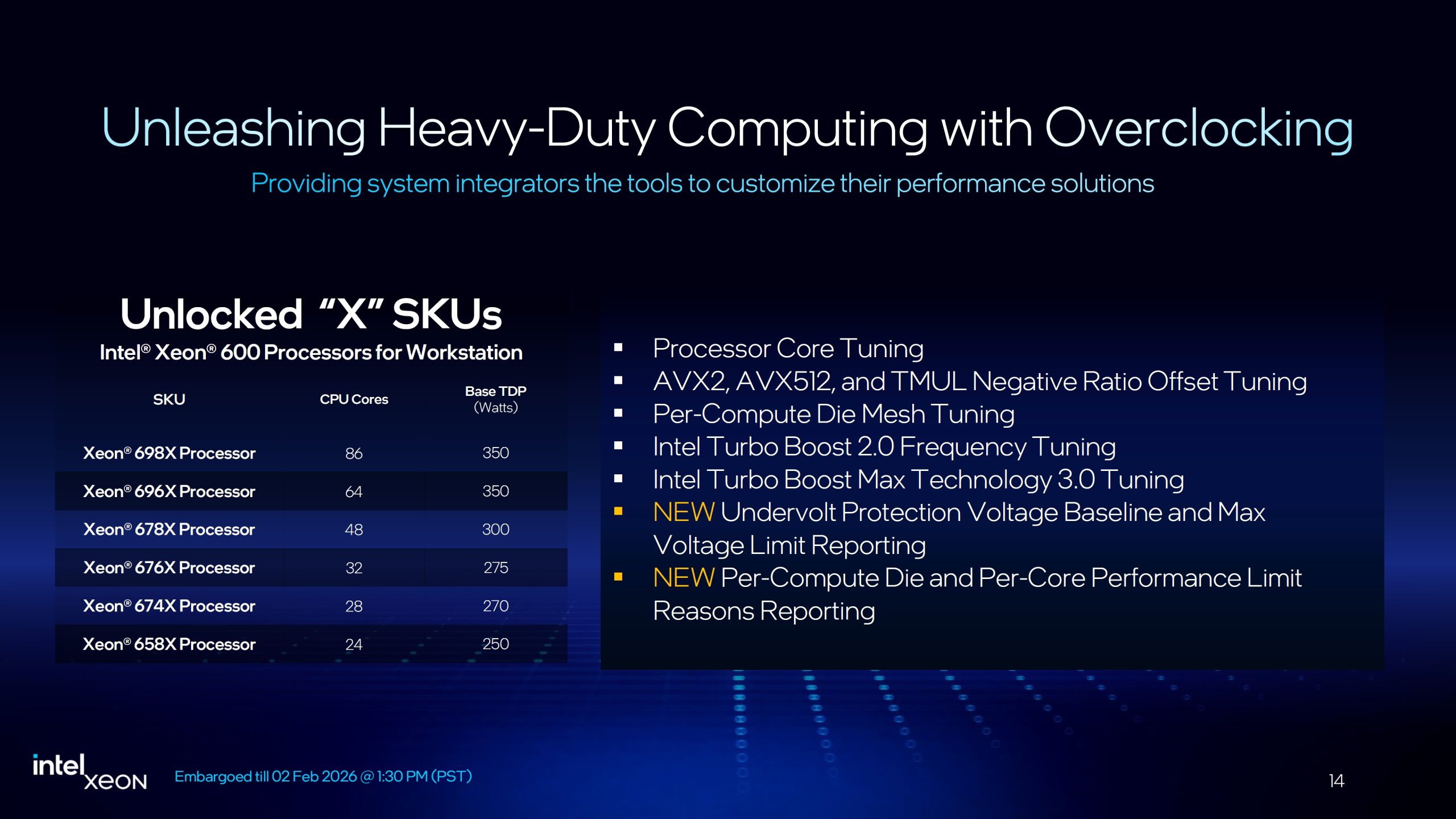
The Intel Xeon 600 family is availabe on the Intel W890 chiplet for socket LGA 4710-2 (V2). CPUs will feature 12 to 86 cores, priced from $499 to $ 7,699. Note that Intel’s higher-end Xeon 600 models are X-series CPUs, which means that they are overclockable. Furthermore, 28-core+ models will support MRDIMM DDR5 memory modules.
With Intel’s unlocked CPU models, users can tune their processors to deliver higher performance levels. This includes per-core CPU overclocking, mesh tuning, and more.
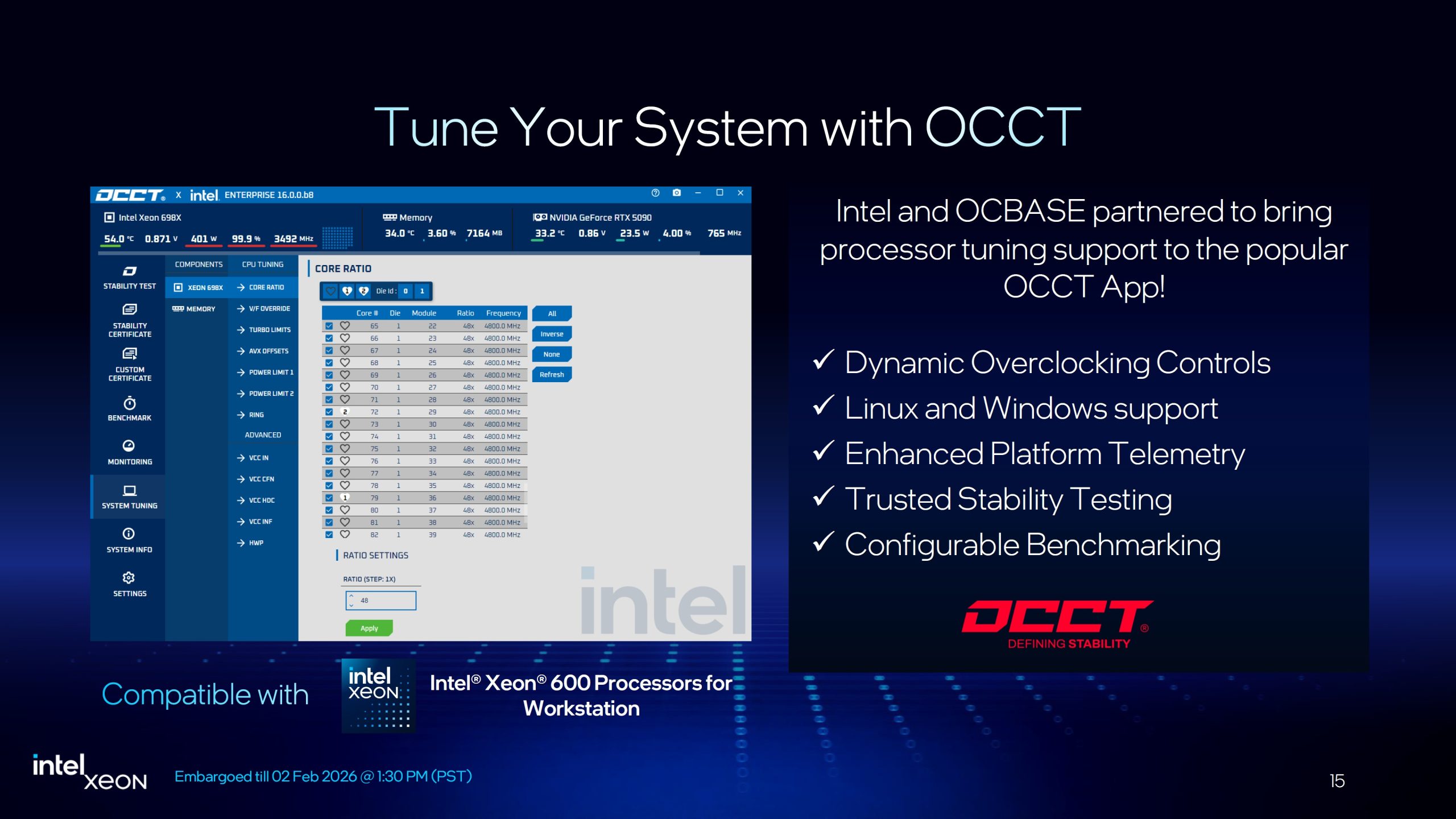
Intel has teamed up with OCCT to deliver CPU tuning within OCCT. OCCT is a top-tier stress testing tool that is available for Windows and Linux users. Yes, this means that Intel’s overclocking tools can be used on Linux with OCCT.
Platform features
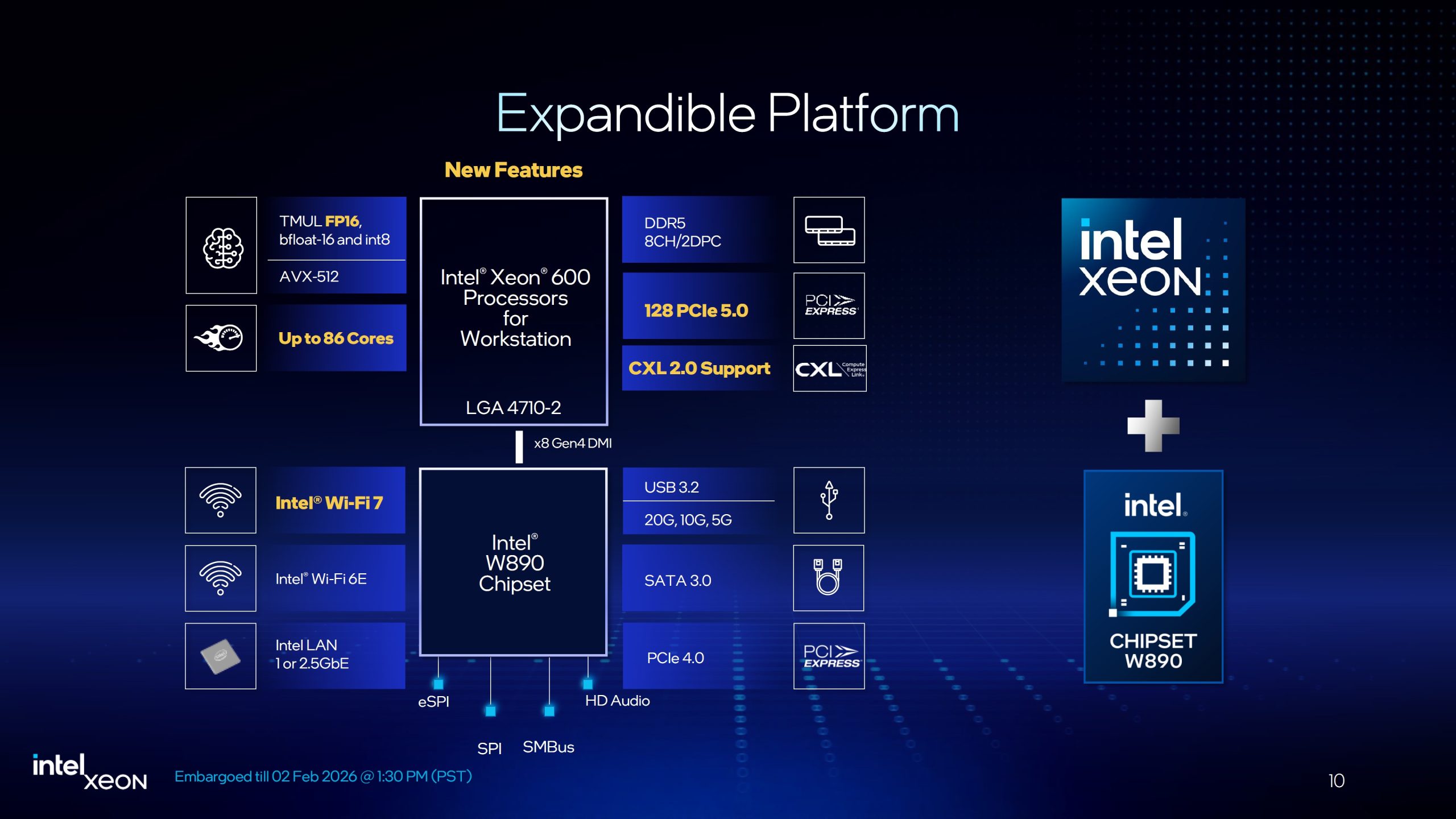
With Intel’s W890 chiplet comes 128 PCIe 5.0 lanes, CXL 2.0 support, and 8-channel DDR5 memory support. This platform can support up to 4TB of DDR5 memory using DDR5 RDIMMs.
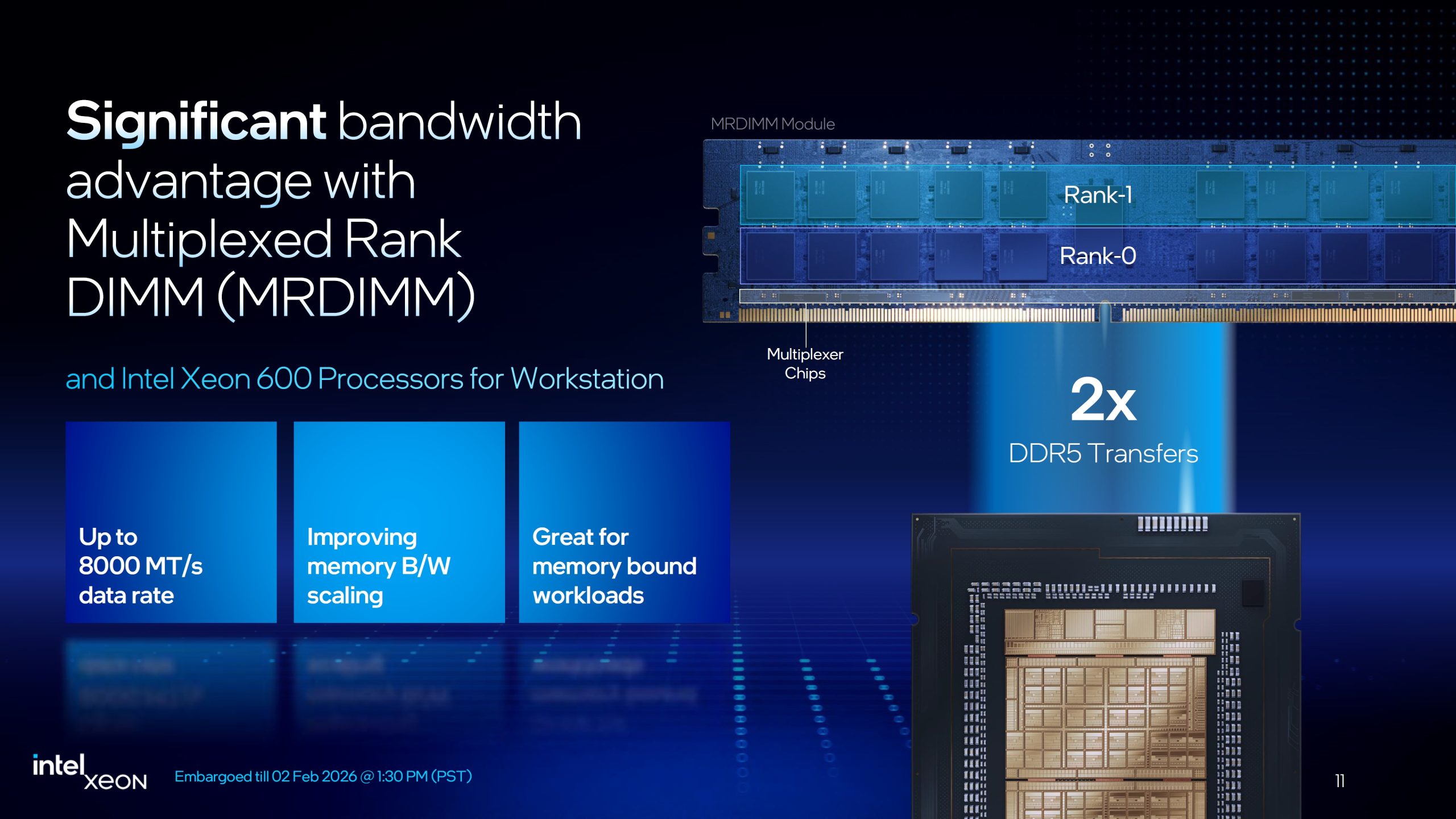
Using “Multiplexed Rank DIMM” (MRDIMM) memory modules, Intel’s Xeon 600 workstation CPUs can deliver higher bandwidth per DRAM module and improved performance in memory-bound workloads. That’s great news for users with high-bandwidth workloads. These modules are supported with up to 8,000 MT/s data rates.
Intel Xeon 600 Performance Gains
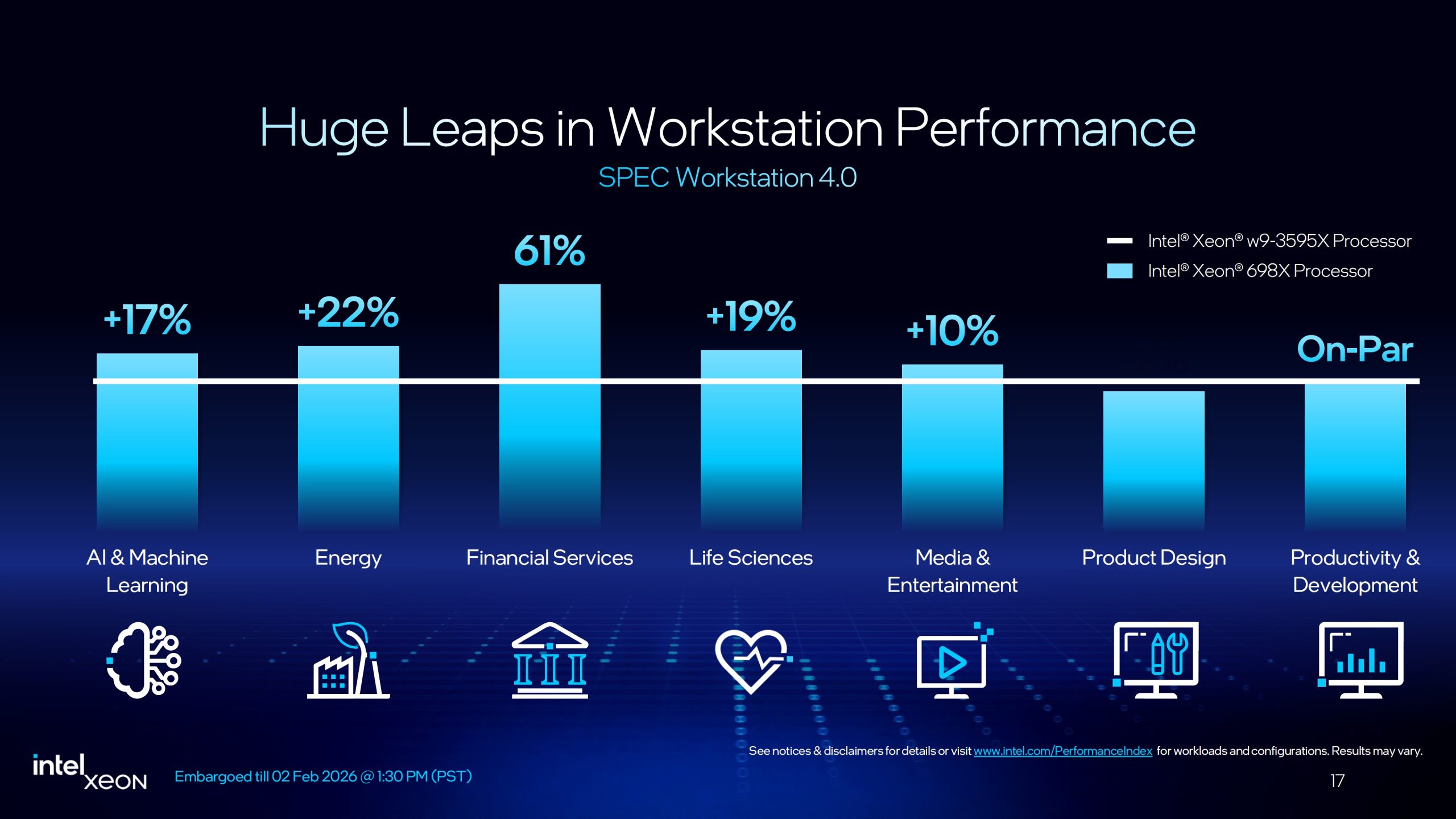
With its new 86-core Xeon 698X CPU, Intel promises significant performance gains across a wide range of workloads. Note that Intel says that Financial Services workloads can achieve up to 61% performance gains. In less multi-threaded workloads, Intel’s performance gains are more limited.
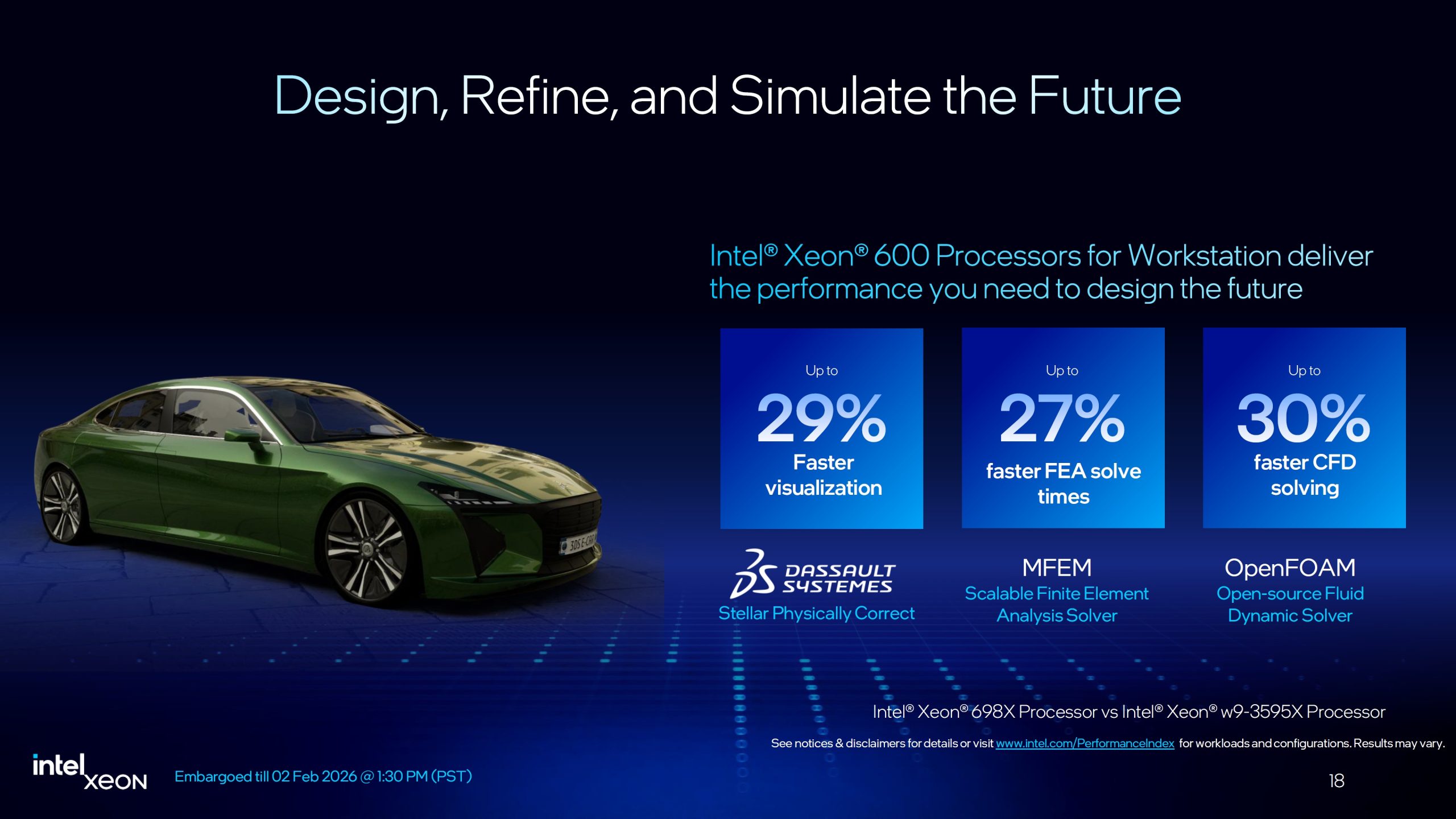
In workstation workloads, such as Finite Element Analysis and Computational Fluid Dynamics, Intel reports 27-30% performance gains. Solid gains for such demanding workloads.
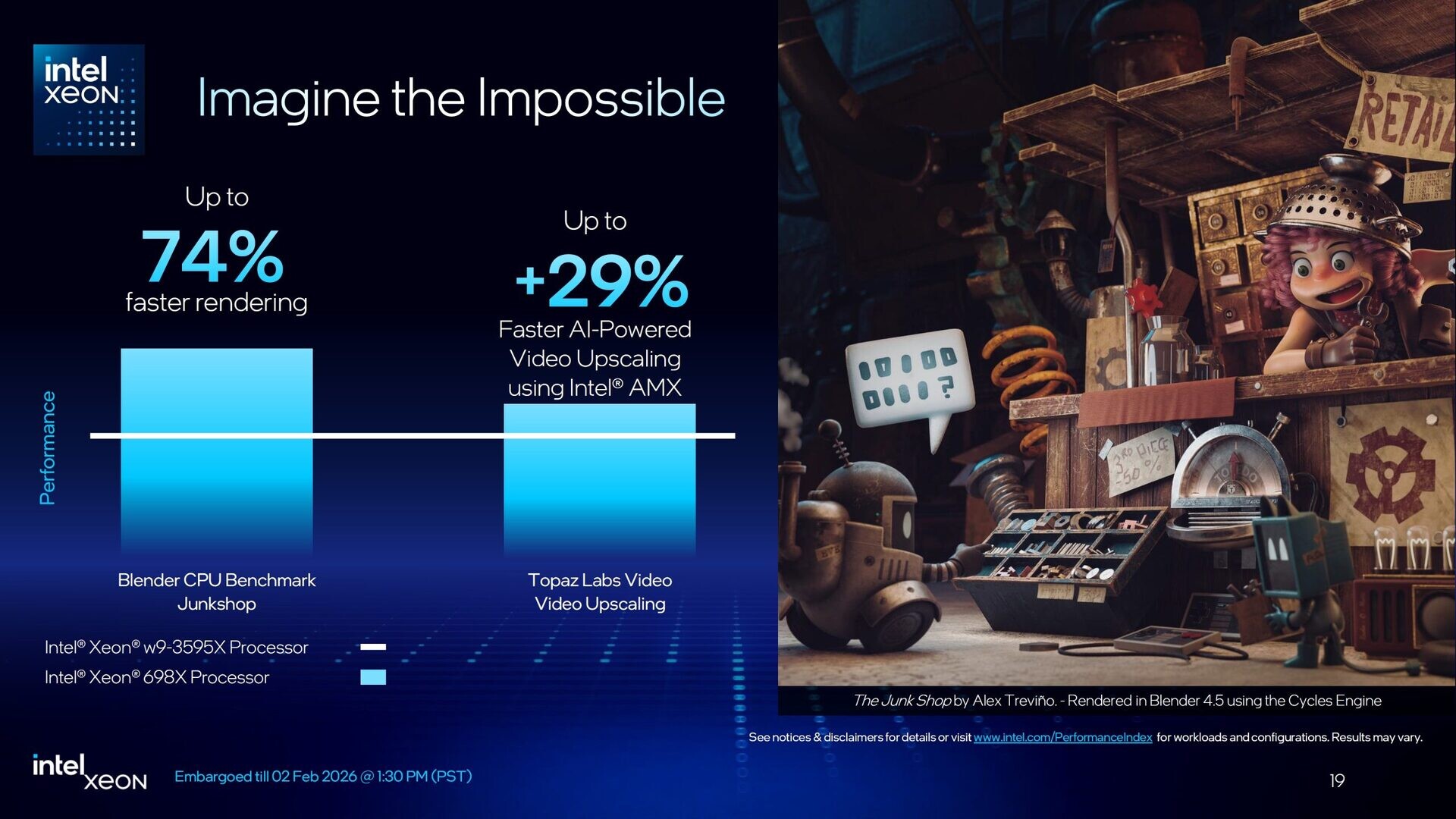
In Blender, Intel confirms its largest performance gains, with up to 74% faster rendering speeds and up to 29% faster AI-powered video upscaling speeds. Sadly, Intel has only compared these CPUs to their last-generation counterparts, and not their AMD Threadripper counterparts.
At $7,699, Intel’s 86-core Xeon 698X is much more cost-effective than AMD’s 96-core AMD Ryzen Threadripper PRO 9995WX, which has an MSRP of $11,699. All models in Intel’s new Xeon 600 lineup are less expensive than their AMD Threadripper counterparts, suggesting that Intel is focusing on value for money instead of peak performance.
Intel says that its new Xeon 600 series CPUs will be available in late March.
You can join the discussion on Intel’s Xeon 600 processors on the OC3D Forums.