


Intel “Unified Core” plans leak – Hyper-Threading Returns!

Intel’s “Unified Core” plans have leaked, and it’s coming to desktop with Hammer Lake
Earlier this year, Intel confirmed the existence of its “Unified Core” with a job listing. Now, Intel’s “Unified Core” plans have leaked, and they are due to come into fruition with Titan Lake and Hammer Lake.
According to leaked documents, unveiled by Moore’s Law is Dead, Intel will be releasing Titan Lake CPUs with “Copper Shark” (CSK) based P-cores and E-cores. This confirms Intel’s “Unified Core” plan. Instead of making separate P-core and E-core architectures, Intel will craft a single core architecture and deliver P-core and E-core variants. P-cores will likely be larger and more performant, while the E-cores will likely feature denser designs with lower maximum clock speeds. We speculated (see here) that this could be the approach that Intel could take with “Unified Core” when the name was first reported in 2025.
Are Intel copying AMD?
Many enthusiasts will notice that Intel’s leaked “Unified Core” approach is similar to AMD’s current approach. Some of AMD’s CPUs feature Zen and Zen c (compact) CPU cores. AMD’s Zen and Zen c cores feature the same architectural feature sets, but AMD’s Zen c cores feature more densely packed silicon, run at lower voltages and operate at lower clock speeds. Some AMD CPUs (mostly laptop CPUs) use a mix of Zen and Zen c series CPU cores.
This approach is much simpler than creating two separate core architectures. It ensures that architectural features are not locked to a single core type. This avoids issues like Alder Lake’s lack of AVX-512 support, since AVX-512 is only available on P-cores. It also simplifies scheduling, as clock speeds will be the primary differentiator between these two core designs. Allocating workloads to the right CPU cores is much easier when the cores are similar.
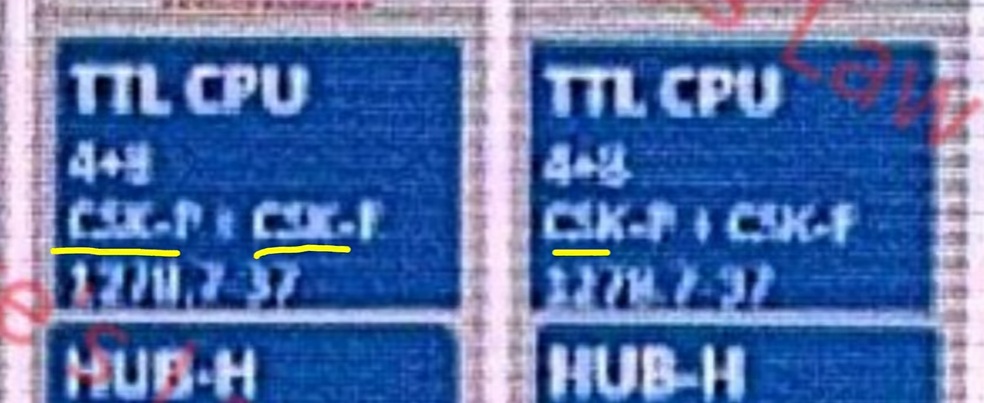
(Image from Moore’s Law is Dead)
Unified Core arrives with Titan Lake
Intel’s “Unified Core” CPUs will reportedly arrive with Titan Lake. While Intel may still call its CPU cores P-cores and E-cores, today’s leak claims that both will use Intel’s Copper Core architecture. This means that both sets of cores will use the same underlying “Unified” CPU architecture.
Titan Lake is reportedly a mobile-focused CPU architecture, like Lunar Lake and Panther Lake, and will not be released on desktop CPU sockets.
Hyper-Threading is coming back!
If today’s leak is correct, Intel plans to bring back Hyper-Threading with its “Hammer Lake” CPUs. Intel is reportedly taking a very AMD-like approach with Hammer Lake, with many of its desktop CPUs using all-P-core designs. Hammer Lake will reportedly use Intel’s “Thunder Hawk” CPU cores, which will be Intel’s second generation “Unified Core”.
In the slide below, we can see that a planned Hammer Lake CPU die features SMT (Simultaneous Multi-Threading), which is another name for Intel Hyper-Threading.

(Image from Moore’s Law is Dead)
Intel is rethinking how it makes CPUs. Instead of making two CPU architectures, Intel plans to pool its resources to make a stronger, singular architecture for its future CPUs. Intel will also make good on its promise to bring back Hyper-Threading, something that many users have disliked about Intel’s newest CPU architectures.
You can join the discussion on Intel’s leaked “Unified Core” plans on the OC3D Forums.