


Leaked Radeon RX 5600 XT benchmarks reveal memory OC scaling

Leaked Radeon RX 5600 XT benchmarks reveal memory OC scaling
Today, new 3DMARK Fire Strike benchmark scores have been leaked, via _rogame, which reveals a correlation between the Radeon RX 5600 XT’s benchmark performance and memory overclocking, proving that the GPU is memory-limited in specific applications.
What’s worth noting here is that these are 3DMARK Fire Strike scores; and that 3DMARK Fire Strike is an old benchmarking utility which runs at 1080p under DirectX 11. As 3DMARK Fire Strike is an older 1080p benchmark, memory bandwidth shouldn’t be a significant constraint on the Radeon RX 5600 XT’s performance, which means that higher resolutions, such as 1440p, could be more performance constrained by AMD’s chosen memory configuration. Newer games would also be more memory-constrained by the Radeon RX 5600 XT’s 12Gbps memory and 192-bit memory bus.
When looking at the Radeon RX 5600 XT’s 3DMARK Fire Strike Graphics scores, we can see that using 14Gbps GDDR6 memory speeds yields a 6.72% boost in performance while using 14.4Gbps memory speeds delivers a 7.5% boost in graphics performance. These results come thanks to 16.7%, and 20% boosts to total memory bandwidth/clock speeds, respectively.
 (Image from _rogame)
Why is the Radeon RX 5600 XT memory limited?
If the Radeon RX 5600 XT is memory limited, why isn’t AMD shipping the graphics card with faster GDDR6 memory modules? Wouldn’t that help AMD compete with Nvidia’s higher cost graphics cards?
The simple answer to this question is pricing and product segmentation. Using faster GDDR6 memory would bring the Radeon RX 5600 XT closer to AMD’s Radeon RX 5700, making it a less appealing purchase. On top of that, higher-speed GDDR6 memory would add more cost to AMD’s budget-friendly Radeon RX 5600, a move which would bring the graphics card closer to the RX 5700 in terms of pricing and performance. It makes little financial sense for AMD to do that.
Hopefully, Radeon RX 5600 XT users will be able to overclock their Radeon RX 5600 XT graphics cards to 14Gbps to regain some of this lost performance potential. However, this depends on the quality of the GDDR6 memory modules on your specific graphics card. Even so, memory overclocking may still be the first port of call for Radeon RX 5600 XT overclockers.
| AMD Radeon RX 5500 XT | AMD Radeon RX 5600 XT |
AMD Radeon RX 5700 |
AMD Radeon RX 5700 XT |
|
| Process Tech/ Architecture | 7nm Navi | 7nm Navi | 7nm Navi | 7nm Navi |
| Stream Processors |
1408 | 2304 | 2304 | 2560 |
| Base Clock | – | – | 1465MHz | 1605MHz |
| Gaming Clock | 1717MHz | 1375MHz | 1625MHz | 1755MHz |
| Boost Clock | 1845MHz | 1560MHz | 1725MHz | 1905MHz |
| Memory | 4/8GB GDDR6 | 6GB GDDR6 | 8GB GDDR6 | 8GB GDDR6 |
| Memory Bus | 128-bit | 192-bit | 256-bit | 256-bit |
| Memory Clock | 14Gbps | 12Gbps | 14Gbps | 14Gbps |
| Memory Bandwidth |
224GB/s | 288GB/s | 448GB/s | 448GB/s |
| MSRP (US) | $169 | $279 | $349 | $399 |
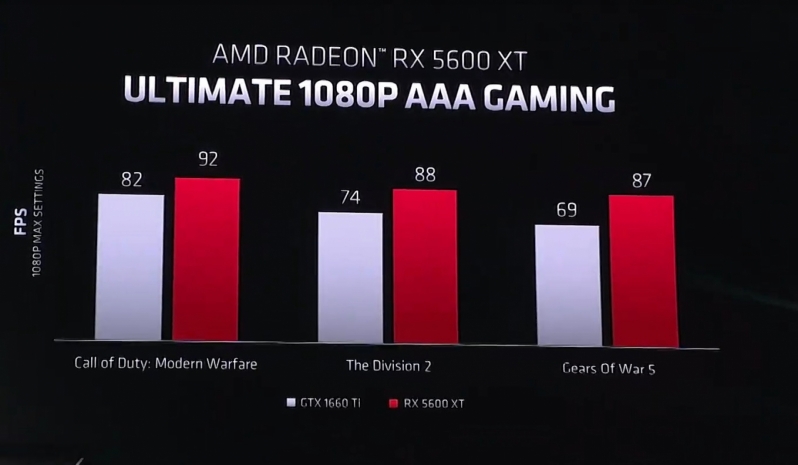
AMD’s Radeon RX 5600 XT is designed to surpass Nvidia’s GTX 1660 Ti graphics card, solidifying AMD’s hold on the sub-$300 GPU market. Hopefully, this graphics card’s pricing will translate well in the UK and Europe.
You can join the discussion on AMD’s RX 5600 XT and its memory scaling on the OC3D Forums.