


Take that Intel – TSMC shuns High-NA EUV with its new foundry roadmap

TSMC doesn’t need High-NA EUV to complete its current roadmap – A12, A13, and N2U nodes unveiled
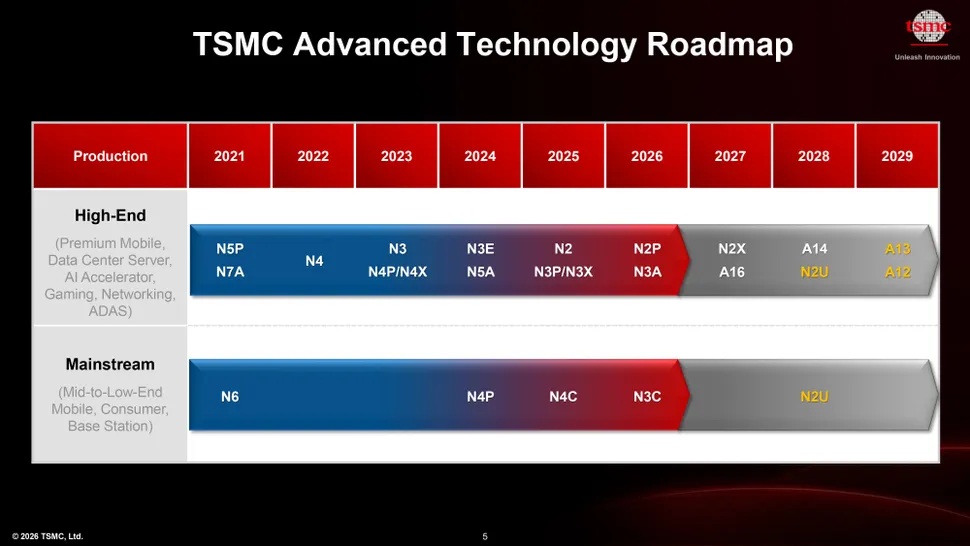
TSMC has unveiled its newest technology roadmap, which extends until 2029. On it, TSMC has unveiled three new lithography nodes, none of which require High-NA EUV machines.
TSMC believes that standard Low-NA EUV machines will be used for all of their lithography nodes until 2029. This is in contrast to Intel, which will be using ASML’s High-NA EUV technology on its Intel 14A node. TSMC isn’t utilising ASML’s most advanced EUV machines because they don’t believe they need them, at least not yet. This should reduce TSMC’s costs, as more advanced EUV machines significantly raise costs.
A13 and A12
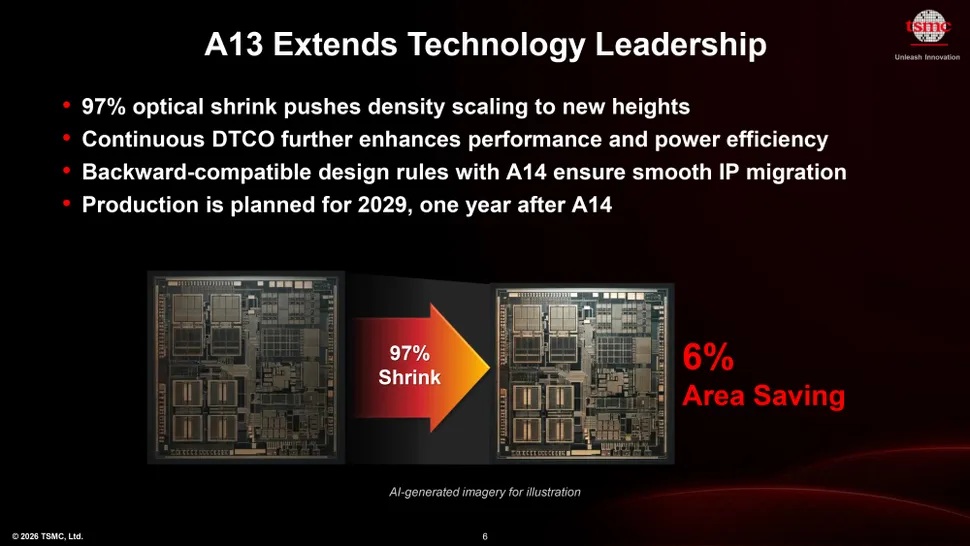
In 2029, TSMC plans to launch its A13 and A12 nodes. A13 is an incremental enhancement of A14, delivering a 6% area reduction while retaining full design rule and electrical compatibility with A14. This node arrives one year after A14, aiming to deliver improved power efficiency.
A12 is a further enhancement of A14 that adds “super power rail” technology. This provides backside power delivery to enhance performance, power, and transistor density.
N2U – 2nm’s final form?
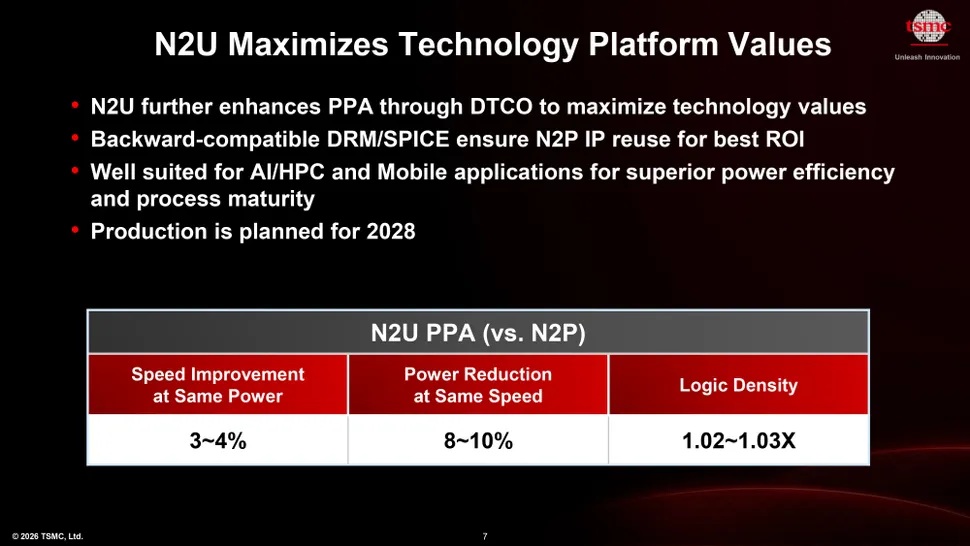
TSMC has also unveiled N2U, a node that will arrive in 2028. This node is a further improvement on TSMC’s 2nm technology, delivering additional performance, power, and density gains. It is backwards compatible with N2P to enable IP reuse, allowing customers to create new products without a full node transition. For example, a N2P product can be moved to N2U and be rereleased as a new/enhanced version.
With N2U, TSMC promises a 3-4% performance increase at the same power, or an 8-10% efficiency improvement at the same speed. Logic density can also be increased by 1.02-1.03x.
TSMC believes that its engineers have what it takes to continue battling the forces of physics to create better and better transistors for future electronics hardware. While TSMC could leverage ASML’s High-NA EUV machines to push things further, the company believes today’s Low-NA EUV machines can be pushed even further.
TSMC’s approach differs from Intel’s. Intel plans to move to High-NA EUV with its 14A (14 Angstrom) node, while TSMC plans to push to its A14 (also 14 Angstrom) using older Low-NA EUV machines. TSMC’s approach will be cheaper, but more challenging. If TSMC can’t deliver its new nodes on time, it risks Intel catching up or surpassing them. Using High-NA EUV machines is undoubtedly an advantage for Intel. That said, TSMC has a stronger starting point and trusts that its engineers can deliver on its roadmap. TSMC will undoubtedly transition to High-NA EUV machines in time, but they don’t feel they need to yet.
You can join the discussion on TSMC’s roadmap on the OC3D Forums.