Cooler Master V8 ACE 3DHP CPU Cooler Review

Conclusion and Video
A fascinating CPU cooler, and a strong performer at high RPMs
Reviewing this CPU cooler has been an adventure. If one thing has been made clear to us, it’s that Cooler Master put a lot of effort into the V8 ACE 3DHP. Cooler Master wanted to make a statement. They wanted to build a single-tower CPU cooler that could compete with the best dual-tower CPU cooler. Using their 3D Heatpipe technology, Cooler Master wanted to create the best-performing CPU cooler of its size, and they have succeeded. That said, there are caveats.
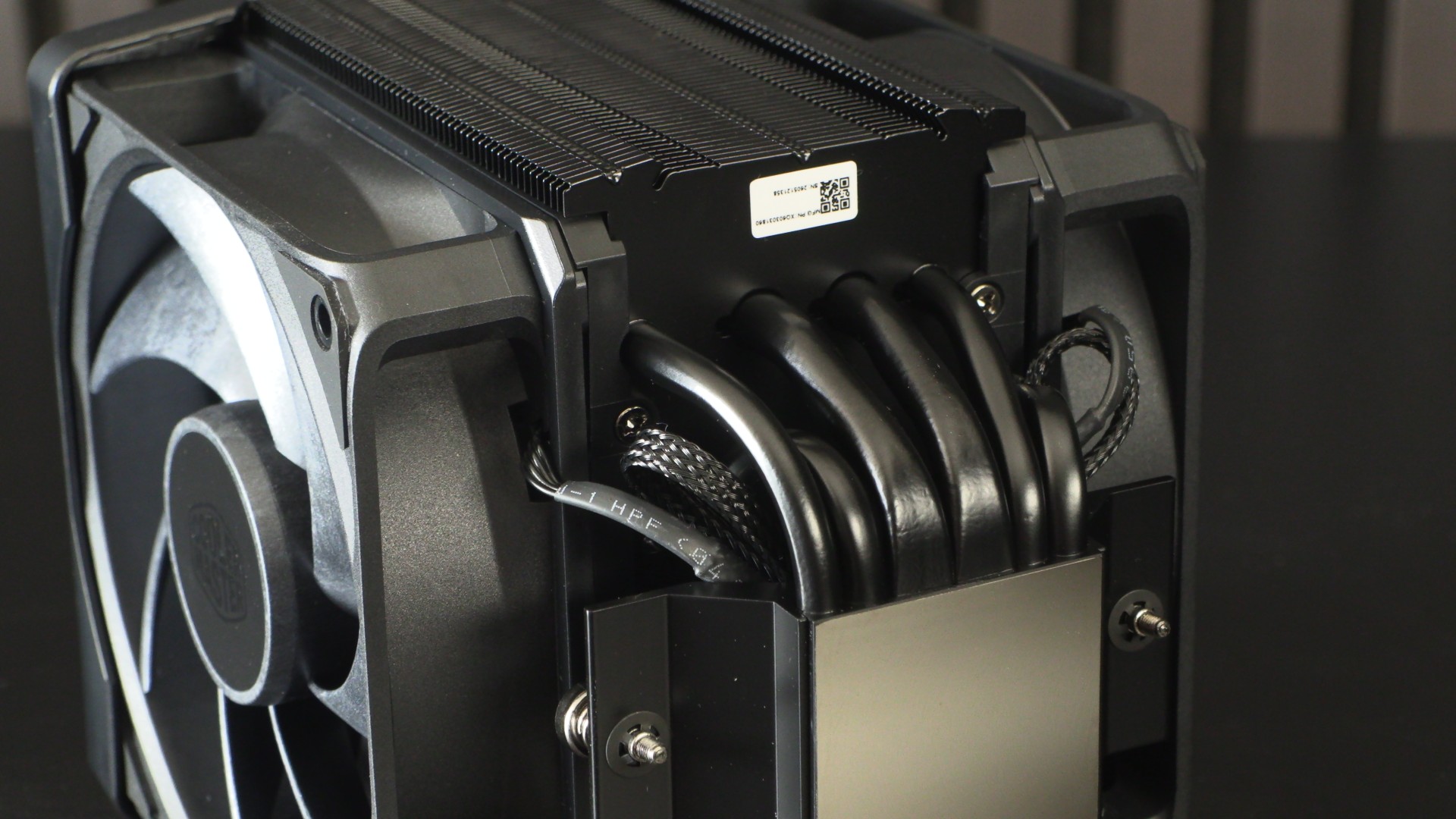
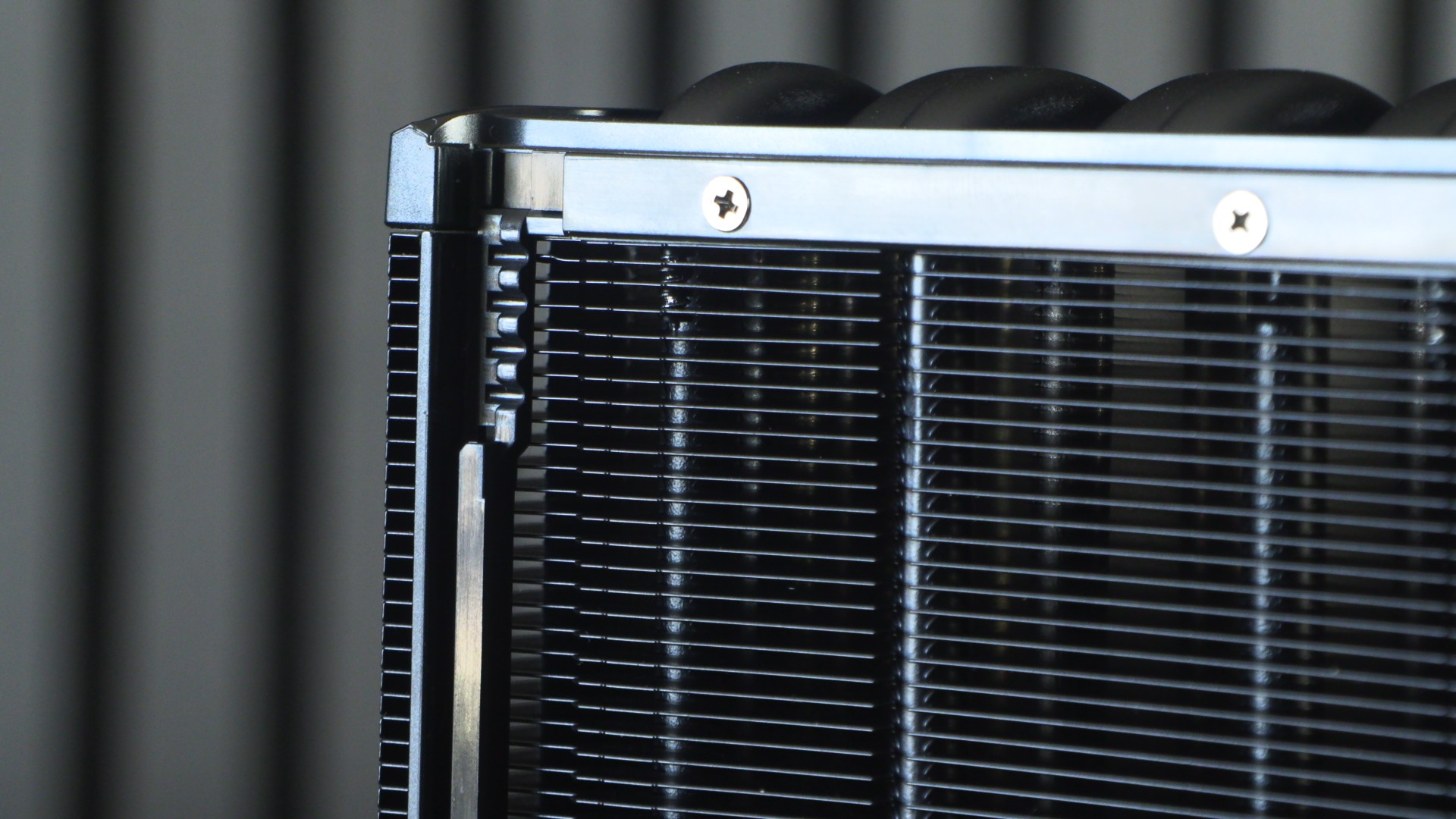
Cooler Master has finely tuned this CPU cooler. To maximise the potential of this single-tower cooler, Cooler Master combined its 3DHP technology with an incredibly dense fin stack. This delivers improved heat spreading and more heat-exchange surface area for the heatsink. However, a dense fin stack of this thickness presents its own challenges. Pushing air through a denser fin stack is harder. Pushing air through a thicker fin stack is also harder. Do both, and you need a lot of air pushing power.
Thankfully, Cooler Master has shipped this CPU cooler with two fans. This gives the cooler a push/pull airflow configuration. The cooler also uses premium 30mm-thick Liquid Crystal Polymer (LCP) fans. Its front and rear fans also use different designs to maximise performance. Cooler Master has tuned this cooler to an insane degree. Everything works together to deliver strong results, assuming you run your fans at high speeds.
(This CPU cooler has a fin stack that is both thick and dense)
Make sure you buy the right version
The Cooler Master V8 ACE 3DHP is available in two flavours: AMD and Intel. The AMD version has a flat base plate, while the Intel version has a slightly convex base. The Intel version of this cooler is convex to counter the natural bending that modern Intel CPUs have when mounted. This applies to LGA-1700 and LGA-1851 CPUs. This slight bend enabled optimal contact with the surface of modern Intel CPUs, delivering improved thermals. The Intel/AMD versions also have optimised heat pipes for their specific platforms. Cooler Master put a lot of effort into optimising these CPU coolers.
We tested both the AMD and Intel versions of this CPU cooler on our Intel-based testing platform. Yes, the AMD version does not ship with Intel mounts, but we had both versions, so we just used Intel mounts on the AMD cooler. Simply put, using the right cooler delivers notably improved thermals. Buyers should make sure they purchase the correct CPU cooler.
Low RPM and High RPM performance
We do more testing than most reviewers. We test CPU coolers under various workloads and test coolers with their fans running at various speeds. In our minds, if we just ran our fans at their maximum speeds, brands could game our tests by releasing coolers with ultra-fast (and ultra-loud) fans. We typically test CPU coolers with their fans at 1,000 RPM, 1,500 RPM, and their maximum RPM. This gives us more comparison points, and allows us to tell you which coolers perform best with low-speed fans. Another way of saying this is that we have a low-noise torture test.
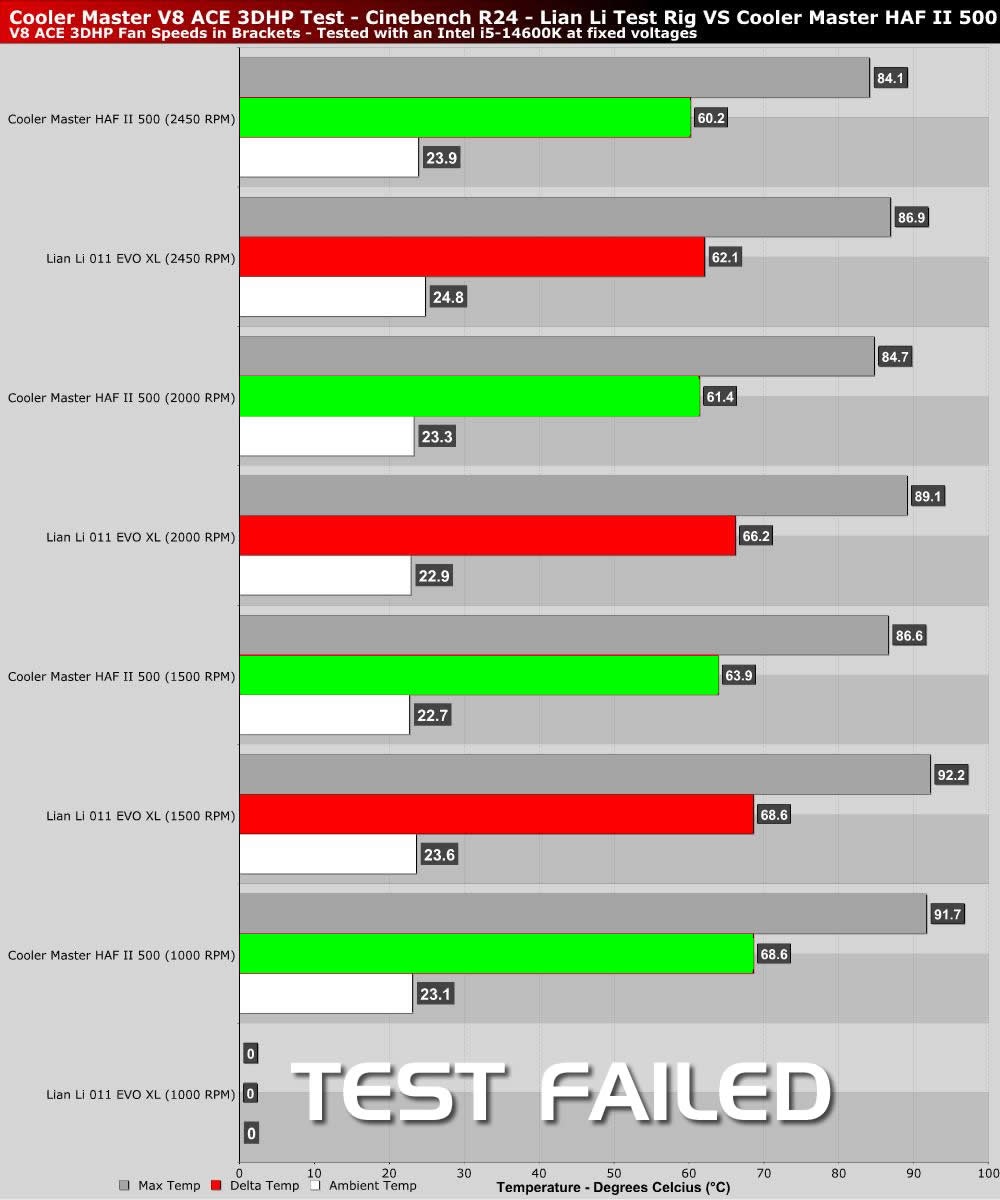
Some companies hate the fact that we test CPU coolers with 1,000 RPM fans. For most coolers, using 1,000 RPM fans would make them incredibly quiet. It also sacrifices thermal performance for the sake of low noise levels. So why are we talking about this? The Cooler Master V8 Ace 3DHP didn’t perform well in our 1,000 RPM fan test. Our hypothesis is that these speeds are not enough to deliver strong airflow through this CPU cooler’s thick/dense fin stack. This delivers sub-optimal performance. This means that this cooler only performs at its best when its fans are set to higher speeds. Case airflow patterns can also have a huge impact here.
This V8 ACE 3DHP is a strong performer, but it needs to be used correctly
When we maxed out this CPU cooler’s fan speeds, it was the best-performing air-based CPU cooler that we have tested on our current test platform. However, at lower fan RPMs, this cooler’s performance dropped off. With its fans running at 1,000 RPM, this cooler failed our Cinebench R24 test. This made us think. Why would this CPU cooler perform so well in one test and so badly in another? The answer is simple: airflow directionality matters when using a thick, dense heatsink.
Our test platform uses a Lian Li O11 EVO XL PC case. This case’s primary air intakes are on the side of the case. That means that the airflow of these fans is not pointed directly at our Cooler Master V8 ACE 3DHP. For a quick test, we removed the top fan from our test rig. This meant that our only exhaust was directly behind the V8 ACE 3DHP. The result? Removing this fan reduced our average CPU thermals by around 0.5 degrees on all tests. That’s not much, but straightening our airflow pattern delivered improved thermals. So what if we used a more optimal PC case?
This CPU cooler is perfect for the HAF II 500
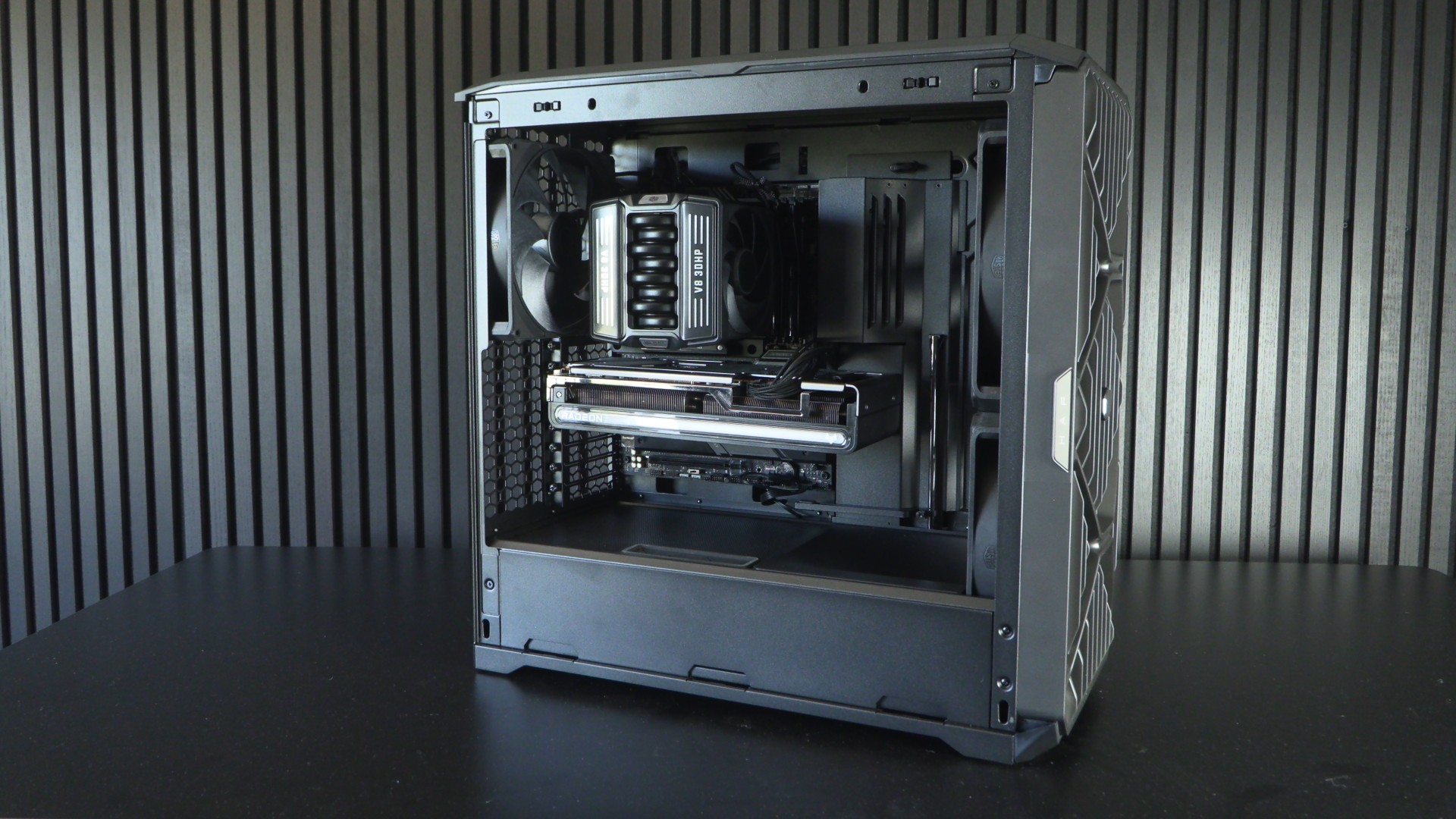
Our hypothesis is simple: the Cooler Master V8 ACE 3DHP uses a dense and thick fin stack and likes a straight front-to-back PC case airflow pattern. This should make it easier for air to flow through the cooler’s fin stack, and deliver better thermal results. We’ve just reviewed Cooler Master’s HAF II 500 PC case, and its clear front-to-back airflow pattern is perfect for testing this theory. So, what were the results?
With the HAF II 500, the V8 ACE 3DHP delivered greatly improved CPU thermals. The cooler passed our 1,000 RPM test and delivered much better thermals in all tests. If used with the right PC case, the V8 ACE 3DHP is an excellent CPU cooler. That said, you will need to make sure that your case has a good front-to-back airflow pattern. The good news for Cooler Master is that they have the case for the job, the HAF II 500.
Honestly, I am impressed with what Cooler Master has done here. Cooler Master wanted to build a single-tower CPU cooler that could compete with larger dual-tower coolers. In this regard, Cooler Master has succeeded. That said, this raises a question: what if Cooler Master made a larger dual-tower CPU cooler? Is a V10 ACE 3DHP coming? I’m not sure, but it’s an obvious next step for Cooler Master.
Cooler Master’s V8 3DHP CPU cooler is an excellent option, but I’d only advise using it in a PC case with a clear front-to-back airflow pattern. That’s where this cooler performs at its best. If Cooler Master is going to optimise this cooler to the Nth degree, you should too. When used well, this CPU cooler will deliver excellent results. For that reason, the Cooler Master V8 ACE 3DHP is getting an OC3D Performance Award.
You can join the discussion on Cooler Master’s V8 ACE 3DHP CPU cooler on the OC3D Forums.