Corsair iCUE LINK TITAN 360 RX RGB CPU Cooler Review

Cinebench R24 Thermals
OC3D CPU Cooler Stress Test
We want to push CPU coolers to their limit, and that requires a workload that will place maximum load on our i5-14600K CPU. Why didn’t we choose an i7 or an i9? The simple answer is that we want to test a variety of CPU Cooler options. If we put the hottest CPU we could in our system, only the best of the best CPU coolers would even past our testing procedures. Since not everyone uses such a power-hungry CPU, we decided to tone the wattage and thermal loads down by using an i5-14600K. Even so, this CPU consumes a lot of power and generates a lot of heat under all-core workloads.
For testing, we have used Cinebench R24. This is an all-core workload that places heavy strain on all available CPU cores. This load pushes CPU thermals higher than any other, and do so consistently. We use Cinebench R24 for 30 minutes to see how hot our CPU gets over that time. If CPU temperatures rise to 100 degrees Celsius or over, that CPU cooler has failed our testing. This is part of the reason why there are more coolers on our higher fan RPM cooler charts. Some coolers will pass our thermal testing at higher RPMs, but fail at lower fan RPMs.
Corsair iCUE TITAN 360 RX RGB 1000 RPM Performance
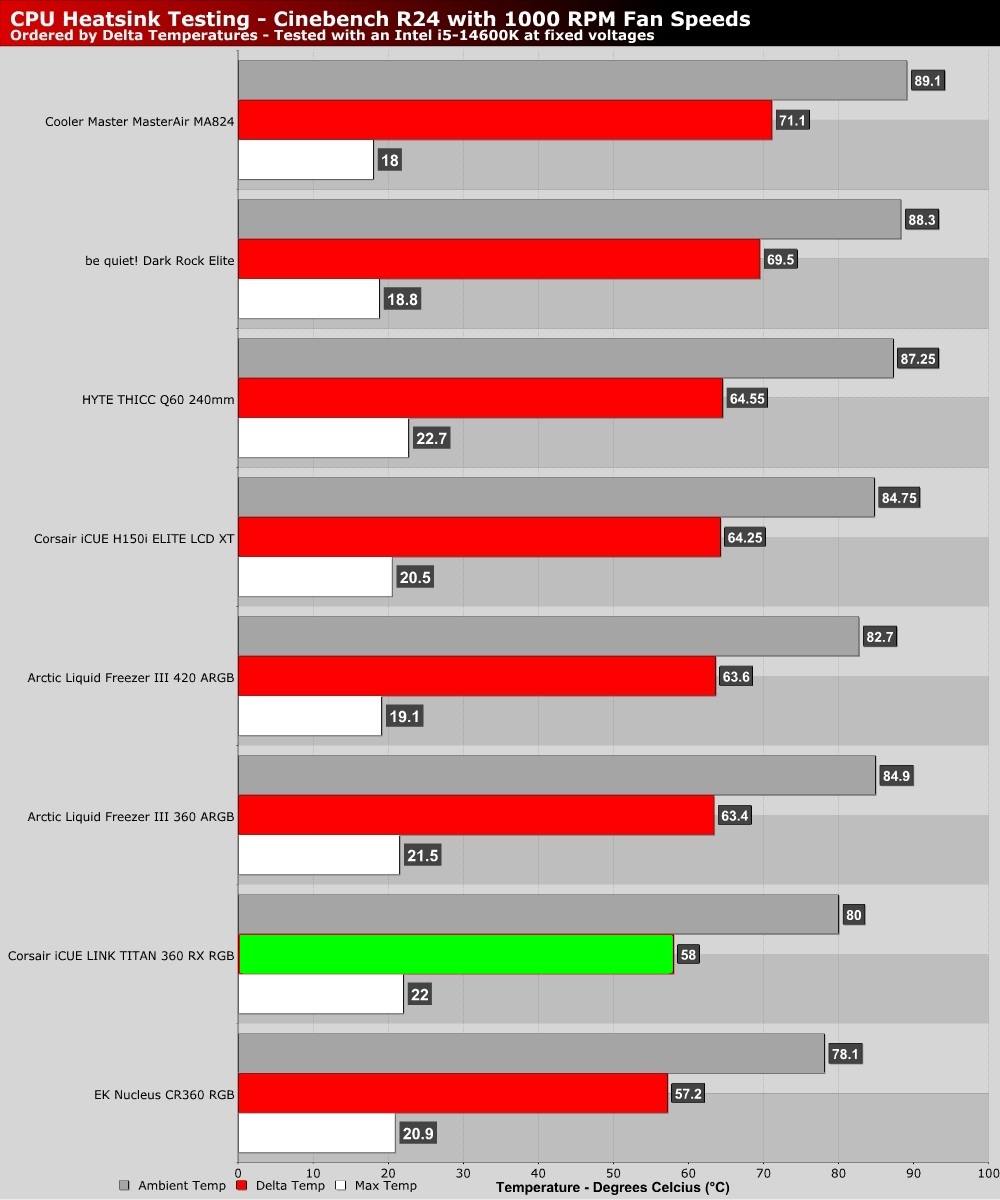
With its fans set to 1000 RPM, Corsair’s new iCUE TITAN is now the second best performing AIO that we have tested in our new cooling test system. It stands within 1 degree of the best performing cooler, and runs over 5 degrees cooler than Corsair’s old H150i ELITE LCD XT. Corsair’s new pump technology clearly has its benefits.
Corsair iCUE TITAN 360 RX RGB 1500 RPM Performance
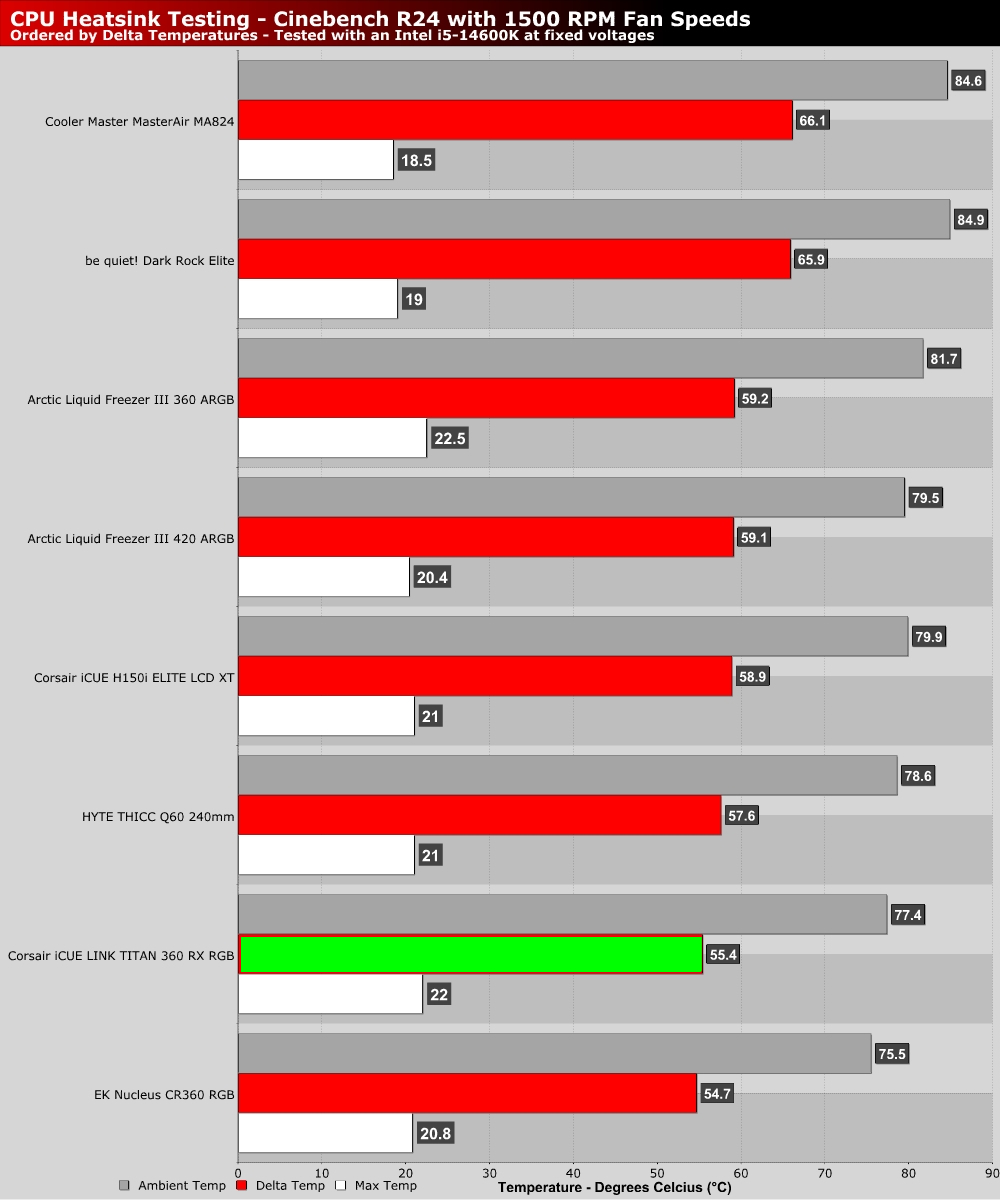
At 1500 RPM, Corsair’s new cooler once again stands amongst the best. Again, it runs with much cooler thermals than Corsair’s last-generation cooler, again highlighting the benefits of Corsair’s “FlowDrive” cooling tech.
Corsair iCUE TITAN 360 RX RGB Max RPM Performance
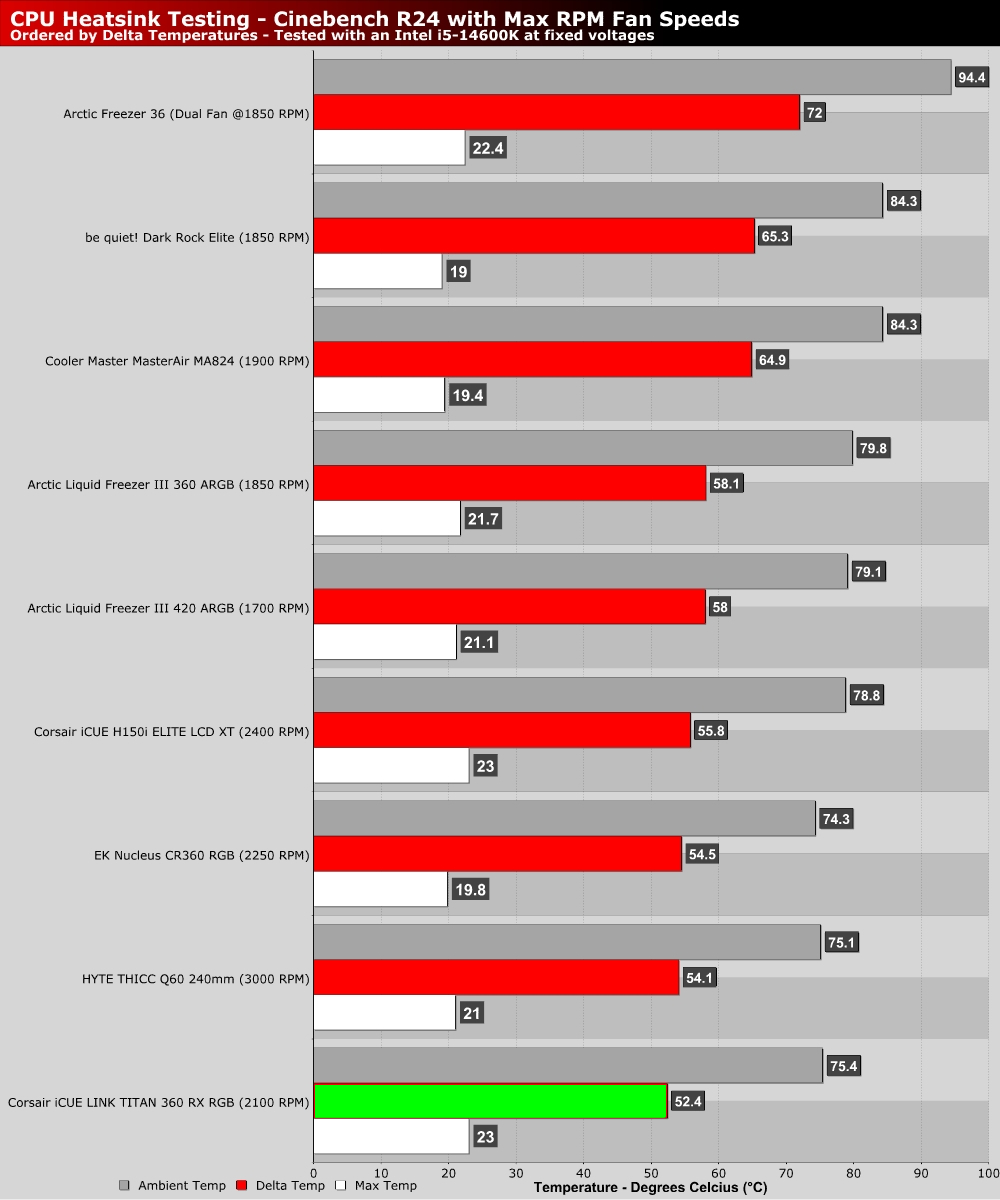
Pushing this cooler to 2100 RPM, its maximum fan speeds, the new iCUE TITAN from Corsair pushes forward to sit at the top of our performance charts. This is despite the fact that the two coolers below it use higher speed fans. Again, this is a strong showing from Corsair, and a clear sign that Asetek’s technology was holding Corsair back. This makes us excited to see what future generations of Corsair’s AIO technology will look like, and what other companies will come up with.