

Water Cooling Kit Group-Test

Up Close: Phobya UC LT 240
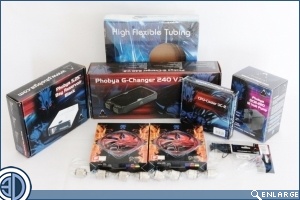
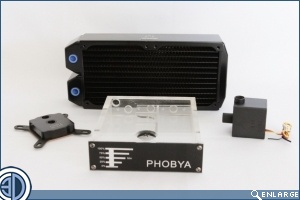
You might be wondering why there isn’t a picture of the box that the Phobya kit comes in. The answer is simple, unlike all the other kits the LT240 doesn’t come in its own custom box, instead it is simply supplied as a collection of parts. This isn’t a problem in itself as the box will surely be discarded anyway, but it might go some way to explain why there are no instructions whatsoever included with the phobia kit. And we mean none, not a sausage, nil, diddly squat. Well you get the idea. This might seem like no big deal if you’ve already slung a loop or two together, but if you haven’t you might be slightly put off by this. Granted some of the manufacturers have gone the extra mile and included extensive installation instructions, but that doesn’t mean that this is a given with kits as manufacturers also bring components together like this as a way of assuring value and compatibility without the need for the consumer to shop around for all the bits and pieces involved in bringing a custom loop together.
Technical Specification
| CPU Waterblock | Phobya UC2 LT |
| Price | £147.05 |
| Intel Compatability | Socket 2011 Socket 1136 Socket 1156 Socket 1155 Socket 775 |
| AMD Compatability | n/a |
| Reservoir | Phobya Single 5.25″ Drive Bay Reservoir |
| Pump | Phobya DC12-220 |
| Pump Flow Rate | 400 L/ph |
| Radiator | Phobya G-Ghanger 240 V2 Full Copper (275x125x60.5mm) |
| Radiator Fans | 2 x Phobya NB-eLoop 120mm |
| Fan Speed | 1600 rpm |
| Fan Noise | 22.5 dBA |
| Fan Connection | 3 Pin |
| Fittings | 8 x Phobya 1/4″ Thread 3/8″ ID – 5/8″ OD Silver Compression Fittings |
| Tubing | 2 Meters Masterkleer Clear 3/8″ ID – 5/8″ OD Tubing |
| Fluid | NOT INCLUDED |
| Package Contents | 1 x CPU Waterblock 1 x Drive Bay Reservoir 1 x Pump 1 x 240mm Radiator 2 x 120mm Fan 2 x 120mm Fan Grill 8 x Compression Fittings 3.3 Meters of Clear Tubing 1 x HeGrease Thermal paste PSU Bridging Plug All Mounting Hardware |
Core Components
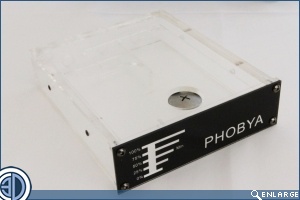
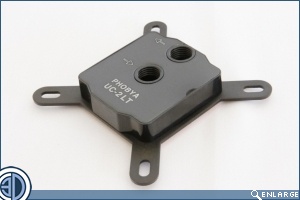
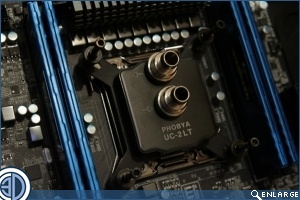
The Phobya kit utilises a single bay reservoir that is similar to the Alphacool unit, with the exception that this one fits easily into the intended bay. The black gauged front of the res sporting the Phobya name is removable should you want to whip out those rattle cans. There are also ports for 5mm LEDs in the res although no LEDs are supplied. The UC-2LT cold plate comes pre assembled for Intel sockets, with no provision in the kit for adaptation for AMD CPUs. The cold plate itself is a hefty affair, however you do get the feeling that the plastic top cover is there to conceal the name of the OEM underneath
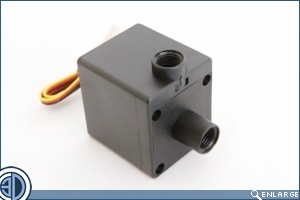
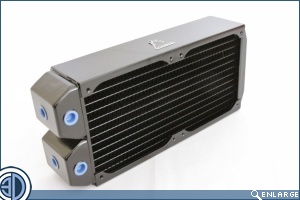
Those of you familiar with water cooling will no doubt recognise the fairly ubiquitous water pump used in the Phobya kit. Nothing wrong with this, tried and tested is always a good thing. Unlike the other kits however the pump cannot be integrated into the reservoir in any way so prepare yourself for a fair bit of head scratching as you endeavour to work out where to mount it. It’s in the Radiator department that the Phobya kit really excels. With the G-Changer 240 V2 a smidge over 60mm thick we’re pretty sure it’s going to produce the goods when it comes to the torture tests. It’s not just in size where the G-Changer has the edge over some of the others on test here, with the EK and XSPC rads only having side tank ports, the G-Changer has an additional set of ports on the end of each end tank making for 4 in total, just shy of the Alphacool’s fully flexible 6 ports.
Assembly and Testing
The fitting method for the Phobya Cold plate is identical to the AlphaCool unit, with even the blocks having more than a passing resemblance to each other. Phobya have supplied 8 3/8″ ID x 5/8″ OD 1/4″ thread chrome compression fittings along with a very generous 3.3 metres (10 foot) of MasterKleer clear tubing to help you bring it all together. The fans included in the kit are the rather unusual NB-eLoop 120s, with red blade edges extending all the way around the interior of the cowling they look to better focus the airflow into the rad. The bright red areas in the corners of the cowlings are actually rubber pads which protrude slightly offering a degree of vibration damping.
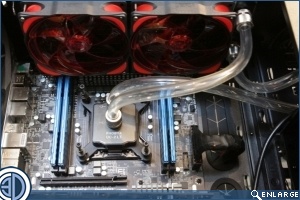
Once assembled the kit ran well although the noise from the pump was the highest observed in these tests. The fans however were very quiet at 12 volts and almost silent when stepped down to the lower speed under the 7 volt supply. It seems the blade design and the rubber mounts must be doing some good at least. We again chose not to mount the res in the highest bay which although might be most aesthetically pleasing does make for a tiresome filling process. On the subject of filling, the Phobya rad is he only one on test to have a bleed port built in, just a shame we couldn’t access it as it as the clearance at the rear of the case didn’t permit.
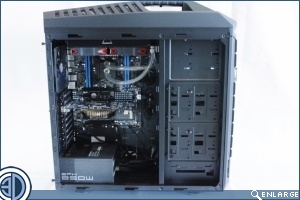
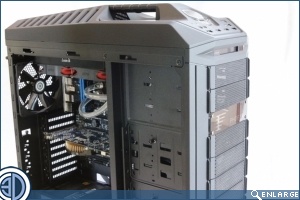
The high gloss acrylic front panel of the single bay reservoir looks rather elegant, with even the large Phobya name and gauge not managing to ruin the looks. Unlike the Alphacool unit the Phobya res slipped easily into the bay, being secured by screws from each side or your cases tool-less mechanism.