


Hellblade: Senua’s Sacrifice PC Performance Review

Conclusion
Hellblade: Senua’s Sacrifice is easily one of the most interesting game releases of 2017, offering a plot/theme that looks heavily into mental illness, which is something that is rarely considered in video games.
With this release, Ninja Theory took a bold step by creating and releasing this game without the help of a publisher, bringing their studio into a mid-tier level of game development that aims for AAA quality and focus while remaining independent and with total creative freedom over their final product.
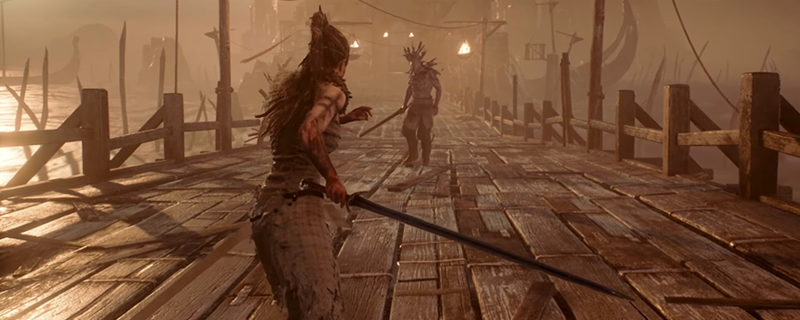
As a game, Hellblade: Senua’s Sacrifice can look a little unimpressive at first glance, with the gameplay focusing on puzzle solving and what looks like a simplistic combat system, though I can assure you that both become much more complex as the game progresses and merge together perfectly with the game’s narrative to create a feeling that can only be described as uncomfortable.
While “uncomfortable” may not sound like a good word when describing a game, in Hellblade it fits perfectly, inserting the player into the titular character’s mind, allowing us to experience her mental anguish as her internal voices offer support, fear and ridicule in equal measure. It is this glance into Senua’s mind that makes the game compelling, merging with every other element of the game to create a very compelling experience.
From an audio perspective Hellblade: Senua’s Sacrifice is expertly crafted, so much so that playing the game without a good set of headphones is almost criminal. Voices speaking to the player at all angles, providing an almost ASMR like effect that allows players to experience Senua’s psychosis. Are these voices giving us useful advice? Are they lying to us? In many ways, the voices also give player important indications like when enemies are behind the player or are preparing for an attack, both of which are highly useful when engaged in combat.
Sadly when it comes to the PC version of the game the game moves from being an interesting narrative and gameplay experience to something that can be downright frustrating, with the game delivering a basic graphical options menu and performance levels that are far from what we would call AAA.
It is always a negative point for a game when players need to delve into .ini files to adjust graphical options or fix bugs, with the game lacking graphical options that most PC gamers would define as basic. From the get-go, this makes the PC version of Senua’s Sacrifice feel unpolished, which is a shame for a game that is otherwise extremely interesting.
Moving onto the game’s controls we can also see that the game lacks basic options for mouse sensitivity and mouse acceleration, showing a distinct lack of consideration for this titles PC release. The controls for the game are all rebindable, though the lack of in-game prompts does make the game difficult to pick up and play initially.
When looking at our performance data, we can see that Hellblade performs best on Nvidia hardware, with out GTX 1060 GPU easily outperforming our RX 480 at all graphical settings. This is expected from a relatively low-budget Unreal Engine 4 game, especially one without AMD game specific drivers, but overall the game’s performance is passable.
On the CPU side, we found that Senua’s sacrifice performs well and show no signs of CPU limitations when running on a modern quad-core CPU, though we did find out dual-core, quad-thread tests to suffer from a hefty performance degradation when compared to a configuration with four fully fledged CPU cores. We would recommend that PC player has a modern quad-core or higher CPU to play this game at maximum settings, with neither AMD Ryzen or Intel’s core architectures showing any real advantage over one another.
In terms of quality, Hellblade: Senua’s Sacrifice cannot be called an Unreal Engine 4 PC masterpiece, but it is a great game if you find the game’s premise and narrative focus to be of interest. Graphically the game can also be extremely impressive, though even at maximum settings pop-in can be an issue.
What we came away with on PC is a feeling that our PC hardware should be performing better, especially when considering other Unreal Engine 4 games that have similar framerate/resolution targets on consoles. Even so, most PC gamers with reasonably powerful hardware should be able to run the game with an average framerate of over 60FPS, though the barebones option menu will make the graphical optimisation process a little more taxing than it should be.
In all Hellblade: Senua’s Sacrifice is a game that has a very interesting premise, a compelling narrative and has expert use of in-game audio. Sadly, the game has released on PC with an implementation that feels rushed. To say the least, we feel that the game deserved a little more polish before release. In terms of port quality the game isn’t awful, we have seen much worse, though it certainly isn’t what we would consider AAA.
You can join the discussion on Hellblade: Senua’s Sacrifice’s PC performance on the OC3D Forums.
