


Updates Tested – PC Performance Gains for Resident Evil Requiem

After multiple driver updates and a game patch, does Resident Evil Requiem now run faster on Nvidia GPUs?
The past week has been a challenging one for Nvidia. Their GeForce 595.59 “Game Ready” driver for Resident Evil Requiem was quickly “unreleased” due to major bugs. To add insult to injury, many gamers reported that Requiem ran faster on Nvidia’s older drivers.
On the OC3D Forums, Dicehunter, a regular of the forums, saw his framerate increase by 16.4% by downgrading from Nvidia’s GeForce 591.86 driver to version 576.88. Since then, Nvidia has released two graphics drivers (1, 2) that focus on Resident Evil Requiem. Furthermore, Capcom has released an update for the game (read more here) that includes optimisations for RTX 40/50 series GPUs.
Given these updates, we thought it would be appropriate to retest Resident Evil Requiem on our Nvidia GeForce RTX 5080 Founders Edition. We will use the same hardware as our original PC Tech Review for Resident Evil Requiem. Has the game’s performance improved? Let’s find out!

Our PC isn’t every PC
What I will note here is that we have not experienced all of the issues that some PC gamers have been reporting. We have now tested Resident Evil Requiem using Nvidia’s GeForce 576.88, 591.86, 595.71, and (as of now) 595.76 drivers. For us, the performance difference between these driver versions is marginal. We did not see the huge performance gains or losses that others have reported.
Sadly, we do not know the cause of these performance issues. However, based on our findings and those of others, it appears not all systems suffer these performance setbacks. However, we did find notable performance gains when we used Nvidia’s GeForce 595.76 Hotfix driver with Resident Evil Requiem’s March 5th update.
Our findings – Resident Evil Requiem now runs notably faster
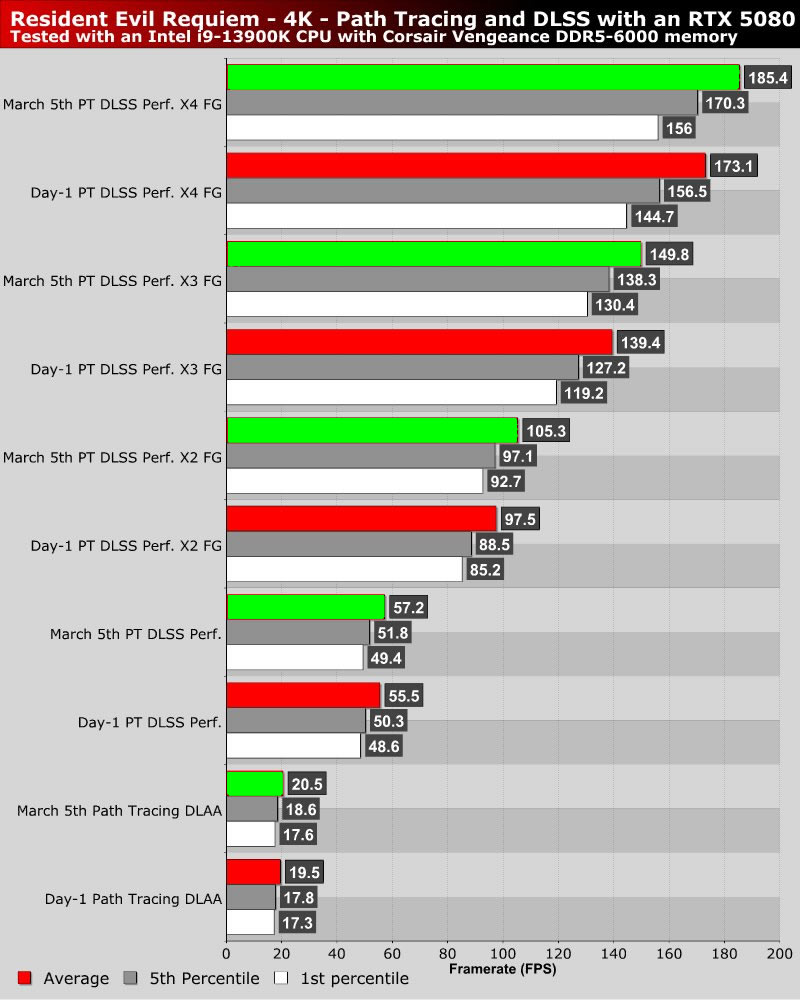
When testing Resident Evil Requiem without ray tracing and with Ray Tracing set to high, the game performed similarly to before. We noted no major changes in game performance. However, this changed when we utilised path tracing. While performance gains were small at native 4K, they became much more significant once we enabled DLSS upscaling and frame generation.
With path tracing enabled at 4K with DLSS Upscaling in Performance Mode and Frame Generation set to 2x, we saw our average framerate increase by 8%. With Frame Generation set to 3x and 4x, our average framerate increased by 7.4% and 7.1%, respectively. Clearly, Nvidia’s driver updates and Capcom’s game updates have done something to impact Resident Evil Requiem’s performance when path tracing and DLSS are utilised.
Conclusion
Since Resident Evil Requiem’s RTX 40/50 series performance issues didn’t impact everyone, not everyone will see the “up to 16%” performance gains that the game’s first update and Nvidia’s new drivers can deliver. Regardless, these updates should deliver performance uplifts to all users of Nvidia’s latest GPUs. As such, we recommend that all Resident Evil Requiem players update their game and download their GPU’s newest drivers.
Even if you haven’t been suffering from any performance issues, these updates should enable some performance gains. This is especially true if you use DLSS Frame Generation. We saw performance gains of 7-8% with DLSS Frame Generation enabled with path tracing. If your PC was harder hit by this game’s reported performance bugs, you may see even higher performance gains. Regardless, you should update your game/drivers.
You can join the discussion on Resident Evil Requiem’s latest PC updates on the OC3D Forums.