


CXMT could match Micron’s memory manufacturing capacity this year, research claims

China’s CXMT could soon rival Micron in DRAM wafer production
ChangXin Memory Technologies (CXMT), China’s top DRAM producer, is rapidly expanding. A new report claims that CXMT will come exceptionally close to Micron’s DRAM wafer production capacity by the end of this year. In the coming years, China could become the world’s second-largest producer of DRAM globally, fundamentally altering the global DRAM market.
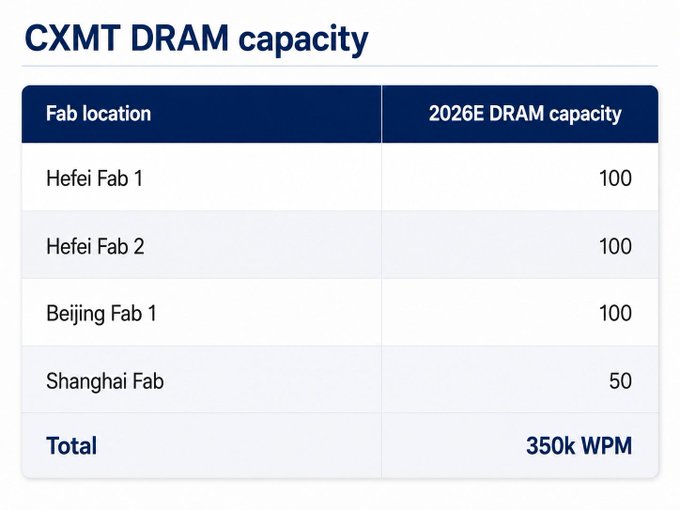
It has been estimated that CXMT will end 2026 with 350,000 wafer starts per month (WSPM). That’s a mere 25,000 fewer wafers than Micron. China has reportedly forced CXMT to share its DRAM technology with other Chinese semiconductor companies, including JHIC, Swaysure, and XMC (a YMTC subsidiary).
Wafer starts vs Gigabytes produced
One thing that’s worth noting is that not all wafers are equal. A wafer of DRAM from one company will not offer the same total DRAM capacity as a wafer from another. Silicon density and silicon yields play a role here. So while CXMT may get close to Micron’s DRAM wafer productivity this year, their silicon may have lower yields and contain less-dense DRAM chips.
Sadly, measuring wafer production is much easier than measuring the exact capacity of DRAM produced. Regardless, CXMT’s growing productivity will result in increased DRAM production, alleviating global shortages.
(Source)
China’s DRAM production capacity could explode by 2030
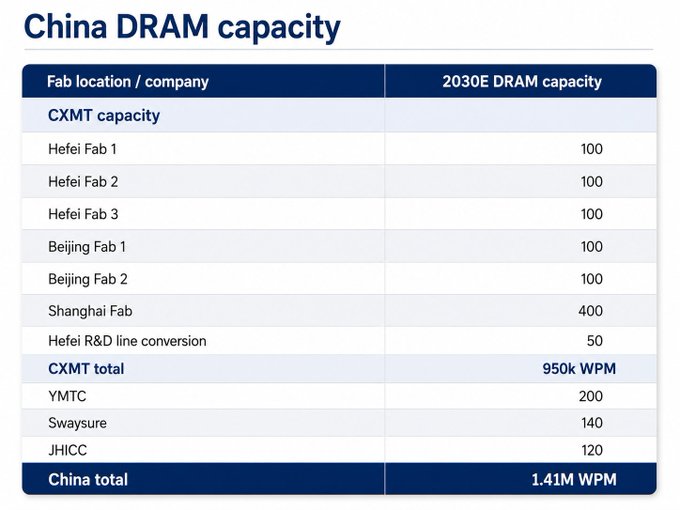
By the end of 2026, CXMT is expected to achieve 350,00o wafer starts per month. By 2030, CXMT alone is expected to produce 950,000 wafer starts per month. This is thanks to the creation of several new fabs and the expansion/conversion of others. Hefei Fab 3 and Beijing Fab 2 should start production. CXMT’s Shanghai Fab should produce 400,000 wafers per month. A Hefei R&D line is also expected to be converted into a full production line, adding more DRAM capacity.
Between CXMT, YMTC, Swaysure, and JHICC, China is reportedly set to produce 1.41 million wafer starts per month in 2030. This should make China the world’s second-largest producer of DRAM.
(Source)
Will China solve the world’s DRAM shortage?
Increased DRAM production will alleviate the world’s DRAM shortage. While CXMT DRAM cannot be sold in the US due to a government sales ban, its memory will satisfy demand elsewhere. This will increase DRAM availability, which will help consumers globally, even inside the US.
While CXMT isn’t expected to get as much usable DRAM per wafer as Micron, SK Hynix, and Samsung, its boosted wafer production will bring more DRAM to the market regardless. Beyond that, CXMT’s tech should continue to improve, which could make its wafer productivity more competitive with the larger DRAM companies.
Does China have the tools it needs to expand its DRAM production this quickly?
The one thing that could hamper China’s DRAM expansion efforts is the availability of high-end semiconductor manufacturing technology. If China cannot acquire or manufacture enoughproduction-ready DUV equipment, the country’s DRAM production ramp could stall. This would be good for the “big three” memory producers (Micron, SK Hynix, and Samsung), but bad news for consumers. After all, more competition is good.
You can join the discussion on CXMT’s increasing DRAM manufacturing capacity on the OC3D Forums.