


Sony’s PS6 “Canis” Handheld to cost over $600 – leaker claims

The memory crisis has made it impossible for Sony to sell its portable PS6 for $600
According to the leaker KeplerL2, it will be impossible for Sony to launch its planned PlayStation 6 handheld for $600. The leaker claimed that the price was “definitely not possible right now”, citing high LPDDR memory prices. Like other memory types, LPDDR has seen massive price increases over the past year. Why? The simple answer is AI and datacenter buildouts. As we have said many times here, gamers don’t hate AI enough.
LPDDR5X memory has seen some of the largest price increases, as it is now used a lot in datacenter products. Nvidia’s latest AI servers all use LPDDR5X memory, the same memory that Sony’s PlayStation 6 handheld will reportedly use. LPDDR5X (Low-Power Double Data Rate 5X) memory was originally intended for low-power mobile devices; now it’s being leveraged by high-end AI servers in datacenters at scale. As a result, this memory type has seen some of the largest price increases.
Leaked PlayStation 6 handheld Specifications suggest that the handheld device will use LPDDR5X-8533 memory across a 192-bit memory bus. This bus width makes 18GB, 24GB, and 36GB memory configurations possible. Given today’s memory prices, Sony may be forced to lower its planned memory capacity to lower the price of its planned handheld. If this happens, it could greatly diminish the generational leap the PS6 console generation delivers over the PS5.
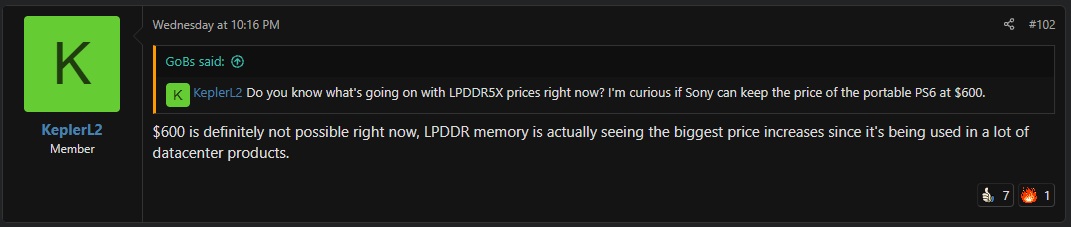
(KeplerL2 on PS6 Handheld pricing)
High prices for next-generation consoles are thanks to AI
If you want to blame anything for the PS6 Handheld’s $600+ pricing, blame AI. Speculative datacenter buildouts have gobbled up the world’s memory supply and have greatly raised the prices of consumer electronics. While other components have also seen price increases, DRAM/memory are the hardest hit. That’s the reason why PlayStation 5 and Xbox Series X/S consoles are more expensive today than they were at launch. It is also why the next generation of consoles will likely arrive at prices consumers will consider insane.
While AI technology can be useful, the speculative datacenter buildout for “big AI” is destroying consumer technology. It has created a tech industry where AMD and Nvidia talk less about the technology behind their products and cater their events and showcases to the dumb money that chases growth at all costs. As someone who wants to know what makes new products better than their predecessors, this change is incredibly depressing. What’s more depressing is that today’s market is turning gaming into a hobby for the wealthy, as the AI memory crisis has made it much less affordable.
Will Project Amethyst save Sony?
For the past few years, AMD and Sony have been working together on Project Amethyst, a hardware/software partnership that aims to make Sony’s next-generation consoles much more powerful. In short, AMD and Sony are pooling their resources to create better hardware and software for next-generation PCs and consoles. One early fruit of this effort is PSSR 2, Sony’s second-generation AI upscaler, which uses the same models as AMD’s FSR 4.1 upscaler.
AMD and Sony have also announced “Universal Compression” technology. This next-generation AMD gaming technology aims to compress all available data within the GPU and dramatically reduce memory bandwidth usage. This tech could also decrease memory requirements, making a lower-memory PS6 console more viable. That said, having less memory would greatly lessen the capabilities of Sony’s next-generation console. After all, having less memory will limit the potential of future games. Regardless, “Universal Compression” should make a lower-memory console more viable, which could reduce Sony’s memory costs for new consoles.
You can join the discussion on the pricing of Sony’s PlayStation 6 handheld on the OC3D Forums.