


Intel Razor Lake-AX to challenge Apple Silicon


Intel preps a huge socket for future CPUs with HUGE graphics chips
Intel is reportedly working on a new CPU that aims to challenge AMD’s “Strix Halo” and Apple Silicon. With its huge 4326 socket, Razor Lake AX aims to bring together strong CPU and GPU hardware to deliver a strong single-package computing solution for the masses.
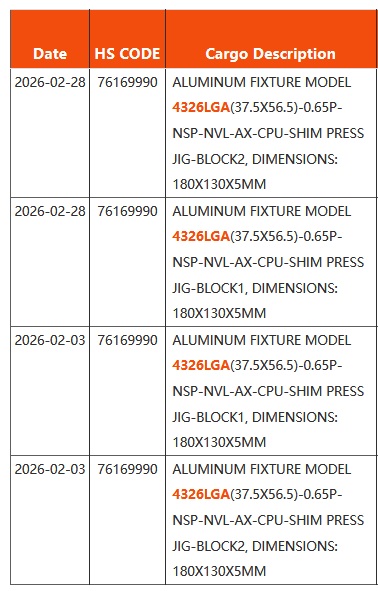
Recently, shipping manifests with “4326LGA” have been spotted, which reportedly support a platform called “NVL-AX”. This stands for “Nova Lake -AX”, a platform that reportedly pairs a 28-core Nova Lake CPU with a powerful Intel ARC iGPU. However, it is currently unknown if Intel plans to release this product. That said, there are reports that Intel plans to deliver a next-generation platform called “Razor Lake-AX”, which pairs the same concept with newer CPU and GPU hardware.
(Intel “4326LGA” socket – via X86 is dead&back)
Razor Lake is Intel’s successor to the Nova Lake processors. Nova Lake is set to launch later this year, replacing Panther Lake and Arrow Lake. With Razor Lake, we can expect new CPU core architectures, which means faster P-cores and E-cores.
Based on the shipping manifest above, Intel’s 4326 socket measures 37.5mm x 56.5mm. This makes Intel’s new CPU socket large. Today’s LGA-1851 socket measures in at 37.5mm x 45mm. Intel’s alleged 4326 socket is over 25% larger. That gives Intel a lot of space to deliver more advanced hardware.
BGA4326 for Razor Lake -AX
— Jaykihn (@jaykihn0) April 5, 2026
Intel needs Razor Lake-AX
If Intel wants to surpass AMD and Apple, it needs a strong unified processor that combines powerful integrated graphics with raw CPU performance. AMD has delivered this with its Strix Halo CPUs. Apple has achieved this with its higher-end M-series Apple Silicon processors. Note that Nvidia also plans to enter this space with its N1 series chips.
If Intel doesn’t deliver something like Razor Lake-AX, the company is doomed to always need to pair its processors with 3rd-party GPUs. When CPU and graphics chips are not delivered in the same package, offering useful features like Unified memory is challenging. Furthermore, cooling and powering separate CPUs and GPUs is a complex task. Note that Intel has a deal with Nvidia to “build and offer to the market x86 system-on-chips (SOCs) that integrate NVIDIA RTX GPU chiplets.” This solves some problems for Intel, but forces Intel to rely on Nvidia.
You can join the discussion on Intel’s rumoured “Razor Lake AX” processors on the OC3D Forums.