


AMD comments on FSR 4 (INT8) support plans

FSR 4 support remains limited to RDNA 4 graphics cards, at least for now
When AMD launched FSR 4 last year, it was game-changing for Radeon. AMD released a version of FSR that finally delivered image quality on par with Nvidia’s DLSS. However, FSR 4 had a major downside: it was limited to RDNA 4 graphics cards. That said, a leaked INT8 build of FSR 4 confirmed that this didn’t need to be the case.
On RDNA 4 graphics cards, AMD’s FSR 4 upscaler uses hardware-accelerated FP8 math to perform its AI upscaling. This hardware acceleration is not available on older Radeon GPU architectures. That said, AMD’s leaked INT8 version of FSR 4 could work on older GPUs, with gamers successfully testing it on RDNA 3 and RDNA 2 GPUs. That said, this INT8 version of FSR 4 is clearly experimental and less refined than FSR 4’s RDNA 4/FP8 version.
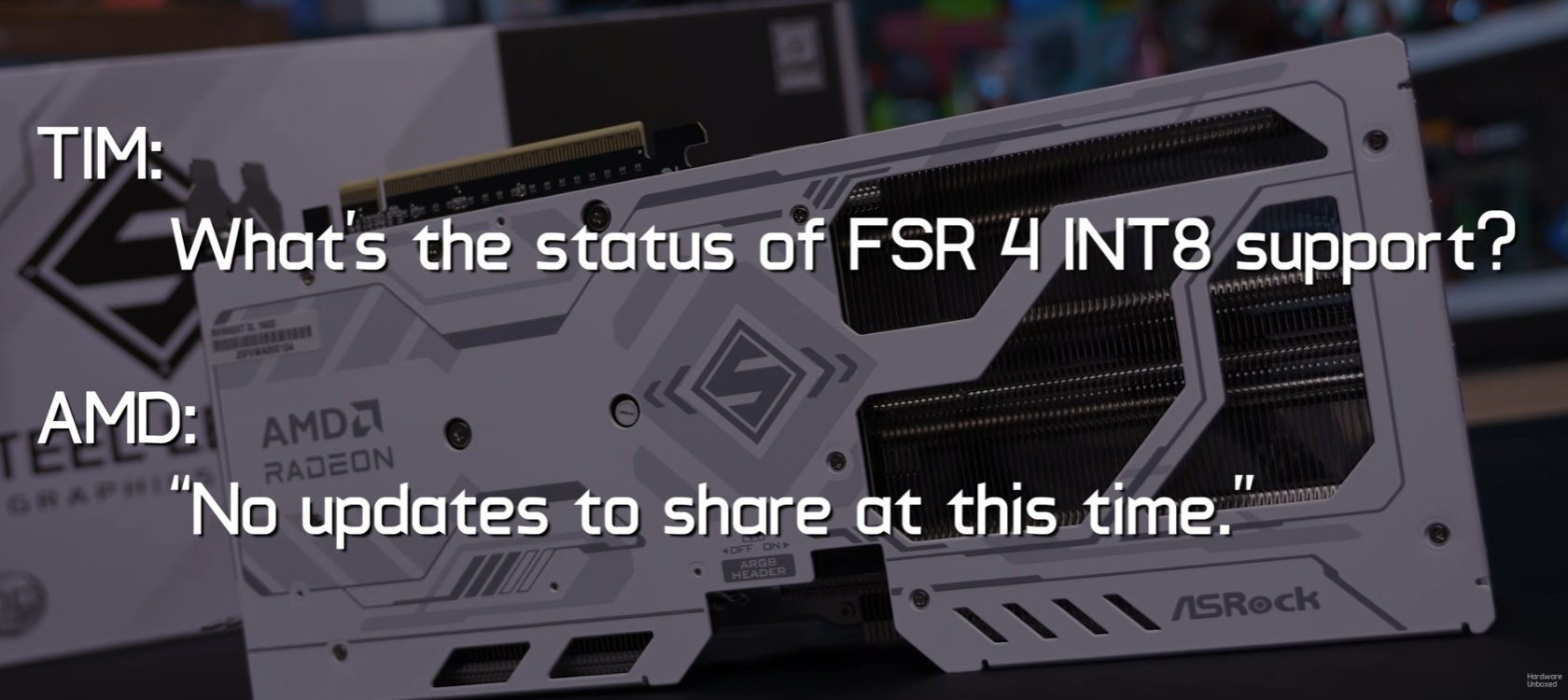
Hardware Unboxed has asked AMD about the status of FSR 4 INT8 support. AMD has responded, stating that it has “no updates to share at this time”. Whether or not AMD brings FSR 4 to its older GPUs remains to be seen. That said, I think that AMD would be foolish not bring FSR 4 to RDNA 3 and RDNA 3.5 graphics cards. New hardware has been released this year with RDNA 3.5 graphics solutions. Simply put, AMD needs to support FSR 4 on these products. If not, they are leaving themselves wide open to long-term criticism.
AMD needs to take an Nvidia-style approach to FSR Upscaling
When Nvidia launched DLSS 4 and DLSS 4.5, which introduced their more demanding 1st and 2nd generation DLSS Transformer models, Nvidia allowed users of its older RTX graphics cards to utilise these new versions of DLSS using its DLSS Override feature. Yes, these new versions of DLSS run slower than their older models on older RTX graphics cards. That said, they still gave gamers the option to use it. It may be sub-optimal, but it still works. Even users of the Nvidia RTX 20 series can use DLSS 4.5 upscaling. Nvidia has let gamers choose between their older (faster) DLSS models and their newer, higher quality (but slower) models.
INT8 FSR 4 may be slower than FSR 3.1 on RDNA 3/3.5 GPUs, but the image quality gains are worth it. If nothing else, bringing FSR 4 to older RDNA GPUs would earn AMD significant consumer goodwill. It will also give AMD’s RDNA 3.5 laptops and gaming handhelds a significant image quality boost. Overall, it’s a good move for AMD. So why hasn’t AMD done it?
You can join the discussion on AMD’s lack of commitment to FSR 4 on older Radeon GPUs.