Gamer pushes GDDR7 to 39 Gbps with RTX 5070 Ti overclock

mVolt+ Extreme enables new levels of GDDR7 memory overclocking
Using the mVolt+ Extreme overclocking tool, RTX 50 series GPU users can bypass the standard overclocking limits of GDDR7 memory. This has allowed some gamers to push GDDR7 memory speeds to new heights, with one RTX 5070 Ti owner pushing his memory speeds to 39 Gbps with a +5500 MHz memory offset/overclock.
At stock, Nvidia’s RTX 5070 Ti runs its GDDR7 memory at 28 Gbps. That makes its 39 Gbps speed a 39% overclock. This increases the GPU’s memory bandwidth from its stock 896 GB/s to 1248 GB/s. This example used Samsung GDDR7 memory modules. GDDR7 overclockability varies with memory manufacturer, and some modules are more overclockable than others.
The overclocker that achieved 39 Gbps speeds reported “about +1 fps for every +1000 memory oc step” in Cyberpunk 2077. With their +5500 memory offset, this presumably gave them a 5-6 FPS boost in-game. These are rather small gains, though this should be expected. After all, the RTX 5070 Ti isn’t a bandwidth-starved graphics card.
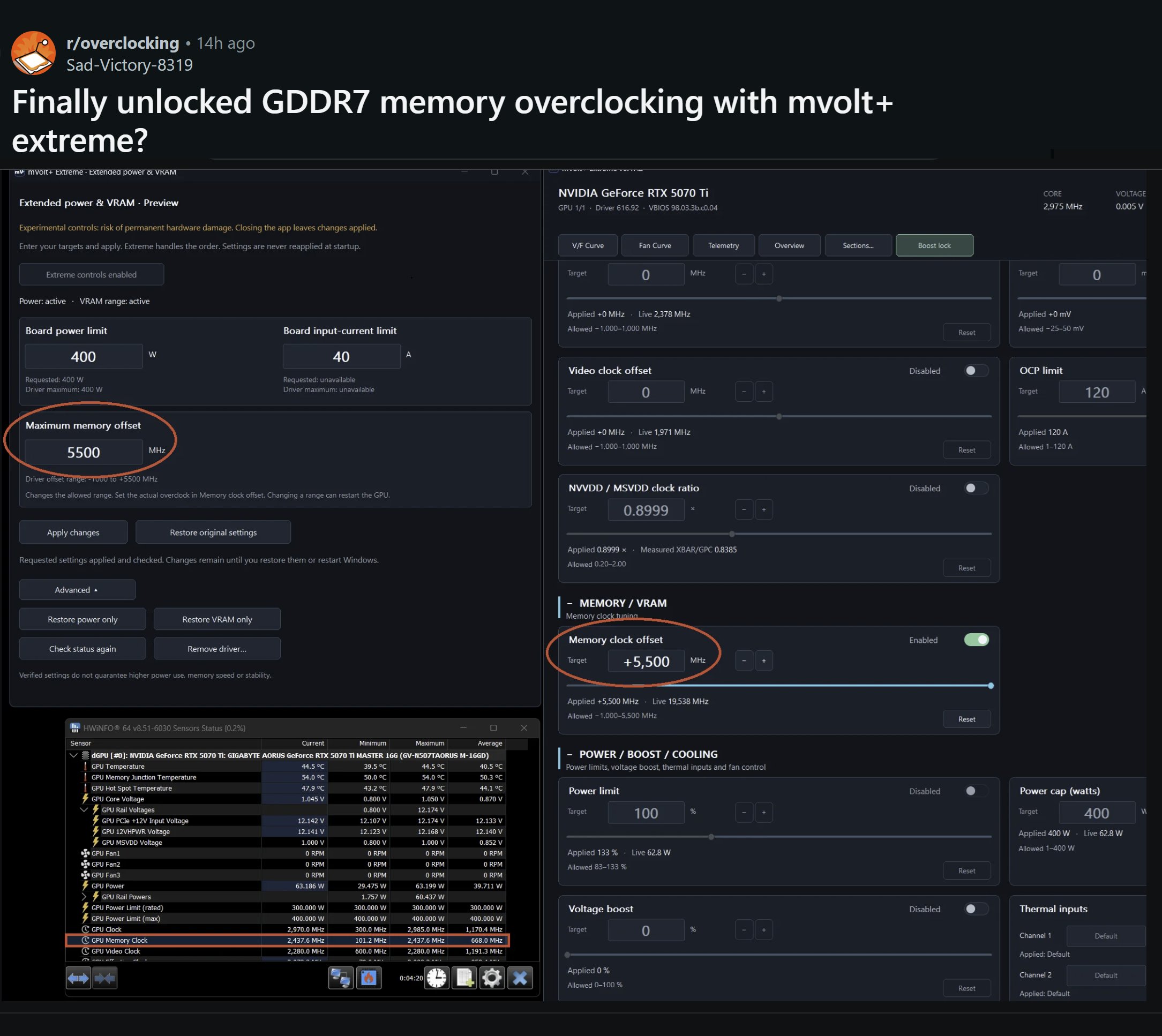
(Nvidia RTX 5070 Ti with 5500 MHz memory offset – Reddit)
Extreme memory overclocking isn’t recommended
For the most part, memory overclocking doesn’t deliver results that are as strong as GPU core overclocking. Memory overclocking increases available memory bandwidth, and most GPUs are designed to have ample memory bandwidth to feed their computational capabilities. Only poorly designed GPUs are bandwidth-starved (caugh, RX 9050 4GB, caugh). For this reason, the benefits of memory overclocking are often limited. Gamers will often get much more mileage from GPU core overclocks. Furthermore, memory overclocking can more easily lead to hardware instability.
While a 39% memory overclock is impressive, that much extra bandwidth doesn’t achieve much. If your GPU already has ample memory bandwidth, having more won’t help much. Still, these overclocks clearly show GDDR7’s potential. Next-generation GPUs will likely ship with much faster GDDR7 modules.
Join the discussion on GDDR7’s high overclocking potential on the OC3D Forums.