


SK Hynix and SanDisk team up to standardise HBF (High Bandwidth Flash) memory

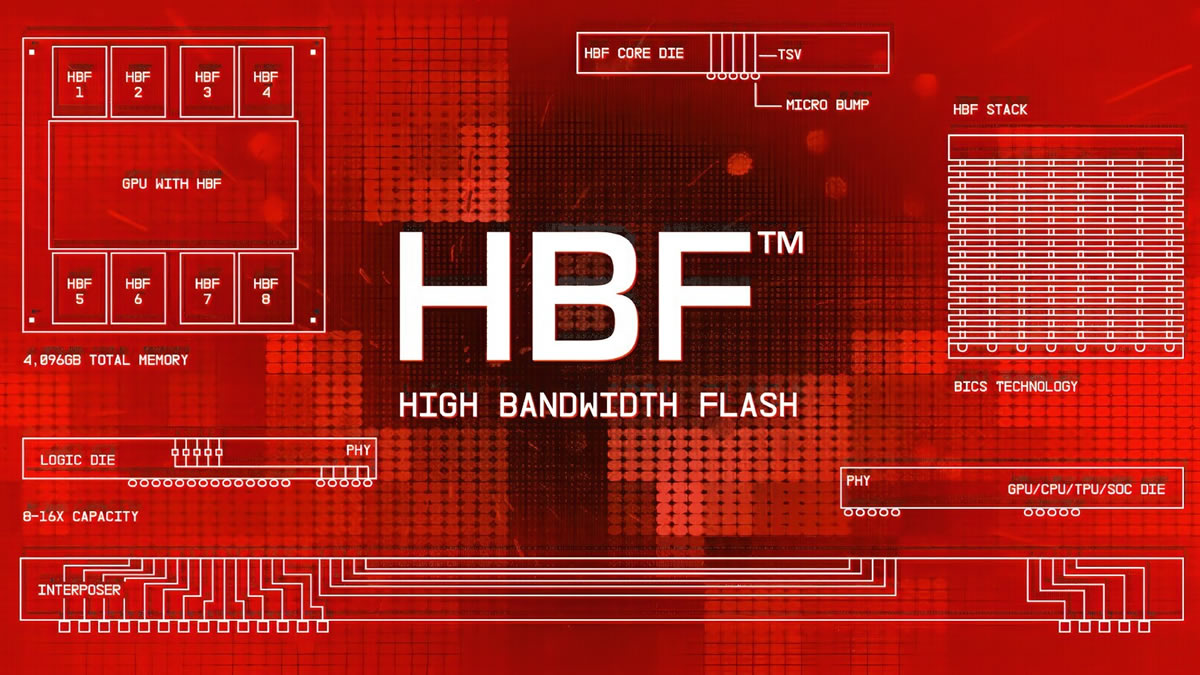
High Bandwidth Flash aims to deliver HBM-like speeds with much higher capacities
SK Hynix and SanDisk held a “HBF Spec. Standardization Consortium Kick-Off” event to found a “dedicated workstream under OCP (Open Compute Project)” and standardise their new memory type.
HBF memory, High Bandwidth Flash, aims to transform the world of AI inference by bridging the gap between HBM memory and SSD storage. This new NAND-based memory type aims to match HBM bandwidth while delivering 8-16x more capacity at a similar cost. This will allow next-generation AI solutions to utilise much larger datasets without a bandwidth disadvantage.
SK hynix Inc. and Sandisk Corporation held ‘HBF Spec. Standardization Consortium Kick-Off’ event at Sandisk Headquarters in Milpitas, California on the 25th(local time) announcing global standardization strategy of next-generation memory solution HBF(High Bandwidth Flash) aimed at the AI inference era.
– SK Hynix
SK Hynix and SanDisk foresee a future in which AI solutions use HBM memory for high-bandwidth performance and HBF memory for higher storage capacity. Alternatively, memory capacity can be maximised with an all-HBF accelerator.
While HBF targets HBM-speeds, new versions of HBM memory are expected to run faster than today’s HBM memory. HBF targets HBM4 speed levels, with SanDisk targeting 1.6 TB/s read speeds and 512GB memory stack capacities.
HBF technology is a new memory layer between ultra-fast memory, HBM and high-capacity storage device, SSD. HBF technology can fill the gap between HBM’s high performance and SSD’s high capacity and ensure both capacity expansion and power efficiency required for AI inferencing. While HBM handles the high level bandwidth, HBF technology serves as a supporting layer in the architecture.
In particular, HBF technology is expected to reduce the total cost of ownership (TCO) while increasing the scalability of AI systems. The industry forecasts that the demand of complex memory solutions, including HBF, will pick up around 2030.
In the AI inference market, the role of a total memory solution company that can provide both HBM and HBF is becoming more important as system level optimization of CPU, GPU, and memory determines the overall competitiveness rather than the performance of a single chip.
In line with this, SK hynix and Sandisk are proactively pursuing HBF solution’s standardization and commercialization based on their design, packaging and mass production experience in HBM and NAND.
– SK Hynix
With their High Bandwidth Flash memory, SK Hynix and SanDisk aim to enable high levels of capacity expansion for AI accelerators without sacrificing raw bandwidth. If successful, this new memory type will enable the creation of more performant AI accelerators. It will also allow AI companies to create larger and more complex AI models.
Memory performance is vital for AI workloads, so allowing more data to be held on each AI accelerator could have a transformative impact on performance. Less reliance on external memory is good. If accelerators spend less time waiting on external memory, they can spend more time working/computing.
You can join the discussion on SK Hynix and Sandisk’s HBF standardisation efforts on the OC3D Forums.