


Microsoft almost doubles its HDD performance with Seagate’s MACH.2 Dual-Actuator HDDs

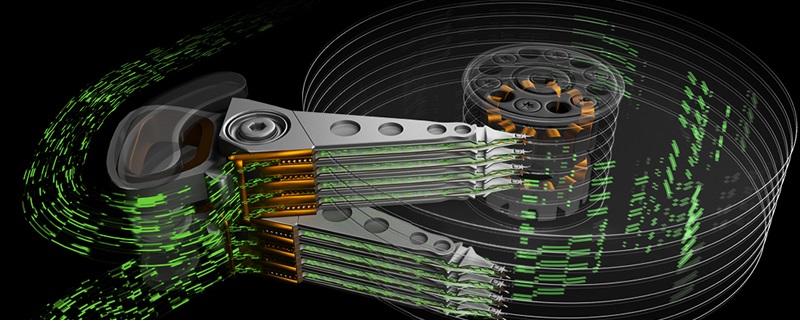
Microsoft almost doubles its HDD performance with Seagate’s MACH.2 Dual-Actuator drives
Seagate has been working with Microsoft to address this issue, having created HDDs which can deliver higher I/O (IOPS) performance by using multiple actuators, delivering a performance increase of between 75% and 95% on Azure servers.
Think of it this way; imagine a server with twelve 8TB HDDs and a second server with six 16TB HDDs. Imagine that the d individual drives in each system offer similar levels of performance, both in terms of read/write throughput and IOPS. Which system is faster if you need to read all of the server’s data? One system has twelve drives reading data, while the other has only six, making the system with smaller HDDs faster, at least in some.
While the example above is perhaps overly simplistic, the problem of “stranded capacity” remains a concern. Larger hard drives need to deliver increase IOPS performance to remain relevant, as storage capacity is meaningless if users cannot access their data quickly. With technologies like HAMR promising huge increases in HDD capacity over the coming years, it is easy to see why IOPS performance is a key research area for Seagate.
With Seagate’s Exox 2X14 drives with MACH.2 dual-actuator technology, Microsoft has confirmed the validity of Seagate’s development units by stress-testing their drives using the company’s simulation tools. Microsoft partner Aaron Ogus has stated that Seagate has been able to achieve a “close to two times” throughput improvement over the company’s currently deployed single actuator HDDs, delivering on the design goals of its MACH.2 technology.
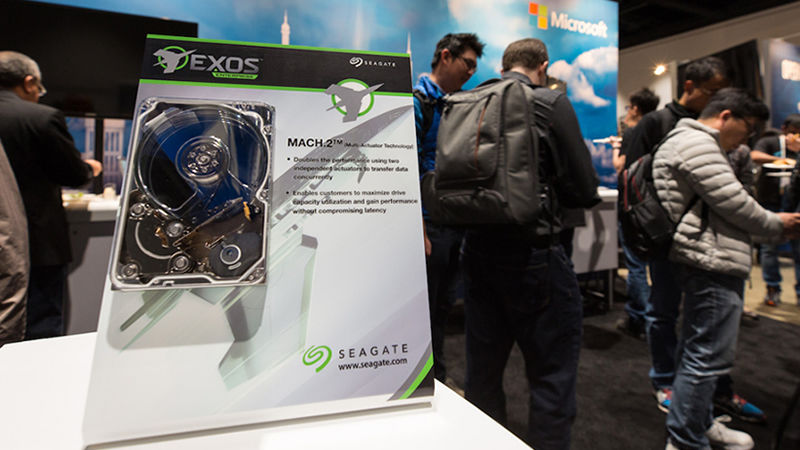
When IOPS-per-terabyte matters, Seagate’s multi-actuator technology enables users of MACH.2 drives to utilise larger drives while maintaining their user’s required performance targets, allowing HDDs to suit the needs of more datacenter customers.
Before now, some server customers were looking to SSDs to solve the IOPS-per-terabyte problem, but with MACH.2, Seagate can satisfy the needs of its customers using more cost-effective HDDs. MACH.2 provides a high IOPS-per-terabyte ratio while also delivering a low cost-per-terabyte.
In a cloud data center, floorspace is key, and MACH.2 can offer users more IOPS performance from a single HDD slot than standard HDDs. In the future, Seagate’s MACH.2 drives will be deployed across Microsoft’s cloud services.
How MACH.2 benefits Microsoft’s Exchange server architecture
In every cloud data center, floor space is at a premium — and for many applications cloud providers are trying to get more IOPS out of the same slot.
MACH.2 drives will be deployed in support all of Microsoft’s CSP services including Azure and Exchange — the breadth of applications sharing floor space means it’s at a premium. Microsoft wants to minimize slot costs, which is a function of floor space, power, and cooling among other things. When a customer finds IOPS trending down on the types of drives installed, they have to look at other avenues such as adding dual-actuator hard drives.
Microsoft’s Exchange architecture is constantly tuned to maximize server throughput. Seagate’s MACH.2 technology will allow Exchange to continue deploying larger and larger HDDs while maintaining SLAs for latency. Seagate’s new platform is allowing Microsoft to deploy higher capacity drives like the 14TB Seagate 2X14, as Seagate’s MACH.2 technology lets them get the throughput they need to support Exchange at that capacity.

You can join the discussion on Seagate’s high-performance MACH.2 HDDs in Microsoft’s Azure infrastructure on the OC3D Forums.