


Lian Li O11D EVO Review

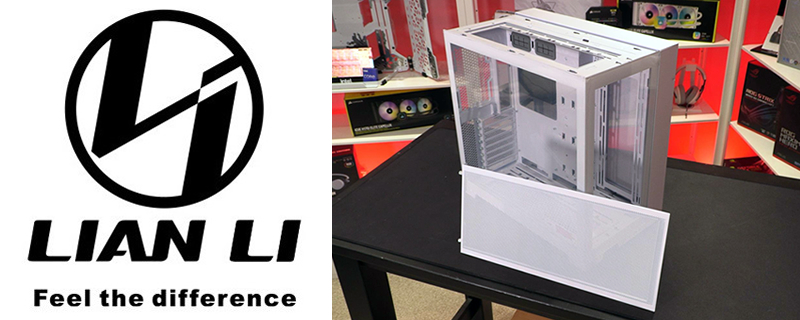
Meet the Lian Li O11D EVO
Lian Li’s O11D is an unassuming case. Its external aesthetic is simple, elegant, and clean. This is not an in-your-face gamer design with too much RGB lighting and hard pointy edges. The O11D EVO is a blank canvas that should allow you to get what you want out of the chassis.
Out of the box, the O11D EVO features no fans, has a single side-panel window and a front panel window and has its front I/O located at the bottom of the case. The case’s front power button is located at the front/right of the case, curving around the corner of the case to make it easily accessible from two sides of the enclosure.

One of the perks of the Lian li O11D is the case’s ease of disassembly. Loosen a few thumb screws and many of this case’s side panels will cone off with ease. This make the Lian Li O11D EVO extremely easy to build in, and very easy to clean and polish when maintenance time comes.

Inside the O11D EVO’s left chamber is space for an EATX motherboard (up to 280mm wide) and space for a huge number of fans, liquid cooling radiators and other components. Power supplies, HDDs, SATA SSDs, and cable clutter can all be safely contained in the O11D EVO’s secondary chamber, keeping this side clean and pristine. This is the side of the case that onlookers will be seeing, and it is easy to make this area of the EVO look clean and tidy.

With the O11D EVO, the top and bottom radiator plates of this chassis are the same. both are removable, and both can support a 360mm radiator or a 280mm radiator. The 120mm fan mounting locations are offset, which will make radiators and fans less likely to interfere with other system components.
The beauty of this design is that it allows fans and radiators to be mounted outside of the O11D EVO, making the PC building process a lot easier.

Too many white cases use black rubber grommets, offering a huge contrast with white power-coated case interiors. While this contrast works for some case, it wouldn’t for the O11D EVO’s white edition. We are glad to see Lian Li investing in grey grommets here, though we would have liked to have seen these grommets also appear at the bottom of the case. That said, this is a small nitpick, as these grommets wouldn’t be seen if O11D EVO users use bottom mounted liquid cooling radiators or an EATX motherboard.

Looking at the motherboard tray below, we can see why Lian Li only recommends ETAX motherboards that are 280 mm wide. While the O11D EVO supports eight PCIe expansion slots, it is not wider than a standard ATX motherboard, limiting the case’s support for larger motherboards. The motherboard mounting plate just ends after 280 mm, after which the case’s steel turns at a right angle and meets some grey rubber grommets.

At the rear of the O11D EVO we can see lounting holes for a 120mm fan, a bottom-mounted PSU slot in the case’s second chamber and a cover plate that covers an area that can be used to mount a second power supply or a selection of HDD/SSD storage drives. Yes, this case can support two PSUs.

As mentioned before, this case supports up to two power supplies. This is good news for those who want to build a monstrously powerful benchmarking or workstation PC, though we don’t see many people using this option.

The second chamber of the Lian Li O11D EVO has two air intake/exhaust grates, with the left acting as a PSU (or dual PSU) air intake while the other works as a intake/exhaust for any fans that are mounted on the plate behind it.

Within the O11D EVO’s second chamber is a central support plate that plays triple-duty as a structural support, a cable clutter cover, and a mounting plate for multiple 2.5-inch HDDs/SSDs. At the rear of the case, there is a black mounting location for multiple 3.5-inch and 2.5-inch storage devices. As mentioned before, this HDD mount can be removed and replaced with a secondary power supply for those who are crazy enough to need two PSUs.

Below we can see the front I/O plate of the O11D EVO. It features two USB 3.0 ports, a single USB 3.1 Type-C port, and an audio/mic input/output jack. This I/O plate can be removed and added to other areas of the O11D EVO chassis.

As can be seen below, O11D EVO users can move the I/O of the case to carious locations to better suit the requirements of the case’s owner. Additional I/O plates can be purchased to add more USB ports to the case, though these I.O boards will lack Audio jacks.

