


The Computer Council – Clocked Gamer Quad

System Setup
Being the first PC system review conducted here at Overclock3D, we unfortunately do not have any results from previous systems to compare the Clocked Gamer Quad against. However, for the benefit of comparison we have constructed a similar spec’d non-overclocked machine to give an idea of just how much faster the Clocked Gamer Quad is to an “off-the-shelf” PC.
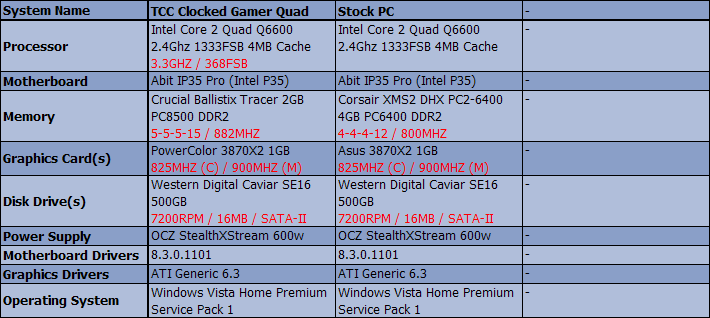
The following benchmarks are part of Overclock3D’s standard suite of applications and should give us a good overall idea of how the Clocked Gamer Quad performs in both synthetic and real world situations.
Synthetic CPU & Memory
• Sisoft Sandra XII 2008c
• Lavalys Everest 4.0
• Sisoft Sandra XII 2008c
• Lavalys Everest 4.0
• SuperPI Mod 1.4 (8m)
File Compression & Encoding
• 7-Zip File Compression
• River Past ViMark
• 7-Zip File Compression
• River Past ViMark
Disk I/O Performance
• HDTach 3.0.4.0
• Sisoft Sandra XII 2008c
3D / Rendering Benchmarks
• Cinebench 10
• 3DMark05
• 3DMark06
• POV-Ray 3.6
3D Games
• Quake 4
• Bioshock
• F.E.A.R
Stability & Overclocking
Being a pre-overclocked system great attention needs to be paid to the stability of the machine under high loads for extensive periods (Gaming etc..). TCC state that every one of the machines in their Clocked range is tested for full stability with 8 hours of Prime95 and 3DMark tests. While this is probably more than enough to guarantee full stability, we decided to push the Clocked Gamer Quad a little harder subjecting it to an entire day’s (12hrs) worth of OCCT and ATITool Artifact Scanning. At the end of the day, the Clocked Gamer Quad had pretty much heated the entire office, but impressively it hadn’t faltered once.

Of course, knowing that the Clocked Gamer Quad was 100% stable we couldnt help but wonder just how much further we could push that 3.3ghz overclock before things started to get a little wobbly. By using the BIOS to simply raise the FSB a few notches, this is what we managed:


While we could have probably taken things further with extra voltage and additional tweaking, we felt that the original 3.3ghz overclock performed by TCC offered the best balance of performance and stability. Re-testing the unit with a further 8-12hours of OCCT just simply wasn’t worth the additional effort for an extra 100-200mhz.
