


Cooler Master Real Power Pro M700 700w Modular PSU

Load Testing
To provide our readers with the most accurate results, Overclock3D uses a custom built PSU load tester on all reviews. This not only gives much more reliable results than the testing methods employed by other sites, but also allows for all current and future review results to be compared side-by-side.
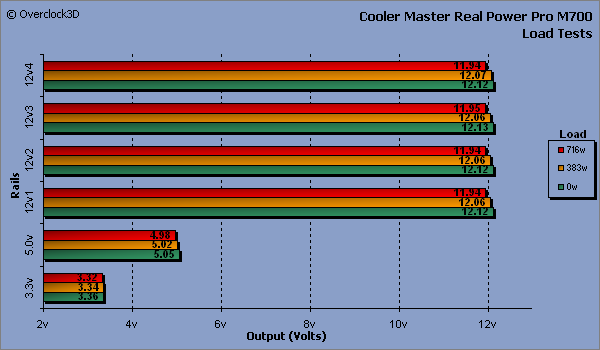
At 0% load, all rails on the M700 sat fairly close to their ideal voltages with minimal amounts of “over-volting”. This trend continued when we applied a load of roughly 50% (383w), with each of the six rails only showing a slight voltage fluctuation of 0.02v – 0.05v. Moving up to a full load of 716w (16w above the continuous output rating for this unit), the M700 still managed good voltage regulation with the highest drop in output being exhibited on the +12v rails which all dipped to around 11.94v.
Efficiency Results
Efficiency tests are performed by measuring the wattage consumed by the power supply at the mains (Mains Draw) against the power consumed by the OC3D power supply stress tester (PSU Load). These results may not be 100% accurate, but have proven to be extremely close to results obtained from professional equipment.
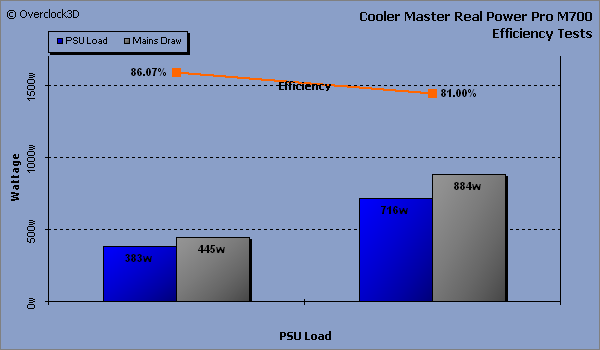
At 50% load (383w) things were looking extremely promising for the M700, with efficiency being calculated at around 86%. However, as the load on the unit was increased all the way up to 716w efficiency took quite a steep downwards curve all the way down to 81%.
To be fair, the large majority of users will probably be placing the unit under a 300-500w load and thus will get a good level of efficiency from the M700, however it would have been nice to see the unit hold around 84-85% efficiency at full load.
Temperature vs Noise Output
As with all components in the modern computer system, the performance of a PSU can be directly affected by heat. Excess heat inside the PSU can easily have a negative effect of the maximum power output of the unit and lead to voltage instability. For this reason, Overclock3D includes temperature recordings taken from the PSU’s exhaust using a thermal probe to highlight any potential issues that the PSU might have obtaining its rated output.
While keeping the temperature of a PSU under control is often just a case of increasing the speed of a fan, this can have a negative impact on noise levels. Therefore, Overclock3D also records the dBA output of the PSU (from a distance of 30cm) in order to gauge it’s suitability for use in a silent environment.
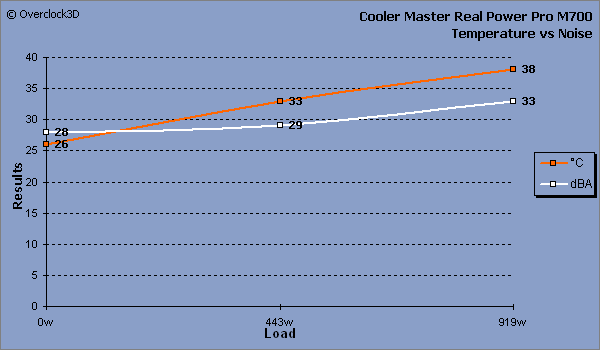
At both 0% and 50% loads there was very little audible change in PSU noise levels with our dBA meter only registering a 1dBA increase. Moving up to 100% load caused the 120mm fan in the M700 to speed up, resulting in a 4dBA rise in noise levels. While these results are certainly a lot higher than the 16dBA quoted by Cooler Master, the unit was still reasonably quiet when placed in a PC case with system, CPU and GPU fans running.
