


Why OCCT has changed GPU Stress Testing and why Furmark’s no longer good enough

OCCT explains its GPU testing methodology and why an “adaptive” approach is best
We test a lot of hardware here, and one of our favourite stress testing tools is OCCT. We’ve used this tool for over a decade, and in recent years it has evolved to cover CPU, GPU, and (most recently) SSD stress testing. The tool has even expanded beyond Windows and into the domain of Linux.
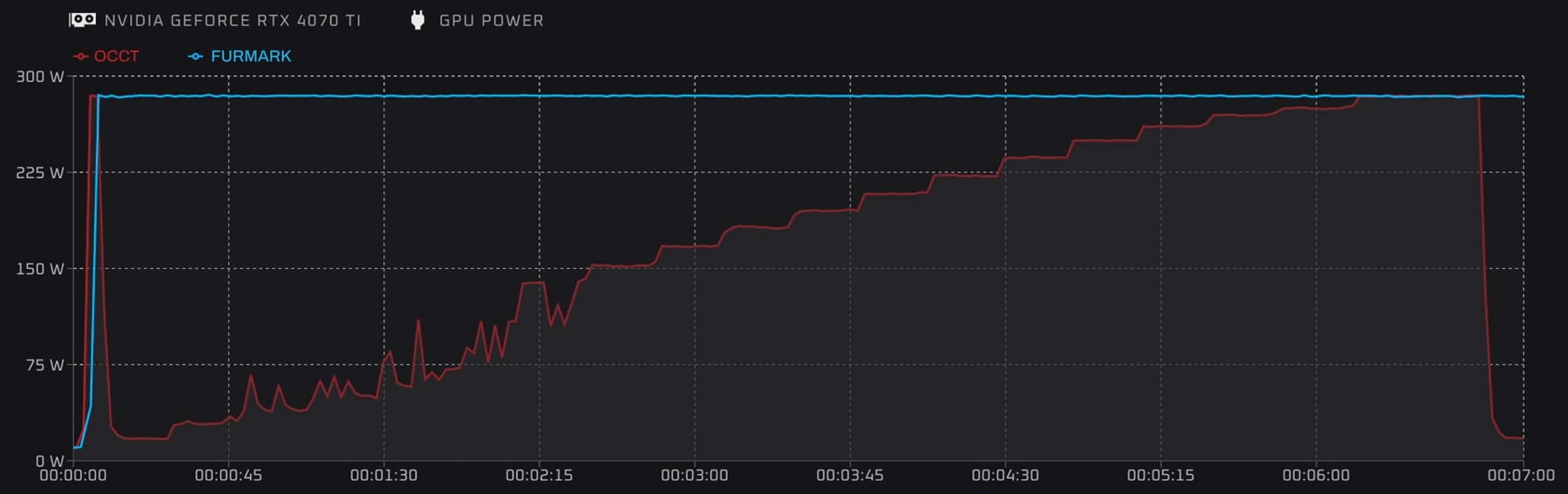
Traditionally, tools like Furmark were the preferred stress testing tool for graphics cards, but its fixed load approach is no longer well-suited to modern graphics cards. GPUs now have highly variable clock speeds, and they are not always at 100% load. This makes fixed 100% loads like Furmark problematic for stress testing. Too often, overclocked GPUs that are “Furmark stable” can fail under gaming workloads, while idling, or when doing basic tasks like video playback.
OCCT’s GPU tests approached GPU stress testing differently. OCCT uses its “3D Adaptive Test” to test graphics cards at various power levels. Instead of giving a consistent load, OCCT gradually ramps up GPU utilisation. This tests a wide variety of GPU clock speeds and power loads. This means that more kinds of errors can be uncovered, revealing instability wherever it can be found.
100% Stress Tests like Furmark don’t reflect real-world usage
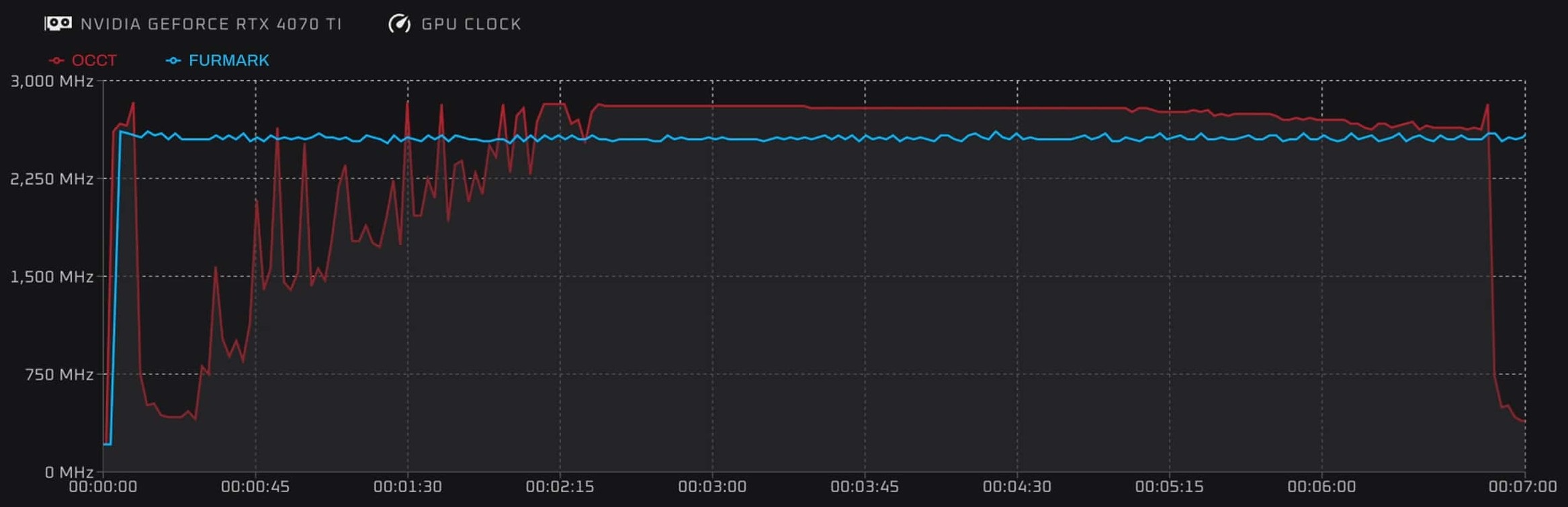
Below, we can see the measured GPU clock speeds of an RTX 4070 Ti running using Furmark and OCCT stress tests. Note that Furmark applies a fixed load, and GPU clock speeds are very consistent. With OCCT, more clock speed states are tested, and higher clock speeds are tested. By using 100% loads, Furmark doesn’t test GPUs at their peak clock speeds.
OCCT better reflects real-world GPU usage by testing a wider range of load conditions and a larger variety of clock speeds. This better reflects real-world workloads like gaming and workstation use.
OCCT has “3D Adaptive” “Variable Mode” tests to find GPU instability in all load conditions
Alongside 3D Adaptive mode, OCCT also has a Variable mode and a Switch mode to test other load conditions. Switch mode can replicate rapid spikes in load, reproducing what occurs when switching between games, menus, and Windows. This kind of testing can uncover new areas of instability that would not be found by a fixed load stress test.
With OCCT V15, OCBASE has improved their adaptive algorithm to deliver more consistent behaviour. These changes allow OCCT to better mimic real-world GPU behaviour.
Other neat OCCT GPU testing features
OCCT can test multiple graphics cards simultaneously, including GPUs from different brands. This feature can stress-test multi-GPU AI workstations, compute servers, cryptocurrency mining rigs, and multi-GPU rendering systems. This makes OCCT a valuable tool for business use, not just for gamers and hardware enthusiasts.
Hardware enthusiasts can learn more about OCCT’s GPU testing methodology here.
You can join the discussion on OCCT’s GPU testing methodology on the OC3D Forums.