


More quality, less VRAM – Assassin’s Creed’s Neural Texture Compression is fantastic!


Neural Textures are already available in shipping games, and they are delivering huge VRAM savings
Ubisoft has confirmed that it has shipped a game with “Neural Texture Compression”, and it isn’t a new release. With 2023’s Assassin’s Creed Mirage, Ubisoft released what’s likely to be the first game to use this technology, delivering greater image quality, lowered storage requirements, and lower VRAM utilisation.
In modern games, textures can account for “about 60%” of a game’s install size. In Ubisoft’s eyes, today’s commonly used texture compression formats are “no longer sufficient”. With Neural Texture Compression, Ubisoft achieved 30% higher “effective compression”. This resulted in reduced storage requirements for Mirage and reduced in-game memory (VRAM) use.
Modern video games rely heavily on high-resolution physically based rendering (PBR) textures to deliver the visual quality and sharpness expected from AAA titles such as Assassin’s Creed. These high-resolution assets account for a large fraction of both disk and GPU memory usage (about 60% of disk size), and the growing demand for 4K textures is rapidly increasing overall game size. Widely used texture compression formats are no longer sufficient at this scale. Because they operate independently on each texture layer, they fail to exploit the correlations that exist across material channels. To address this limitation, we have developed a neural material texture compression technique that uses machine learning to exploit this cross-channel structure and reconstruct full PBR materials in real time, enabling higher effective compression (about 30% in Assassin’s Creed Mirage) without sacrificing visual quality.
– Ubisoft
Less VRAM use, higher image quality
With Neural Texture Compression, Ubisoft achieved higher image quality and reduced texture sizes. Below, we can see textures for a table using standard and Neural Textures. With the Neural Textures, the table’s wood grain is much more detailed despite being around 30% smaller.
With the storage requirements of many modern games ballooning, Neural Textures provide a path to higher-quality games without increased storage utilisation. Note that this is an early example of Neural Texture Compression. Higher compression rates are likely possible.
Below are screenshots comparing standard texture sets to neural textures. In these examples, neural textures not only preserve or improve visual quality, but also reduce memory usage by approximately 30%.
– Ubisoft
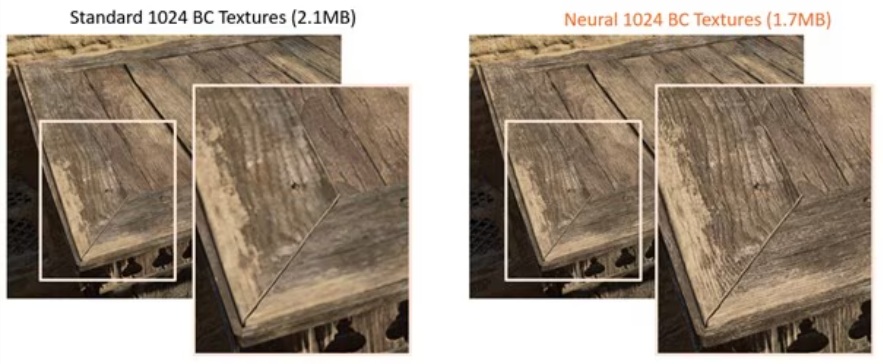
(More quality, less VRAM – Source: Ubisoft)
Huge benefits, but there are still trade-offs
Note that Ubisoft did not use Neural Texture Compression for all of its assets in Assassin’s Creed Mirage. Ubisoft used this tech only on “objects with high instance counts” and when “significant memory pressure” was present. Ubisoft says that they were “constrained by runtime performance”. That means that Neural Texture Compression has a performance cost.
While Neural Texture Compression was too computationally expensive for Ubisoft to use everywhere, it is worth noting that Assassin’s Creed Mirage is a cross-generational game on PS4, Xbox One and newer consoles. If this texture tech can run on these platforms, it should run on more modern hardware with ease. After all, modern GPUs all feature built-in AI acceleration technology. Additionally, DirectX is being enhanced with new Neural Rendering features to make tech like this more viable.
In the shipped game, usage was constrained by runtime performance. To keep costs within budget, Neural Texture Compression was applied selectively to a subset of assets, focusing on objects with high instance counts and significant memory pressure. This limited the total number of pixels reconstructed by the neural decoder, while still delivering a meaningful reduction in texture memory and preserving visual quality where it mattered most.
– Ubisoft
Neural Textures are the future
In today’s market, storage and memory are expensive. For this reason alone, Neural Texture technology needs to be utilised more widely. We already know that Sony and AMD are aiming to tackle this directly with “Project Amethyst” and its “Universal Compression” technology. Nvidia also has Neural Texture Compression Technology (NTC), which can cut texture sizes by as much as 90%.
Assassin’s Creed Mirage proves that Neural Textures can work on shipping games with today’s hardware. Now we need developers to share their knowledge and push to make future games more efficient using this tech. With lower memory and storage use, Neural Textures allow developers to do more with less. Given the cost of memory today, this is a huge win for everyone.
You can join the discussion on Assassin’s Creed Mirage’s Neural Texture tech on the OC3D Forums.