


Nvidia DLSS 5 is NUTS!

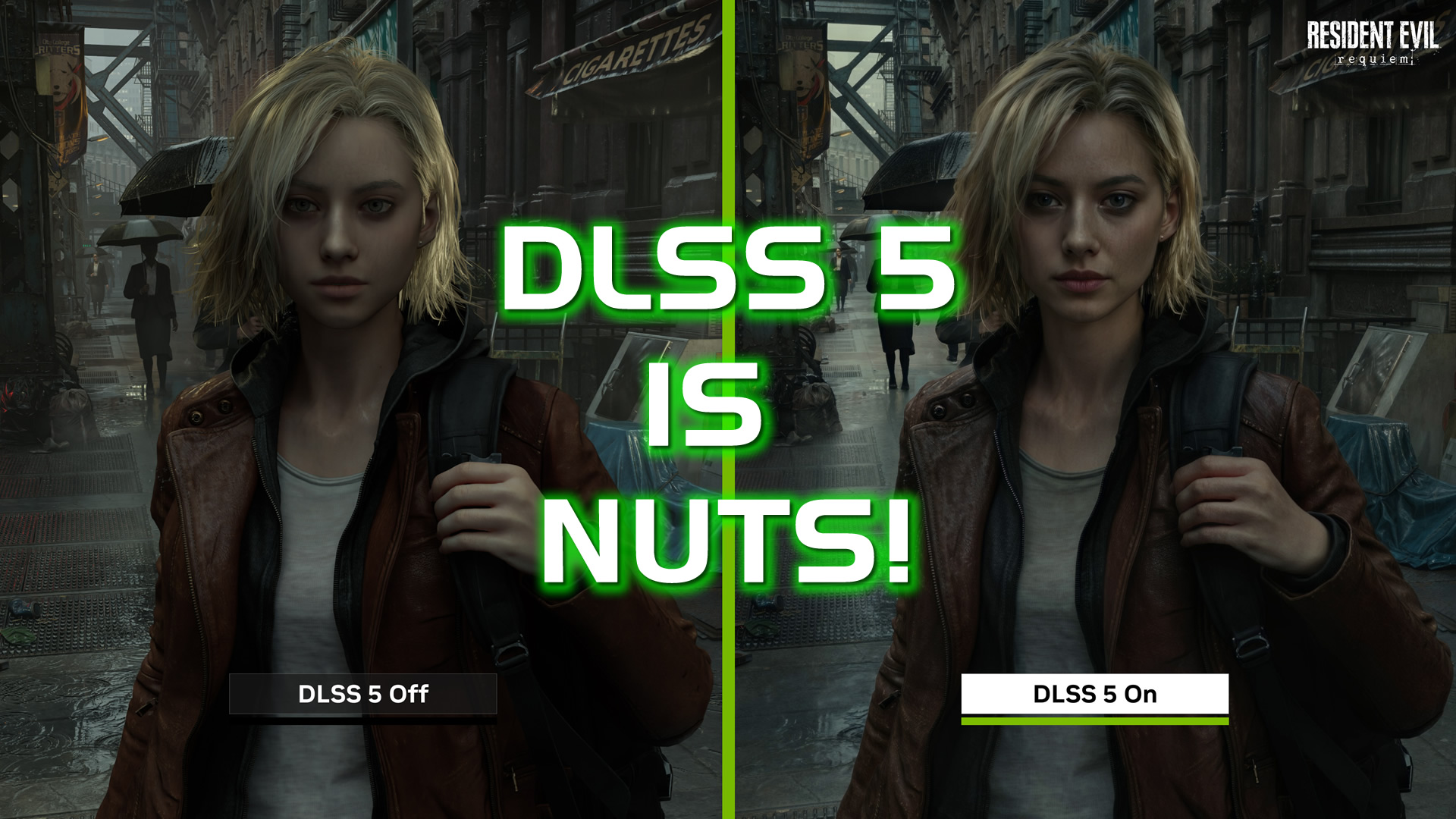
Nvidia promises photorealistic graphics with DLSS 5
At GTC 2026, Nvidia has shocked the gaming world with DLSS 5, a new AI model that promises to deliver photorealistic visuals with today’s gaming hardware. DLSS 5 is due to launch this fall, and Nvidia calls it their “most significant breakthrough in computer graphics since the debut of real-time ray tracing.”
So what is DLSS 5? It isn’t higher levels of upscaling or frame generation. DLSS 5 is a model that can infuse scenes with photorealistic lighting, materials, and other enhancements. Faces and fabrics are more realistic, and lighting is stunning.
DLSS 5 learns from video AI models that can generate photorealistic visuals. Rather than generating content on the fly, DLSS 5 uses existing game visuals and frames as its source. Then DLSS 5 takes these scenes and infuses them with accurate real-time lighting and other enhancements to create visually spectacular gameplay. This isn’t an AI video generator; it is a technology that sits on top of game engines, enhancing visuals while maintaining game/scene structure, semantics, and accuracy.
DLSS 5 is not intended to replace game engines or today’s computer graphics. Well, at least not entirely. It uses today’s game engines and visuals as a springboard to deliver AI enhancements. It won’t replace games with so-called “AI slop”. DLSS 5 takes a game and enhances it to make it more visually spectacular. Game mechanics remain the same, game animations remain the same, and assets remain the same.
Honestly, if you told me Nvidia had this tech a day ago, I would have thought you were joking.
NVIDIA today unveiled NVIDIA DLSS 5, the company’s most significant breakthrough in computer graphics since the debut of real-time ray tracing in 2018.
DLSS 5 introduces a real-time neural rendering model that infuses pixels with photoreal lighting and materials. Bridging the divide between rendering and reality, DLSS 5 empowers game developers to deliver a new level of photoreal computer graphics previously only achieved in Hollywood visual effects.
– Nvidia
DLSS 5 will work on today’s RTX GPUs
Nvidia has confirmed that DLSS 5 will be supported by the gaming industry’s biggest publishers. This includes Bethesda, Capcom, Hotta Studio, NetEase, NCSOFT, S-GAME, Tencent, Ubisoft and Warner Bros. Games. In the video above, we can see DLSS 5 working in Resident Evil Requiem, Hogwarts Legacy and Starfield.
What’s important to note is that DLSS 5 will not require new hardware; it will run on today’s GPUs. It will work on RTX 50 series GPU, and Nvidia is currently refining and optimising its technology to make it more performant. That said, it is currently unknown what the performance cost of this new technology is. Nvidia says that DLSS 5 will be arriving “this Fall”.
Video AI models have rapidly learned to generate photoreal pixels, but they run offline, are difficult to precisely control and often lack predictability, with every new prompt generating bespoke content. For games, pixels must be deterministic, delivered in real time and tightly grounded in the game developer’s 3D world and artistic intent.
DLSS 5 takes a game’s color and motion vectors for each frame as input, and uses an AI model to infuse the scene with photoreal lighting and materials that are anchored to source 3D content and consistent from frame to frame. DLSS 5 runs in real time at up to 4K resolution for smooth, interactive gameplay.
The AI model is trained end to end to understand complex scene semantics such as characters, hair, fabric and translucent skin, along with environmental lighting conditions like front-lit, back-lit or overcast — all by analyzing a single frame. DLSS 5 then uses its deep understanding to generate visually precise images that handle complex elements such as subsurface scattering on skin, the delicate sheen of fabric and light-material interactions on hair, all while retaining the structure and semantics of the original scene.
DLSS 5 provides game developers with detailed controls for intensity, color grading and masking, so artists can determine where and how enhancements are applied to maintain each game’s unique aesthetic. Integration is seamless, using the same NVIDIA Streamline framework used by existing DLSS and NVIDIA Reflex technologies.
Availability and Game Developer Support
DLSS 5 will be supported by the industry’s biggest publishers and game developers, including Bethesda, CAPCOM, Hotta Studio, NetEase, NCSOFT, S-GAME, Tencent, Ubisoft and Warner Bros. Games.– Nvidia
Nvidia has confirmed that DLSS 5 is coming to AION 2, Assassin’s Creed Shadows, Black State, CINDER CITY, Delta Force, Hogwarts Legacy, Justice, NARAKA: BLADEPOINT, NTE: Neverness to Everness, Phantom Blade Zero, Resident Evil Requiem, Sea of Remnants, Starfield, The Elder Scrolls IV: Oblivion Remastered, Where Winds Meet and more.
Regarding artistic intent
Nvidia has confirmed that developers will be able to control/tune DLSS 5’s colour, intensity, and masking to determine how and where enhancements are applied. This will allow game developers to maintain their game’s aesthetic and stay true to their artistic intent.
You can join the discussion on DLSS 5 on the OC3D Forums.