


Alleged Nvidia RTX 60 series GPU Specifications Leak

It looks like Nvidia’s RTX 60 series doubles down on path tracing
A new leak has unveiled alleged specifications for Nvidia’s RTX 60-series GPUs, along with performance targets. If these rumours are correct, Nvidia’s next-generation RTX graphics cards will use GR20x “Rubin” series silicon with TSMC 3nm silicon.
According to Red Gaming Tech, Nvidia’s RTX 60 series aims for a “2x” increase in path-tracing performance over the RTX 50 series. In non-raytracing (“pure raster”) performance, gains will reportedly be much smaller at around 30-35%. If this is true, Nvidia is doubling down on ray tracing and path tracing performance with its RTX 60 series. These new GPUs will reportedly feature 6th-Generation Tensor Cores and 5th-Generation RT Cores.
With both PlayStation 6 and Xbox “Project Helix” (leaked specs here), it makes sense for Nvidia to target path tracing harder than ever. After all, these will be the first consoles with powerful ray tracing hardware. That means that next-generation games should make extensive use of ray tracing, unlike today’s PS5 and Xbox Series X/S games.
Nvidia RTX 6090
NVIDIA’s RTX 6090 will reportedly use NVIDIA’s GR202 silicon, which reportedly features up to 192 Stream Multiprocessor (SM) units. The GPU is also expected to feature a 512-bit memory bus, with the GPU supporting 32GB of memory.
Nvidia’s RTX 6090 is unlikely to use all of Nvidia’s GR202 silicon, much like most other RTX XX90-class GPUs. Nvidia’s RTX 5090 features 170 SM units, which means that the RTX 6090 could feature an SM count that’s up to 12.9% higher. Furthermore, Nvidia’s RTX 60 series GPUs will also reportedly feature slightly higher clock speeds than their RTX 50 series GPU models.
If these specifications are correct, Nvidia’s RTX 60 series performance gains will stem from architectural advantages and not raw increases in SM count. If Nvidia intends to deliver a 2x increase in path tracing performance, we can expect some big changes to how ray tracing is handled with RTX 60 series GPUs.
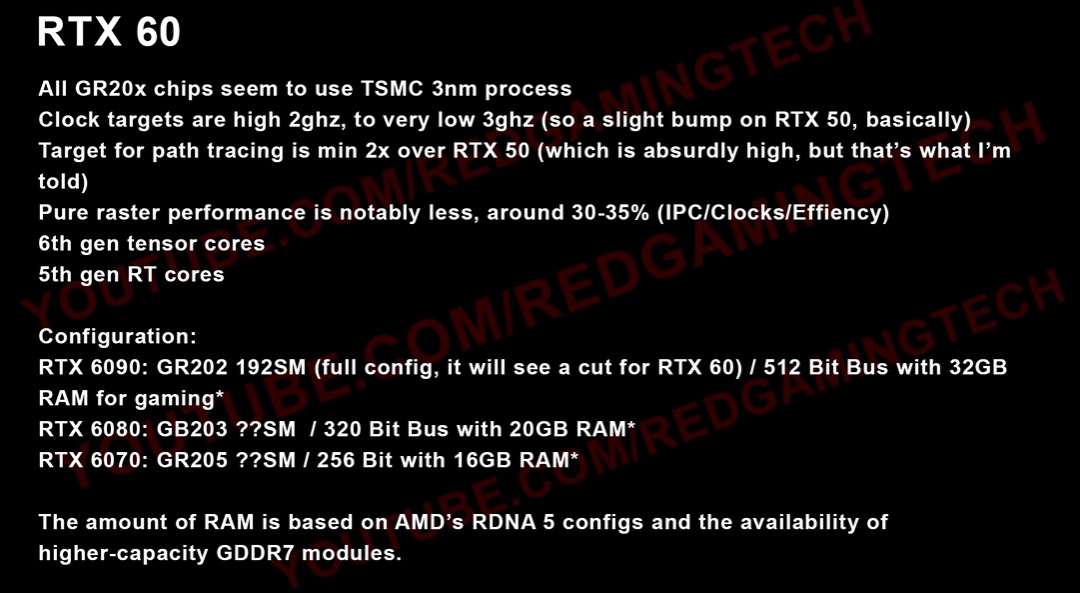
(leaked RTX 60 series GPU details – via Red Gaming Tech)
RTX 6080 and RTX 6070 memory specifications
Nvidia’s RTX 6080 and RTX 6070 will reportedly feature memory bus sizes of 320-bit and 256-bit. These are 64-bit upgrades over Nvidia’s RTX 5080 and RTX 5070, respectively. If Nvidia uses the same capacity GDDR7 modules as today, both of these new GPUs will get 4GB of additional memory. However, Nvidia can easily swap these out for higher-capacity modules if they are readily available. Furthermore, if AMD invests in higher-capacity memory, Nvidia may be forced to make similar investments. Ultimately, the memory used with these GPUs is to be determined. The memory market is a mess right now, and everything could change between now and the release of these alleged GPUs.
If these specifications are correct, Nvidia plans to give RTX 60 series users access to much more memory bandwidth than before. The RTX 6070 reportedly features a memory bus that is 33% larger than its predecessor, a significant upgrade.
Do these rumours make sense?
For the RTX 60 series, it makes sense for Nvidia to invest heavily in ray tracing and path tracing performance. After all, both next-generation consoles aim to deliver high-end ray-tracing experiences in console games. If Nvidia wants to step ahead of these systems, it needs to deliver higher levels of ray tracing/path tracing performance. If Nvidia fails to deliver large performance gains, AMD has a serious chance to catch up, which wouldn’t be good for team green.
Nvidia’s RTX 6090 is expected to be a bigger GPU than its predecessor, with a higher SM count, new Tensor Cores, and new RT Cores. So far, so expected. We will see in time if this leak’s specifications are true, and if Nvidia can deliver “2x ” path-tracing gains over its RTX 5090. As always, take hardware rumours with a grain of salt until hardware is officially announced.
You can join the discussion on Nvidia’s leaked RTX 60 series GPU plans on the OC3D Forums.