


AMD “RDNA 4m” GPU spotted for future mobile CPUs


Linux compiler work unveils new mobile Radeon graphics architecture
New Linux efforts for AMD’s Radeon software stack have unveiled a new graphics architecture, one that sits between RDNA 3.5 and RDNA 4 in terms of functionality. Right now, Phoronix, which uncovered these changes, calls this new architecture RDNA 4m, as this GPU is likely to be part of future AMD mobile processors.
With AMD’s Zen 6 “Medusa Halo” processors reportedly using RDNA 5 graphics, it is probable that AMD’s lower-end Zen 6 “Medusa Point” processors will use RDNA 4m. This new architecture reportedly features “FP8 and BF8 conversion support”, a function previously exclusive to AMD’s RDNA 4 GPUs. This means that Medusa Point systems should support AMD’s AI-powered FSR 4 upscaling solution. Since this architecture is defined as GFX11 (RDNA 3.X) rather than GFX12 (RDNA 4), this GPU is not a “full RDNA 4”. Even so, the architecture should pack the RDNA 4 features that matter most.
This is great news for AMD’s future mobile processors. FSR 4 support would be a great feature add-on for future gaming handhelds and similar devices. That said, it is a shame that AMD isn’t using its newest graphics architectures to construct these chips.
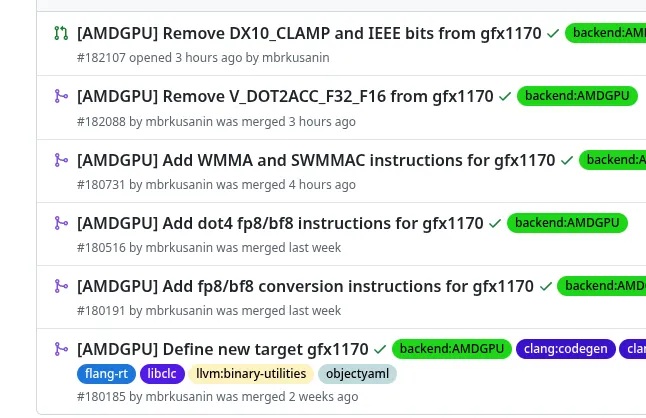
(GitHub – via Phoronix)
“RDNA 4m” is RDNA 3.5 renewed?
AMD’s new GFX11 architecture also reportedly supports new WMMA and SWMMAC instructions. These instructions imply stronger matrix instruction support, which is good for AI and computational workloads. With AI being the biggest buzzword in the tech world ATM, it makes sense for AMD to target these workloads with their newest mobile chips.
If you were to believe recent rumours, AMD planned to utilise RDNA 3.5 graphics for several future generations of Ryzen AI mobile processors. Now, it looks like AMD is taking a hybrid approach for its lower-end processors. AMD is updating its architecture to deliver the functionality that users need. However, they are not moving to their newest architectures for their lower-end processors. Why would AMD do this? That is unclear. Right now, AMD’s integrated graphics are on the I/O tile of their mobile processors. These chips tend to use older lithography nodes. That being the case, is it possible that AMD is unwilling to backport their newest architectures to these older nodes?
You can join the discussion on AMD’s next-gen mobile graphics architecture on the OC3D Forums.