


Total War: Pharaoh’s Nvidia ACE AI Advisor is a VRAM gobbler

An AI Advisor is coming to Total War: Pharaoh, and it’s (currently) a VRAM hog
Creative Assembly is currently working with Nvidia on an “experimental” AI advisor that’s powered by Nvidia ACE. This advisor is currently part of a developer build of Total War: Pharaoh. However, it is due to be tested by members of the Total War community within the next few months.
Instead of using pre-written messages, Total War’s AI Advisor can use data from the current game state to advise players. With the right game data, they can advise players about army compositions, the economy, and why certain things happened in-game. The aim is to create an advisor that can be more helpful to Total War newcomers than the game’s existing Advisor. That said, as it stands, this AI is a resource hog.
As it stands, the current (experimental) version of Total War’s Nvidia ACE AI uses 6GB of VRAM. That’s a lot of VRAM, especially since Total War: Pharaoh’s recommended GPU is a 6GB GTX 1660 Ti. Not many gamers have 6GB of VRAM to spare. That said, future versions of Total War’s AI advisor could be less resource-intensive.
Total War: PHARAOH – How NVIDIA ACE Is Powering A More Helpful, Interactive Advisor
Creative Assembly’s award-winning Total War games combine deep turn-based grand campaigns with epic real-time battles, alongside many intricately crafted systems.
For much of the franchise’s history, in-game advisors have provided tutorials and introductions to these systems, helping players master the complexities and nuances of each title. Using Total War: PHARAOH as a testbed, Creative Assembly is experimenting with a new, dynamic AI advisor, powered by NVIDIA ACE, that will assist players in learning the game’s many systems and mechanics.
NVIDIA ACE is a suite of AI technologies, spanning models, developer tooling and on-device inference, designed to help studios build knowledgeable, actionable and conversational in-game characters.
The Total War: PHARAOH AI advisor is powered by a small language model, running locally on the user’s GPU; ACE’s developer tools were used to build the pipeline that connects Total War’s extensive game data to the model.
The AI processes the player’s prompts, current game state, and data retrieved from the game’s complex database, containing up-to-date information about units, economy and resource management, faction traits, buildings, status effects, and much more.
Together, these systems deliver real-time, context-aware guidance that adapts to what the player is doing, while staying in-character and faithful to the game’s lore and time period.
This early prototype is part of a program to research how Creative Assembly can make Total War more approachable, dynamic, and ultimately more accessible to players of all skill levels, without losing any of the depth that has defined the franchise over 25 years.
In the coming months, Creative Assembly will be inviting select Total War players to help test, challenge, and shape these systems, with player expertise and feedback guiding how experiments like this could influence future Total War titles.
In time, these foundations support more ambitious ideas: dynamic characters with their own voices, loyalties and memories, creating Total War campaigns that react in deeper, more surprising ways, making every playthrough feel unique.
– Nvidia
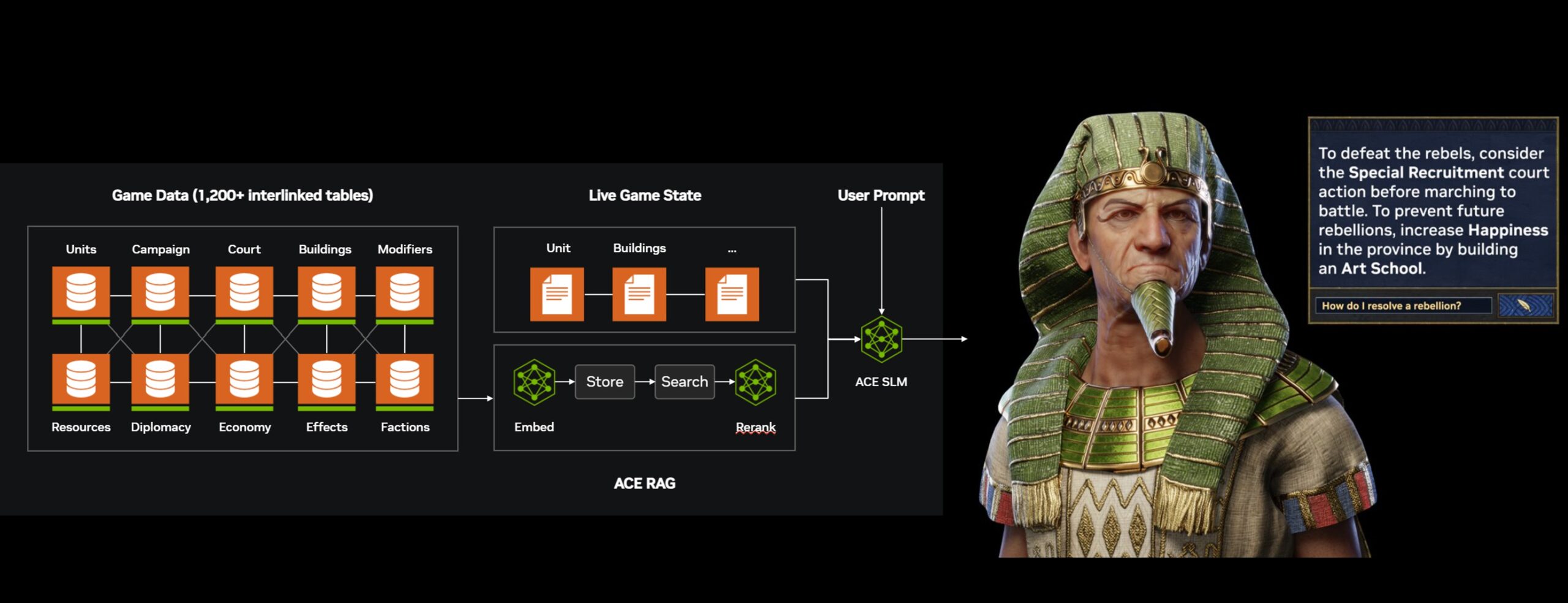
Total War’s AI advisor is an experiment, and a useful one at that. The AI is entirely offline and uses your own system resources to operate. It’s powered by a small language model using Nvidia’s ACE developer tools. These tools were used to build a pipeline that connects Total War’s game data to the AI’s model, allowing it to deliver useful information. The video below shows this AI in action.
A foundation for the future?
With AI, games like Total War could become much more immersive. Enemy leaders could become more dynamic, with AI generating unique lines when players enter diplomacy with them. Perhaps they can mention recent events or make vocal demands. For now, Creative Assembly’s experimentation is limited to its AI advisor. While it appears to be a useful tool, it’s too VRAM-hungry to be usable for most PC gamers.
Mainstream GPUs are still launching with 8GB of VRAM. With that being the case, 6GB of VRAM for an AI advisor is a big ask. Right now, the best advice such an AI could give most gamers is to turn it off to save VRAM. Either future GPUs need much more VRAM, or AI needs to become much more memory-efficient. If neither happens, this kind of AI will remain useless for the average gamer.
You can join the discussion on Total War’s experimental AI advisor on the OC3D Forums.