


Absurd Framerates – Death Stranding 2 tested with DLSS 6x Frame Generation

Death Stranding 2 now supports Nvidia DLSS 6x Multi-Frame Generation on PC
With update 1.9 for Death Stranding 2, the game now supports Nvidia Streamline SDK version 2.11.1, which adds DLSS 6x Multi-Frame Generation. This patch also follows a recent update that added XeSS Multi-Frame Generation to the game, highlighting Kojima Productions’ and Nixxes’ excitement for smoothness-boosting frame generation technologies.
We’ve decided to test this new update with Nvidia’s RTX 5080 to see how far framerates can now be pushed in Death Stranding. Additionally, we wanted to see if the game’s performance has improved. Does the game run faster than it did at launch?
Patch 1.9 Release Notes
Updated NVIDIA Streamline SDK to version 2.11.1, which adds VSync support for DLSS Frame Generation and increases the maximum Multi-Frame Generation setting available for supported hardware.
Resolved a crash that could occur when using the Music Player.
Fixed an issue where the cargo highlight outline animation could malfunction at high refresh rates.
Resolved an issue where highlighted tutorial elements could appear misaligned when using a resolution that does not match the display aspect ratio in exclusive fullscreen.
Fixed graphical distortion affecting rocks when Upscale Quality was set to Ultra Performance.
Performance improvements since launch
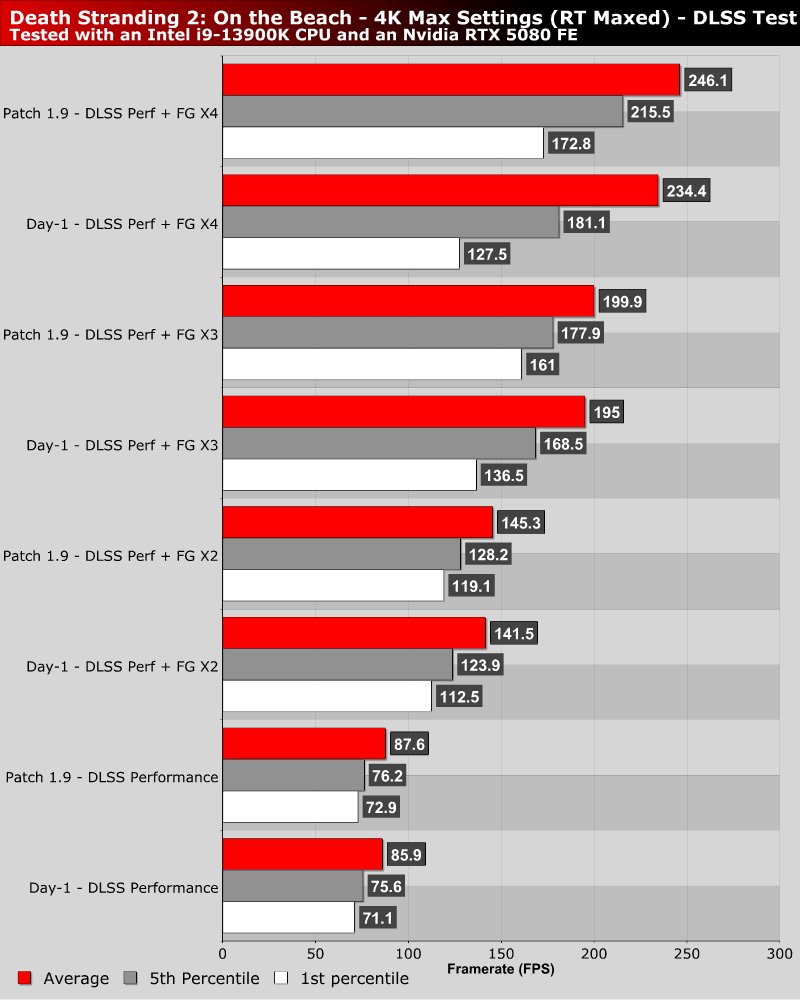
For starters, let’s have a look at how Death Stranding 2’s PC version has improved since launch. Note that frame pacing has improved when DLSS Multi-Frame Generation is enabled. This has been the case since update 1.3, though things have become even more refined since then. 1st percentile framerates are greatly improved when DLSS Frame Generation is enabled. This increases Death Stranding 2’s framerate consistency, making the game feel smoother. Baseline framerates have also improved slightly.
Even with maxed-out graphical settings, Death Stranding can run with an average framerate of over 240 FPS at 4K with an Nvidia RTX 5080. This enables incredibly smooth visuals on displays that support such high framerates. This is why high-refresh-rate 4K displays exist.
DLSS 6x Multi-Frame Generation in Death Stranding
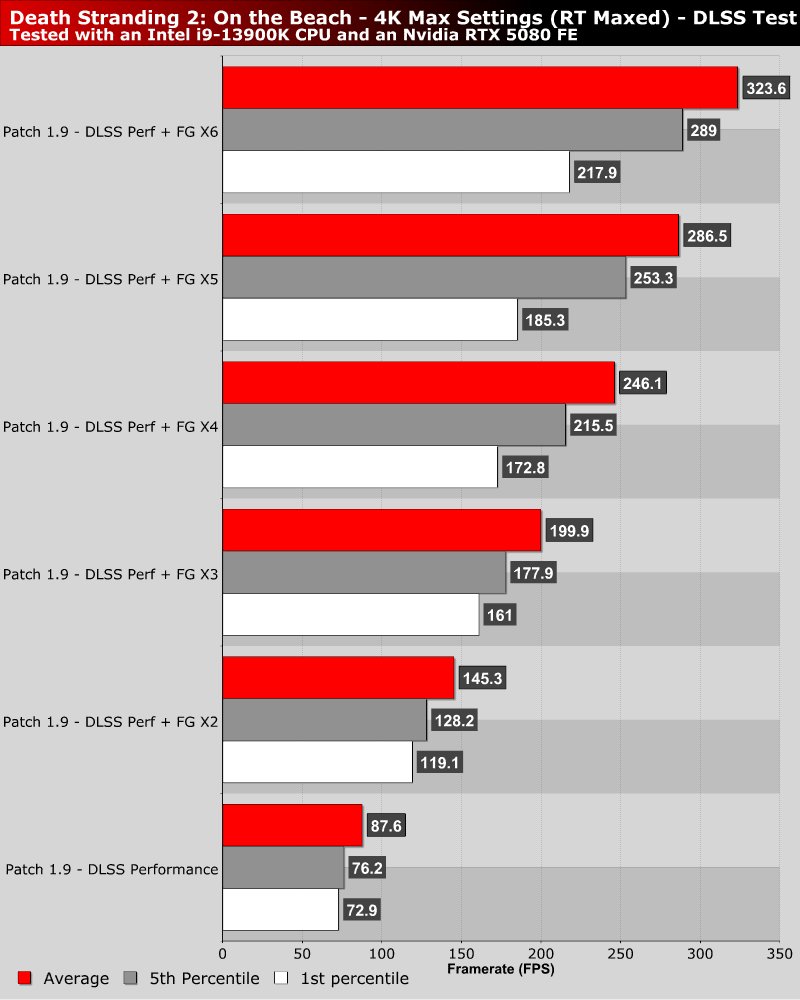
With DLSS 5x and 6x Frame Generation, Death Stranding 2’s framerates can be boosted to even greater heights with our Nvidia GeForce RTX 5080. With 6x Frame Generation, the average framerate rises to over 320 FPS. That’s faster than what any currently available 4K gaming display can show. While some may call these framerates excessive, it is worth noting that MSI and Samsung both unveiled 4K 360 Hz OLED monitors at Computex 2026. 60 FPS multiplied by 6 is 360 FPS. Coincidence?
With some minor settings tweaks (lowering ray tracing settings), Death Stranding 2 should be able to run at 4K 360Hz with ease on these future displays, perhaps even with a higher baseline framerate and less frame generation. After all, ray-traced reflections have a huge impact on this game’s performance. You can see this in our original PC performance review for Death Stranding 2.
Conclusion – The world might need faster 4K gaming monitors
Nixxes and Kojima Productions are committed to making Death Stranding 2’s PC version the best it can be. At launch, the game ran well on PC. Since then, the game has been further optimised. Furthermore, the game’s developers have doubled down on Frame Generation. Since launch, DLSS Frame Generation’s frame pacing has improved, and XeSS Multi-Frame Generation has been added. Now, DLSS Multi-Frame Generation 5x and 6x modes have been enabled. That’s great news for gamers with high-refresh-rate monitors.
Fake frames discussions miss the point – Motion clarity is what matters
A common complaint about frame generation technologies is that the added frames are “fake”. One benefit of higher frame rates is reduced latency. This allows games to feel snappier and more responsive. Frame Generation does not deliver this benefit, though it does allow games to look smoother in motion.
Higher framerates increase the motion clarity of games. This allows games to appear sharper and more detailed. Frames blur into each other less, and fast motions appear more fluid. While DLSS-generated frames are “fake”, their impact on motion clarity is real. Multi-frame generation technologies allow gamers to get more from their high refresh rate monitors. That said, I wouldn’t recommend using any frame generation technology unless the game already runs at a high baseline frame rate. Using DLSS 6x Frame generation to move from 20 FPS to 120 FPS isn’t a good move.
DLSS 6x Frame Generation is a good addition to Death Stranding 2, but it’s only useful for a small number of gamers. You need an Nvidia GeForce RTX 50 series GPU and an ultra-fast gaming display to benefit from this feature. That said, for the gamers who have those features, this is an awesome upgrade.
You can join the discussion on DLSS 6x Frame Generation in Death Stranding 2 on the OC3D Forums.