


Nvidia RTX 5090 Founders Edition Review

Conclusion
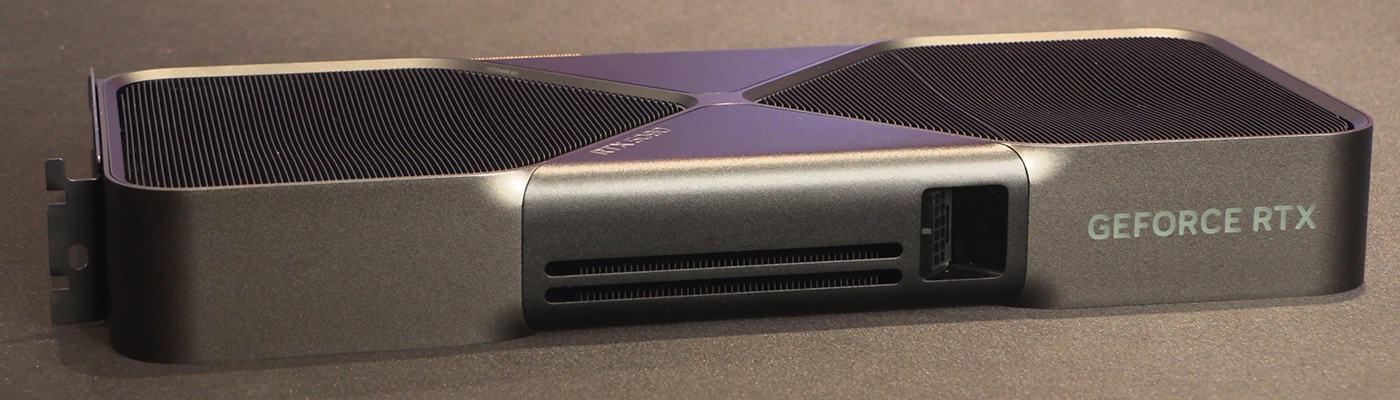
Conclusion
You can easily look at the results today and be swept away by the abilities of the new Multi Frame Generation technology. Positive thoughts, because we love high frame rates. However, if you’re being unkind, negatively by saying it’s all software. That’s largely why we tested the way we did today.
Firstly, you get the regular OC3D test setup. We’re running a broad suite of games covering a number of genres. Yes, with games that have a tendency to be graphically taxing, but this is a graphics review. If we tested on Stardew Valley or Dwarf Fortress we’re not going to learn much. These benchmarks let us compare, as much as possible, apples to apples. We’re running vanilla and some form of super-sampling. Sometimes we just have ray-tracing only, but largely you’re getting the raw horsepower of the card, and then the card with bells and whistles turned on. This helps AMD more than Nvidia, as AMDs frame generation is a smeary mess, but the Nvidia version is crisp. With DLSS 4 it’s sharper than ever.
Multi Frame Generation
Speaking of DLSS 4, that comes with the big ticket item in the Blackwell release, Multi Frame Generation. By refining the algorithm, and giving the card newer generations of hardware, the RTX 5090 can now generate three extra frames from a single frame rendered. As you could see from our results in Alan Wake II, Cyberpunk 2077 and Star Wars Outlaws, the effect is considerable. Cyberpunk 2077, with an open world, neon soaked, usually wet and thus reflective environment is about as good as games can look. Turn on path-tracing and it’s nearly real life. That path-tracing has a massive performance cost though. On the RTX 4090 you get 133 FPS @ 4K without it, 40 FPS with it.
Even turning DLSS and Frame Gen on doesn’t recoup all that, maxing out at 104. Click through the Multi Frame Gen settings on the RTX 5090 though and that number hits 241 FPS. With, and we cannot state this enough, NO loss in visual fidelity. That’s Cyberpunk at 4K with pathed ray-tracing turned on and a frame rate you’d require a very expensive monitor (4K@240Hz!) to appreciate fully. When CD Projekt Red’s Magnum Opus first appeared you could get smoother frame rates from a flipbook.
Pure Hardware
All of which returns us to the way we’ve tested how we have. Because in regular mode, with DLSS turned on and, at most, a single frame generated as is currently the way, the RTX 5090 is another big step forwards on the best of the current cards. Anything which can stomp on a RTX 4090 is crazy good. That the RTX 5090 Founders Edition can do that, and then has much further to go with the benefits of MFG, makes any claims about it being a purely software-based improvement look as ill-informed as they do.
Already that’s more than enough to make the Nvidia RTX 5090 Founders Edition a Day One recommendation to anyone serious about their gaming. We haven’t even mentioned the crazy low latencies – and thus higher KD ratio – of the upgraded Reflex 2 technology. Or RTX Neural Faces that can convert a 2D picture into a 3D character. We’ve not discussed, because it’s embryonic, the potential of the AI powered NPCs with the Nvidia Ace technology. Or the extra broadcast features, faster encoding and decoding, and all the AI calculation benefits having this much power at your disposal can bring.
Simply put, the Nvidia RTX 5090 has coalesced all the current thinking on AI, performance, sharpness, and generative content into a single card that blows the doors off anything on the market. It’s the future, today.

Discuss the Nvidia RTX 5090 Founders Edition in our OC3D Forums.