


PowerColor Vega 64 Red Devil Review

Conclusion
The PowerColor Devil range has always been a rare beast. Rather than trot it out for every single AMD Radeon GPU, PowerColor have always reserved it for the GPUs that really challenge the established order. Given how AMD GPUs have been of varying quality through recent years it means that the Devil brand still stands as a byword for something special, rather than cheapened to the point of meaningless like an Armani suit or a Tesco Value brand Single Malt Whiskey.
When AMD released the RX Vega it was clear that the difficulties of recent years were behind them and they had a genuine challenger for a place in the systems of those of us for whom no amount of frames per second is ever enough. Indeed the bog-standard AMD reference card easily matched the GTX 1080, and at a very attractive price point.
The ASUS Strix revealed just how good that reference Vega was, or at least how consistent the RX Vega GPU is regardless of how much extra cooling or power you give it, by matching the AMD card frame for frame. The PowerColor Red Devil continues this trend by only really matching that AMD card. In terms of performance it’s as good as the original Vega64, or even the Strix, but it doesn’t stand out from the crowd in terms of raw frame rates. Clearly whatever voodoo AMD have going on with their Radeon department they have designed a GPU which performs well under all conditions. It is worth mentioning, if you’re one of those people who glance at graphs and not read the text, that the Windows 10 Creators update has added some issues to certain games, so in a couple of our results we’re not really comparing apples to apples, something that we pride ourselves on here in the OC3D bunker. It’s only the lower resolution (1080) that really gets affected but we thought we’d mention it again for the ADHD crowd.
Therefore unlike previous iterations of the PowerColor Devil range the Red Devil has to be judged on what else it has to offer rather than just how much extra performance it unleashes. Cooling certainly is handled with all the capability you’d expect from such a behemoth of a cooler. The triple width and triple fans mean that we saw identical temperatures whether in silent mode or heavily overclocked. Instead of thinking about it in stark number terms you have to imagine it slightly sideways, wherein the silent mode is very quiet indeed, standard mode a little louder and overclocked mode runs the fans faster to maintain that temperature, even though it manages it easily. Although the temperatures might be the same because of the excellent capabilities of the cooler it’s actually the noise you’re changing. Much like the way you overclock the RX Vega is by increasing the power target rather than just the voltages. It’s a different way to achieve the same effect.
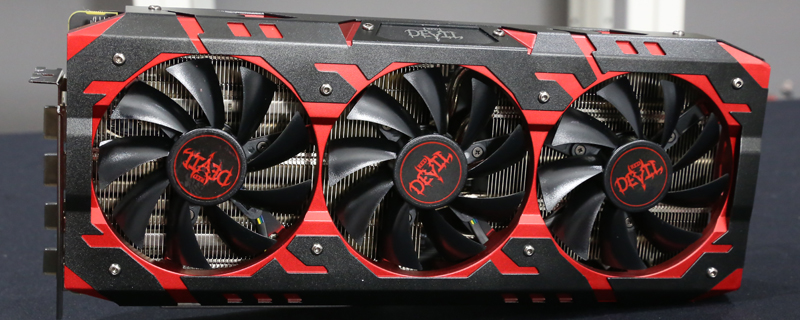
Aesthetically it all depends on how much you like the colour red. With so many recent setups being about monochrome colours and RGB lighting, the Red Devil sticks firmly to its guns and goes all in on the black and red that still adorns the vast majority of system builds around. Thankfully you can turn off the red logo light and when you do it’s mirrored at the back so it looks particularly lush.
With the Vega proving itself to be extremely consistent whether as a reference card or something beefy like the Red Devil the differences are mainly to be found in the aesthetics and cooling performance, both of which the PowerColor handles with aplomb. So if you like the looks, you’re sure to like the performance and thermals, and thus it wins our OC3D Performance Award.
Share your thoughts on the PowerColor Vega64 Red Devil in our OC3D Forums.
