

How Intel supercharged mobile and gaming with Panther Lake

Meet Intel Panther Lake – Deep Dive

We were at Intel’s 2025 Tech Tour to talk about Panther Lake
At the start of this month, Intel hosted journalists from around the globe at its 2025 Tech Tour event in the US. Why? Intel wanted to dive deep into Panther Lake, the company’s next-generation mobile CPU architecture. They wanted us to know that they had something special in store, and that this product required more than the usual video call.
With Panther Lake, Intel aimed to deliver more than a standard yearly update. It aimed to build upon what it had achieved with Lunar Lake and take it to the next level. Intel sought greater flexibility in its designs. They wanted to scale performance to greater heights. Lastly, and most importantly, they tried to deliver leading power efficiency.

Fusing the benefits Lunar Lake and Arrow Lake together to create something better
One key aspect of Panther Lake is its ability to combine the best elements of Lunar Lake and Arrow Lake. While having on-package memory has its advantages, it isn’t ideal when you have customers who have different memory requirements. With Panther Lake, Intel is using off-package memory, similar to Arrow Lake, supporting DDR5 and LPDDR5X memory. This enables increased design flexibility, allowing memory configurations to be determined by device makers, rather than Intel.
With Panther Lake, Intel also sought the low power draw of Lunar Lake, but aimed to push forward the performance of their CPU, GPU, and NPU. In this sense, Intel aimed to achieve the CPU performance of Arrow Lake within the power envelope of Lunar Lake, while refining its CPU, GPU, and NPU architectures.

Separated GPU tile = more flexibility
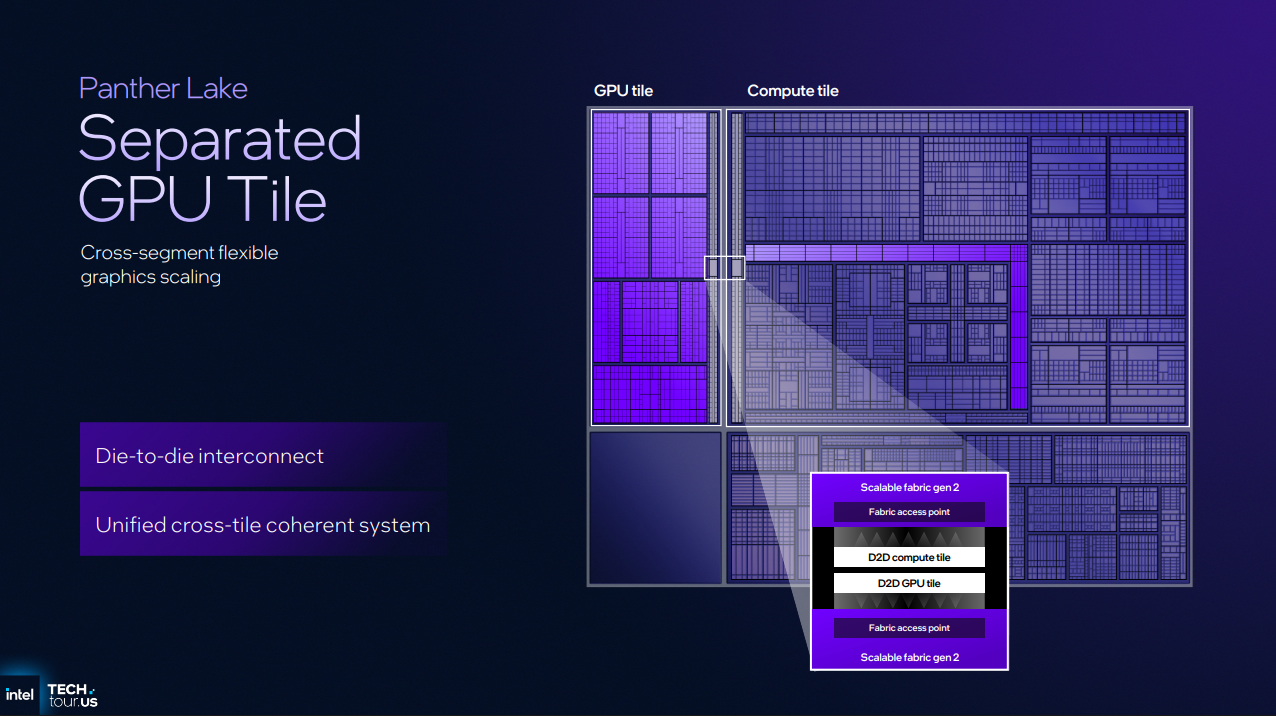
With Panther Lake, Intel has split its GPU tile from its main SOC. This enables Intel to utilise different GPU tiles for various CPU models. For some processors, a larger GPU can be used to boost performance. For lower-end devices or devices that will use discrete GPUs, a smaller Intel GPU can be utilised. Again, this gives Intel more flexibility and offers Intel’s partners more choice.
Chiplet design, complex construction
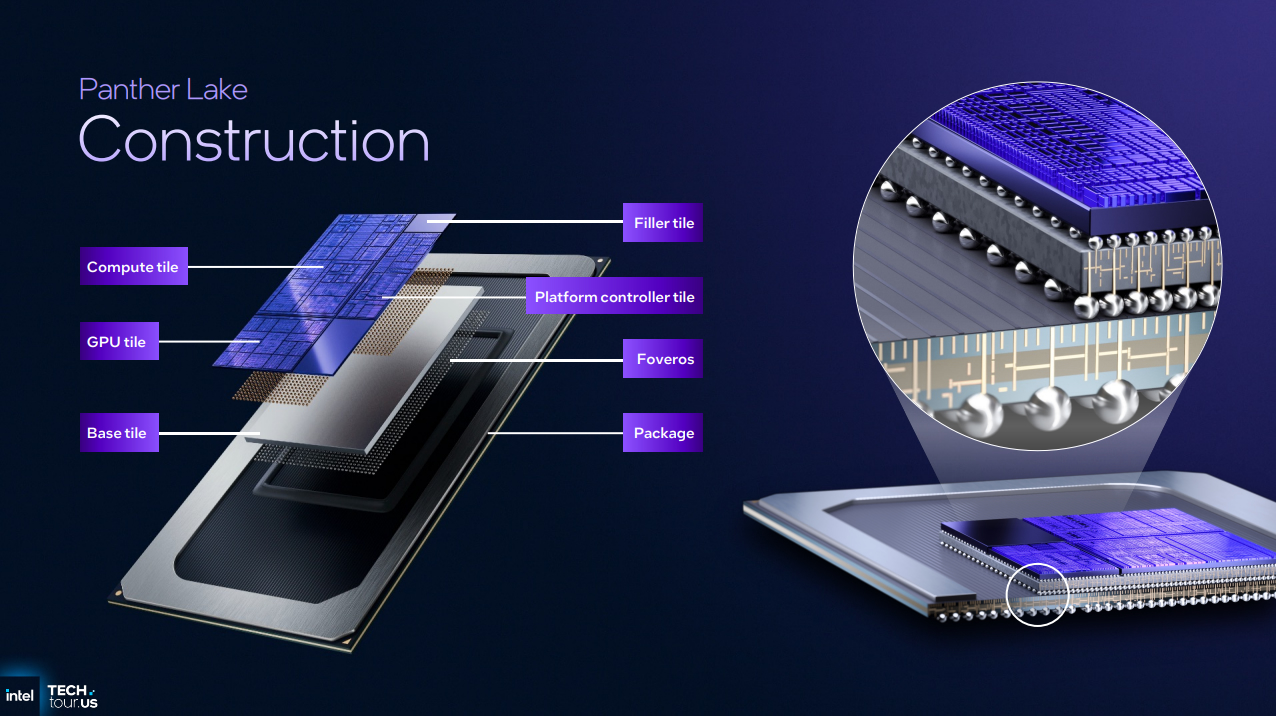
Intel’s newest CPUs are built using several tiles. There is the Compute tile, which contains CPU cores; there is the platform tile, and a CPU tile. These are tied together using a base tile. Several filler tiles can be used for structural rigidity.
The platform controller tile features components such as USB, Thunderbolt, PCIe lanes, and Wi-Fi/Bluetooth controllers. The GPU tile features an Intel Xe3 GPU. The Compute tile contains Intel’s CPU, NPU, and media engines.
The chiplet nature of these designs allows Intel to use different process technologies for each chip. This can reduce costs and deliver more optimal performance levels for individual chips over a traditional monolithic CPU design.
Flexibility is key
Intel doesn’t manufacture laptops; it produces the chips that power them. In other words, Intel needs to create processors that device makers want to use. That means that they need to deliver a processor that is easy for them to use and offers them the design flexibility they need.
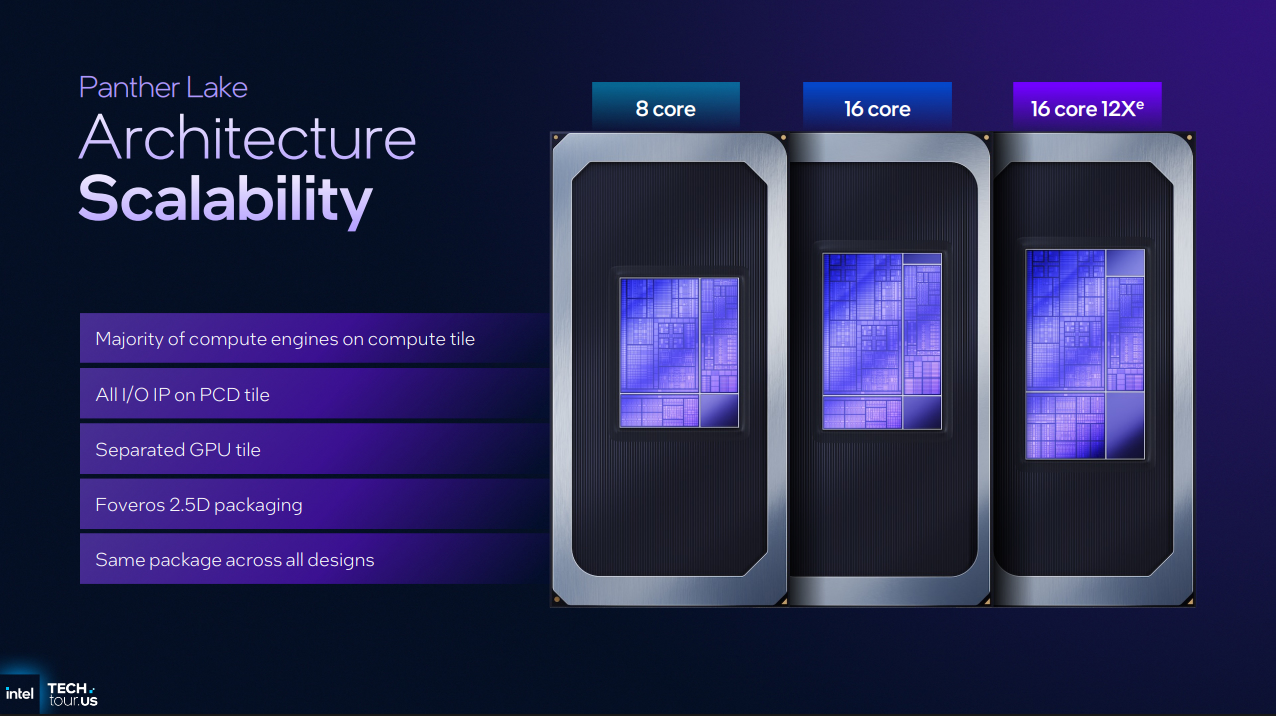
With Panther Lake, Intel made various chip options that all use the same package. That means that laptop makers won’t need different motherboard designs for specific Panther Lake SKUs. Placing memory on the motherboard also allows manufacturers to define how much memory their laptops have, or use DIMM slots to make laptops user configurable.

Intel has created 8-core and 16-core Panther Lake chip options, and an option that contains a larger 12Xe graphics chip. If OEMs want a bigger GPU, they can have it. If they don’t, they have other chip options.