


Monster Hunter Wilds PC Benchmark Analysis

Conclusion

What Monster Hunter Wilds’ PC benchmark tells us about the game
Having extensively tested Monster Hunter Wilds’ PC benchmark, I feel that Capcom has tried to push their RE Engine too far. Thanks to their desire for larger, seamless maps and larger numbers of monsters, I fear Capcom has pushed the RE engine beyond its limits. While I don’t think this game’s performance profile is as poor as Dragon’s Dogma 2 (though we will have to see about that when the game launches), I am concerned about Capcom’s insistence of using their RE Engine for all of their newest games.
Capcom’s RE Engine tends to work best when games are split into levels with limited scope. This was the case of Resident Evil 7, 2, 3, Village, and 4. This was also true for Devil May Cry 5. For larger open-world games, like Dragon’s Dogma 2, performance issues appear to emerge. This leads to a question. Should Capcom develop a separate engine for their large open-world RPGs?
Are Monster Hunter Wilds’ visuals worth their performance cost?
While some aspects of Monster Hunter Wilds’ visuals look great, there are other areas where the game falls short. While the game appears to be larger in scope, this doesn’t feel like a game that’s seven years newer than Monster Hunter World.
Based on the performance of the game’s PC benchmark, Wilds relies too heavily on resolution scaling and frame generation to achieve 60+ FPS framerates on PC. This is bad news for users of lower-end PC hardware, as Monster Hunter Wilds demands incredibly powerful hardware for those who don’t want to use upscaling and/or frame generation.
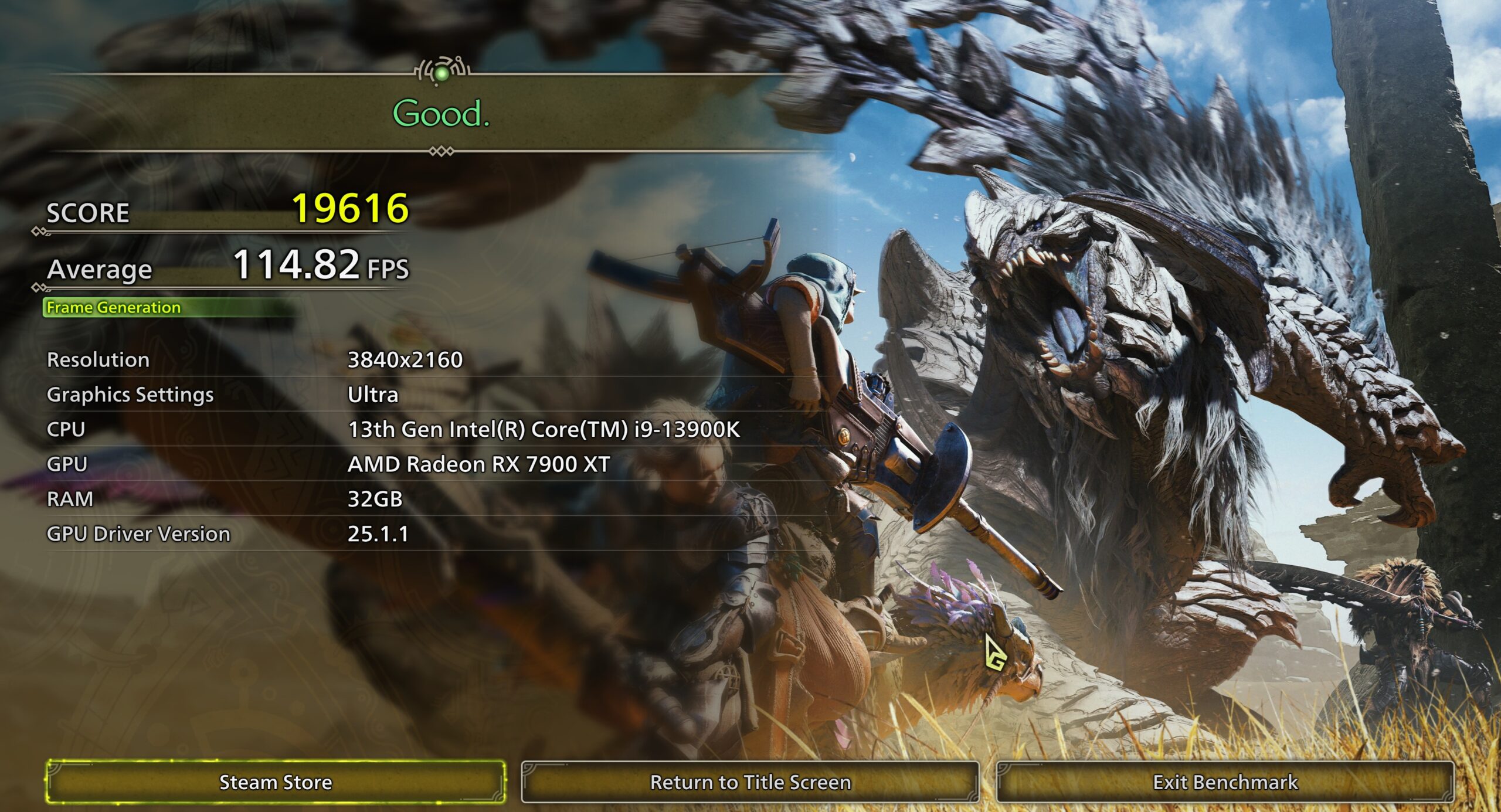
From a performance perspective, Monster Hunter Wilds’ PC benchmark leaves me disappointed. Performance can vary wildly on a scene-to-scene basis, and the game’s visuals do not justify its huge hardware demands. I hope the final game includes some new optimisations that will make this game run smoother.
Given the game’s performance on PC, I have to wonder how the game will look and run on consoles. How stable will the game’s 60 FPS modes be? What is image quality like? Is this another “next-gen” game that is smeared into oblivion with resolution scaling?
Visuals aren’t everything, but performance is a vital part of any gaming experience. Based on this benchmark, Monster Hunter Wilds has not impressed us. Let’s hope that the final game can run better, as I don’t want this game to be another Dragon’s Dogma 2.
You can join the discussion on Monster Hunter Wilds’ PC benchmark on the OC3D Forums.