

Resident Evil Requiem – PC Tech Review

Ray Tracing VS Path Tracing
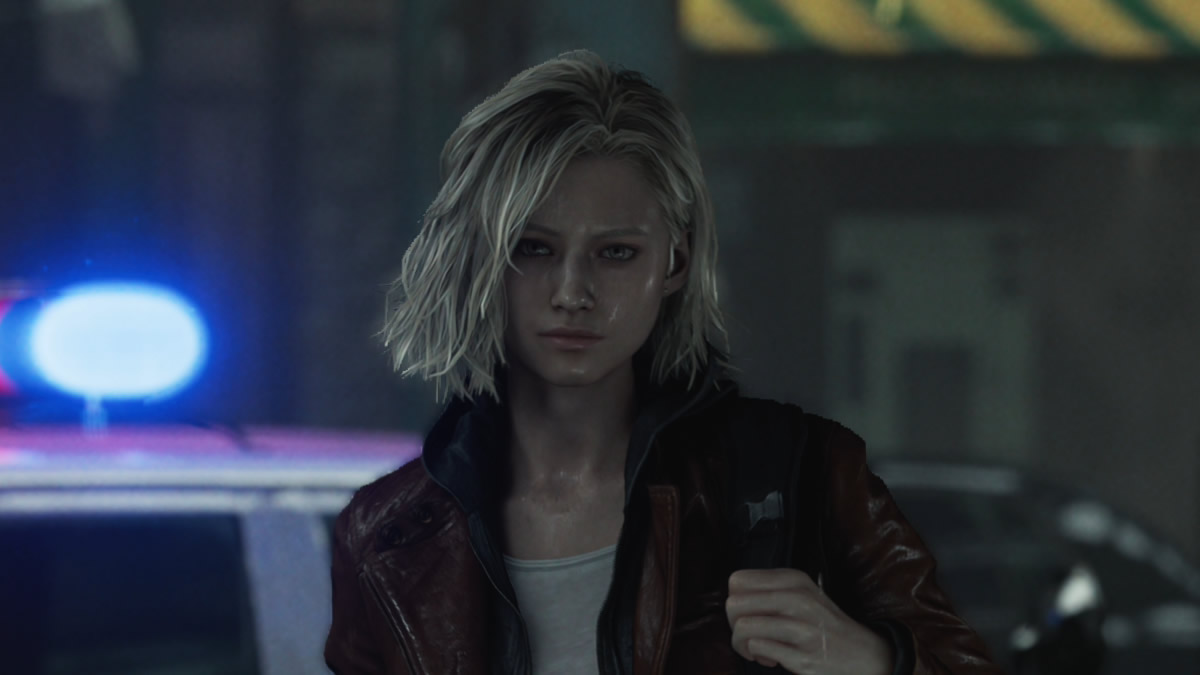
Path Tracing – Is it better than ray tracing?
One of the key selling points of ray tracing is that it is supposed to deliver more accurate/realistic lighting. The sad fact is that while ray-traced lighting is a step in the right direction, it often isn’t performant enough to be entirely accurate.
When ray tracing is added to most games, it is limited. How many light bounces are allowed? How many light sources cast rays? Will it only allow the sun to cast rays, or will all light sources be able to cast rays?
In Resident Evil Requiem, Path Tracing is an Nvidia-exclusive mode that brings together several Nvidia technologies. It uses Nvidia’s DLSS to construct the game from a lower-resolution source, and DLSS Ray Reconstruction to gather more data from each ray cast, enabling higher-fidelity ray tracing without a larger number of ray casts. This, alongside Nvidia’s newer RTX graphics cards, makes path tracing performant enough to be usable. Below, we can see how Path Tracing improves Resident Evil Requiem on PC over its standard Ray Tracing mode.
RT High VS Path Tracing
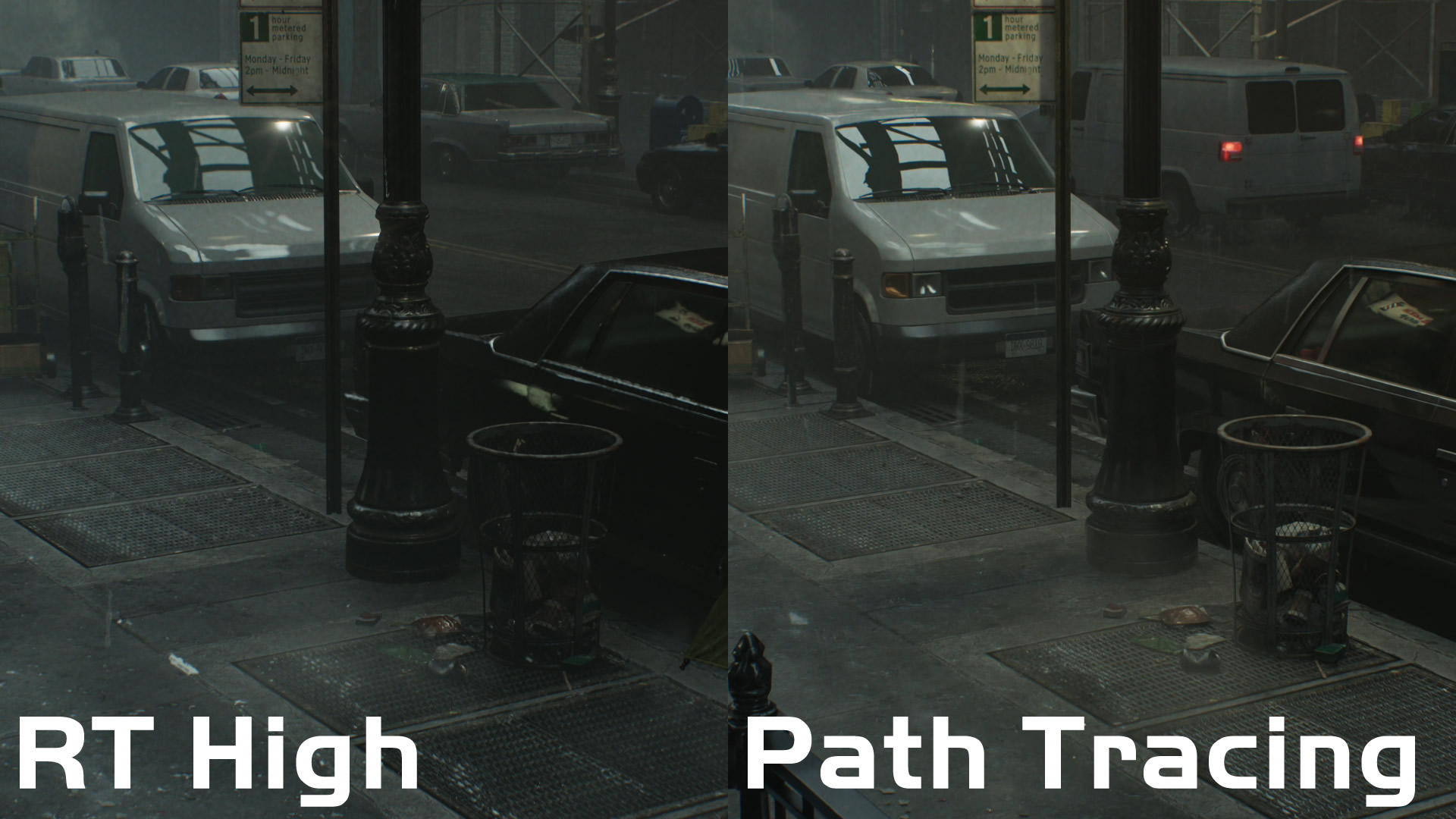
If we look at the bin/trash can in the image below, we can see that it is dark when ray tracing is used. Why is it dark? Isn’t there a lamp post beside it with a lamp on top? With path tracing, all lights appear to be ray-casting, and more light bounces are used. This creates more accurate lighting and often makes the areas darkened by ray tracing less dark.
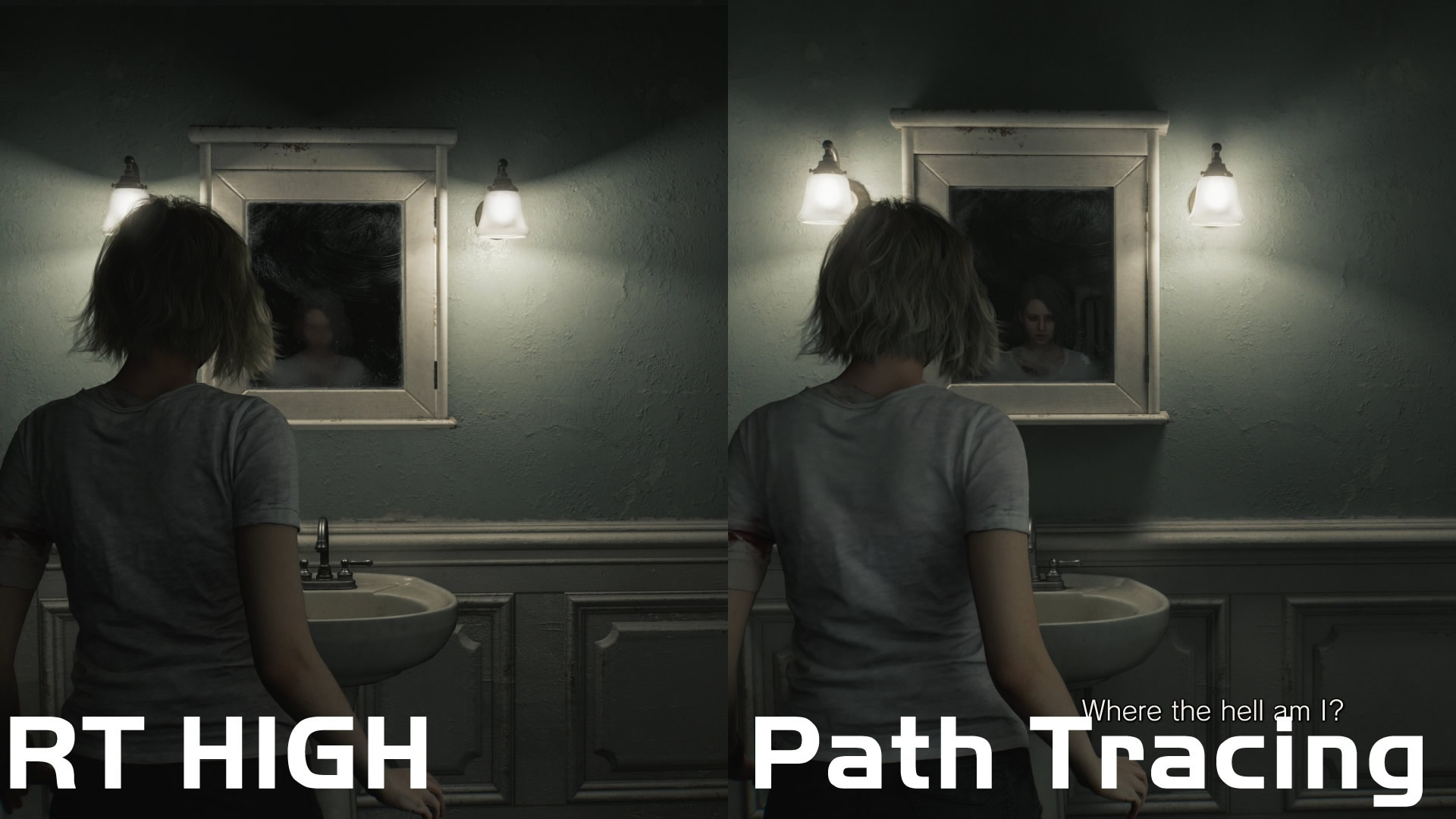
Below, we can also see that reflections are sharper and more detailed. This is largely thanks to Nvidia’s DLSS Ray Reconstruction tech.
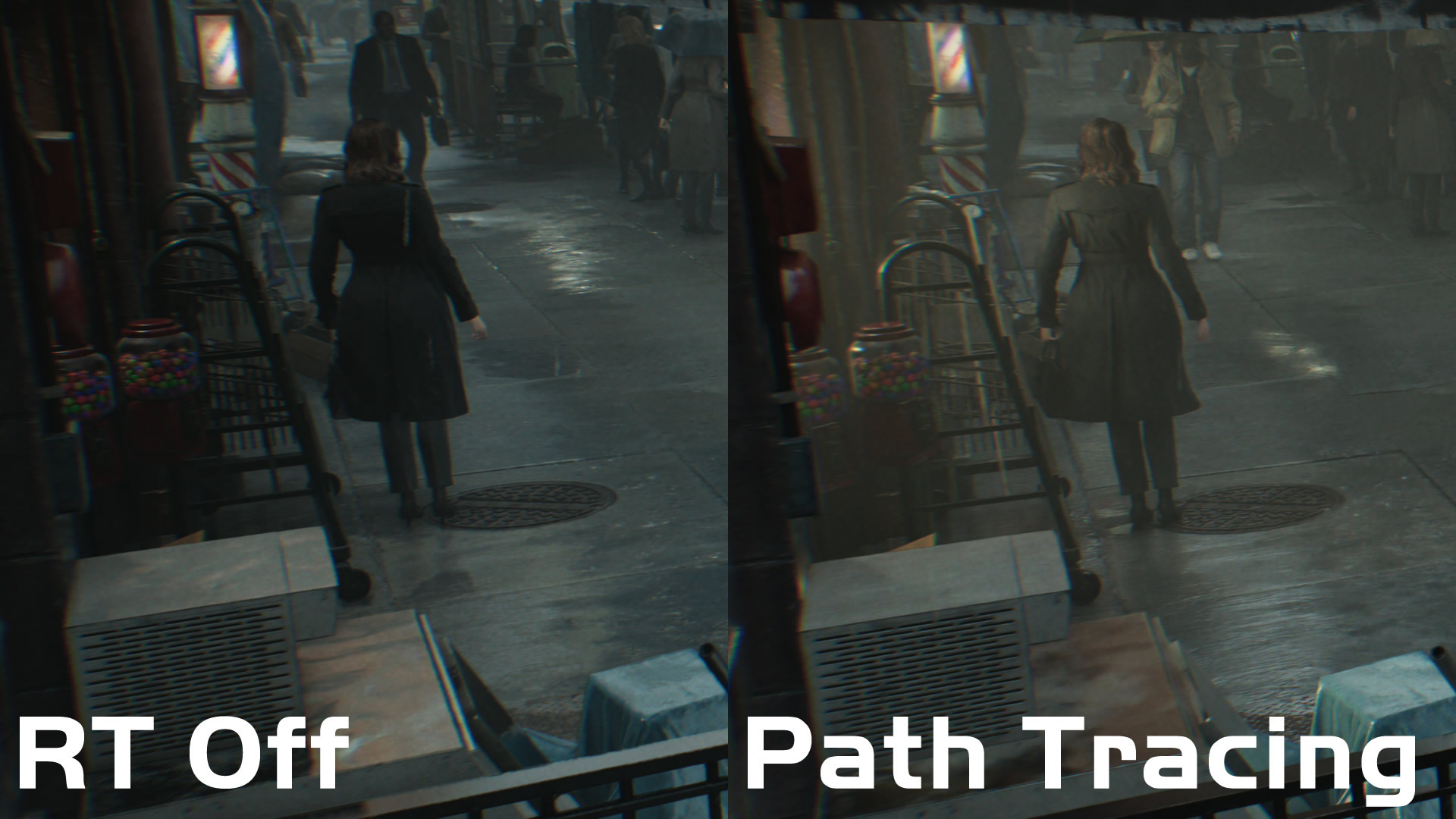
Below, we can see another example of how lighting changes with path tracing. With path tracing, the shop window to the left casts light onto the woman on the street and nearby objects. Directional lighting now has a larger impact on the scene, and the brighter shop windows now cast light onto the street. This has a huge impact anywhere neon lights are present.
Where ray tracing often limits itself to a scene’s primary light source, path tracing tries to accurately display world lighting. More light bounces, more light sources, more accurate reflections.
Below, we can also see that reflections are now much more accurate. With path tracing, we can see Ashcroft’s face with much more clarity. This is mostly due to Nvidia’s DLSS Ray Reconstruction tech, rather than to a huge increase in ray count. Regardless, this level of improvement is impressive.